LIVE OAK BANK IS A CLASSIC WILMINGTON BUSINESS STORY — ON STEROIDS.
A successful executive relocates to the Cape Fear region for its quality of life and could easily retire, but he isn’t enamored with the idea of spending his remaining days chasing around a golf ball.
Instead, a company is born.
Here’s where the storyline diverges from the usual path. Most executives create a lifestyle business that also allows them to boat, golf, travel and pursue other leisurely interests. But Chip Mahan isn’t like most executives.
The 65-year-old Mahan, who created the first Internet-only bank more than 20 years ago, is seemingly always in motion, sketching out strategies on a whiteboard, leading discussions with groups of millennial employees or flying out of Air Wilmington on one of his company’s three private planes.
Mahan does not have small ideas.
Along with business partner Lee Williams, Mahan started Live Oak Bank in 2008 with the idea of creating a bank without branches by leveraging cloud-based technology and expertise in targeted industries, starting with veterinarians. Today, Live Oak is a public company worth more than $700 million and with more than 400 employees.
In 2012, Live Oak spun off its technology arm into a separate company called nCino. The company has since raised tens of millions of dollars from venture capital groups and other investors and grown to 280 employees.
Many think this spinout business will eventually be worth more than its parent company.

Along the way, Mahan (
right) and the firms’ other executives discovered the Cape Fear region is a fertile ground to grow technology companies. They note the combination of quality of life, affordability and employee loyalty makes the region an idyllic place to innovate.
“It’s the best of all worlds,” Mahan said. “It’s our little bit of heaven here.”
The innovations that launched Live Oak started with insights about seemingly innocuous loan programs run by the Small Business Administration (SBA).
Mahan’s team noted that making SBA loans is far more profitable than conventional retail banking – and doesn’t require the immense overhead of branches, drive-in windows and ATMs.
They studied publicly available data to learn which businesses are most credit-worthy. The answer?
“Veterinarians have a great payment record,” Mahan noted.
Live Oak started with a deep dive into the animal care industry, hiring experts in running veterinary practices, flying to clients to help them implement best practices and visiting veterinary schools to build relationships with future veterinarians who would soon need loans to build their businesses.
One by one, the bank added to the industries it serves: funeral homes, chicken farms, independent pharmacies, wineries and more.
Live Oak employs experts on each of the industries it serves. This strategy made it the nation’s second-largest SBA lender in 2016, when its loan production hit $1.5 billion.
To reach that point, though, the bank had to contend with an ocean of data. Making a single SBA loan generates 148 documents, Mahan said. As a national lender with just one branch, Live Oak couldn’t rely on paper and emails. This led the bank to build its own cloud-based software solution. Soon it became obvious that this software would be useful to other banks.
But a bank couldn’t easily sell software to competitors. So in 2012, Live Oak spun off that piece of its business. “Encino” is Spanish for the live oak tree. After dropping the initial “e,” the company became nCino.
nCino
“We don’t take ourselves too seriously,” nCino CEO Pierre Naudé (below
left) said, “but we take our business seriously.” After just five years, he said, it has 130 corporate customers and is making a distinct impact on its chosen community.
“If we keep on this trajectory,we can change the employment landscape of Wilmington," Naudé said, "we can create an ecosystem of technology companies,” much as another Wilmington-based corporation, PPD, has spawned dozens of other pharmaceutical research companies.
It has its first international client and is opening a branch in London. “The software can scale from the smallest to the largest bank,” Naudé said. Users range from small community banks to some as big as SunTrust, with $200 billion in assets. For all that growth, though, the company is happy to remain where it began, in Wilmington.
Early on, management calculated how Wilmington real estate’s modest cost basis – “a fraction of the cost in big cities,” Naudé said – plus quality of life and low turnover produced far more value than any benefits those big cities might have offered.
At one point, nCino weighed Wilmington against Atlanta as its permanent home. “There isn’t a large technology industry here,” Naudé acknowledged, but employee turnover is 25 percent or worse at similar companies in Atlanta. Without Atlanta’s stress-inducing congestion or high costs, employees in Wilmington tend to stay on the job longer.
Hiring the “first nucleus” of qualified employees was easy, Naudé said. He found good people in Wilmington, underemployed for their skill levels. But the challenge of attracting people from Raleigh, Charlotte or Charleston led to a decision to take recruiting away from human resources and make it a marketing function. “You treat recruitment like you do sales to banks.”

The company’s sales pitch to talented tech or sales people focuses on the lifestyle they can enjoy. “This is still a technology career path, second to none,” Naudé said, “but without the traffic of the big cities,” and with affordable housing, pleasant climate, and significant cultural and recreational advantages. nCino offers its staff free stand-up paddleboard or surfing lessons at Wrightsville Beach, convenient to its Mayfaire location. A significant contingent of employees bicycle to work.
“To me, there’s been absolutely no negatives” to operating here, Naudé said.
Mahan echoed that sentiment. He has no trouble attracting top talent to Live Oak Bank. Unlike Silicon Valley, where everyone seems to be looking to jump ship to the next big thing, employees in Wilmington tend to stay put.
“It’s a mighty friendly place,” Mahan said. “It’s a great place to raise a family.”
He contrasted hellish traffic in Atlanta and Chicago with Wilmington, where a bad day might involve waiting through two traffic-light cycles.
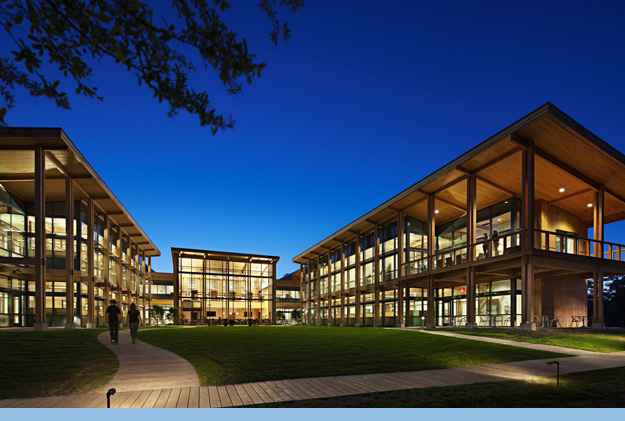
Live Oak’s headquarters occupies two airy, light-filled buildings on a wooded campus off Shipyard Boulevard. A third building is planned.
At nCino, Wilmington’s lifestyle and living costs are just half of the recruiting pitch. The second part is about the company itself. As Naudé put it, “What is the kind of culture and the kind of company that will attract the kind of people you want to work for you?” Watchwords are speed, independence, respect and empowerment. “We really live that culture,” which appeals to younger job prospects, he said.
Live Oak’s culture is similar. “You want to create that atmosphere where you have the right folks and the right business model,” Mahan said, "and the right business model."
Advancement opportunities, excellent benefits and a wide range of perks all help. Examples include fully paid health insurance, an in-house gym with personal trainers, and a dog park. Live Oak has topped American Banker magazine’s “Best Banks to Work For” list for three consecutive years.
While both companies recruit out of town, they also hire plenty of UNCW computer science and business majors – about 200 at last count, Mahan said.
For the foreseeable future, nCino won’t emulate Live Oak by building its own headquarters. Its current leased space can absorb up to 600 people. Naudé said the company doesn’t want to be distracted by the challenges of design and construction.
Mahan is upbeat about both companies’ continued growth in Wilmington. “It’s the greatest thing in the world.”
Naudé agreed. “This is just a beginning. The best is yet to come.”
- John Meyer