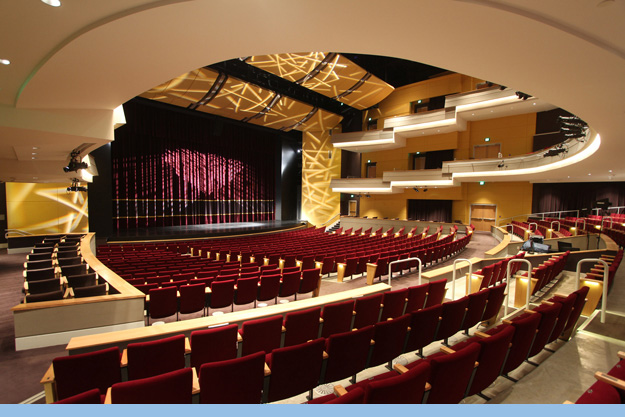
DOWNTOWN WILMINGTON IS BEGINNING TO EXPERIENCE A NEW WAVE OF GROWTH, different in both scale and kind from what had made the area both attractive and popular in earlier years.
Downtown’s remarkable turnaround in the late twentieth century was mostly driven by small-scale projects.
Typical were rehabilitations of historic buildings, new restaurants, stores and nightclubs, and the occasional new “in-fill” structure. Big public investments included a department-store-to- library conversion, and expanding the historic Thalian Hall theater.
More recently, while that sort of development continues, the major action has been in downtown’s once-neglected north end. Former industrial sites and low-value commercial properties have become a blank slate for ambitious entrepreneurs and local governments.
A catalyst was the long-awaited Wilmington Convention Center, which opened in late 2010.
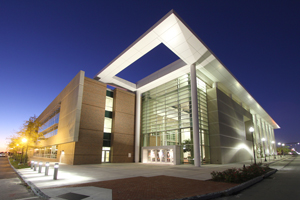
Then, financed by bond issues, Cape Fear Community College opened its 250,000-square-foot Union Station building in 2013 on North Front Street, and the Wilson Center (
above and left), the dramatic new performing arts building, opened in 2015 on North Third Street.
Last year, voters approved a bond issue to develop a large northern riverfront park.
The head of downtown’s economic development agency calls the park the city’s “front yard.” The Wilson Center’s architect described its soaring lobby as the city’s “front porch.” And the spot where North Third Street meets highways from out of town has been called Wilmington’s “front door.” Downtown, both old and new, is presenting Wilmington’s best front to the world.
An entirely new streetscape of apartments, condos and offices lines once-desolate North Third Street. PPD’s headquarters tower on North Front, an anchor for northern downtown since 2007, is now being surrounded by new developments.
A vast ex-industrial tract is being turned into a marina, restaurants, entertainment stage, multifamily housing, offices and hotels.
The developer working on this project, Chuck Schoninger, said the former Almont Shipping Co. property quickly caught his eye. Bracketed by the Convention Center, PPD, and the CFCC campus, the site seemed full of “mixed-use” possibilities.
“We just followed the landscape of what PPD did for us,” Schoninger explained, creating sleek new uses completely unrelated to what had gone before.
As capital started to loosen up after the recession, Schoninger formed partnerships with investors and builders.
A first step was to dredge out what is now Port City Marina, between Hanover and Harnett streets. Where freighters once unloaded, yachts and other pleasure craft now dock.
A pier with the skeleton of a band shell, soon to be roofed and partly enclosed, will be a venue for concerts. Schoninger predicts a range of shows, with admissions from $10 to $50, can draw audiences of all kinds to the site and its new restaurants, Blackfinn Ameripub and Vida Mexican Kitchen y Cantina.
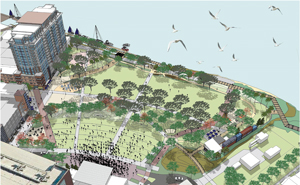
The city’s planned new park (
right), just to the north, will also include a permanent concert stage. It would house such events as Azalea Festival concerts, accommodating big audiences. Schoninger predicts people visiting the park and strolling the Riverwalk will find his waterfront restaurants to be welcome amenities.
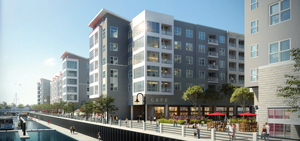
Just inland from the marina and the planned 325-apartment complex Pier 33 (
below left), the 10-story Hotel Indigo is expected to break ground this spring. Next steps, on parcels Schoninger owns in the shadow of PPD, are a proposed office tower and a second hotel. Another 150 condo units are proposed overlooking the Convention Center.
“Downtown is in the midst of a major transition,” said Ed Wolverton, executive director of Wilmington Downtown, Inc. That public-private partnership began 40 years ago, during downtown’s lowest ebb, to “revitalize” the old central business district.
Planning For Change
Several key choices in prior decades set the stage for this transition, Wolverton said, including “some strategic decisions made by local government.” Notably, the city built the long-awaited Convention Center, extended the Riverwalk, and is rebuilding older stretches of that popular promenade. The new waterfront park will take shape soon, thanks to voters. The city also invested in major improvements to Front and Third streets, burying overhead wires and improving “streetscaping.”
While the city was working on the Convention Center, PPD Inc. built a $110 million “anchor” for downtown’s northern end. That put 1,500 well-educated, well-compensated employees downtown every day, providing new customers for shops, restaurants and attractions.
More potential customers are moving into big new residential developments. The two-year-old City Block apartments are fully occupied, just as the waterfront Sawmill Point complex is opening for tenants, Wolverton noted. When it is fully rented, he expects the proposed Pier 33 and River Place complexes to be finished and accepting tenants.
Those “24-hour users,” as Wolverton called them, keep streets busy. Hundreds of new downtown residents will also be “a built-in customer base for shops and restaurants and attractions,” some in mixeduse space below apartments. Downtown is experiencing an “explosion of the craft beer industry,” with five microbreweries operating and a sixth on the way. “We’re seeing a vast improvement to our night life,” with more places appealing to “foodie” culture. Likewise, home-grown demand for groceries and household needs is driving consumer-focused retail growth on blocks once dominated by tourist-oriented shops.
That’s not to say visitors won’t still be important. Economic development experts have argued, as Wolverton said, that “tourism could be a bigger economic driver than it was.” Meeting and driving that demand are hundreds of new hotel rooms. Most important may be the 186-room Embassy Suites going up next to the Convention Center. This will aid recruiting of major conventions, which want accommodations and meeting rooms on the same site.
In downtown’s core, along Grace Street, two new hotels opened during the past two years. Two others, a stone’s throw from the Convention Center, are expected to break ground this spring. Hotel Indigo, 125 rooms in 10 stories, will be on Schoninger’s property opposite the Convention Center, and the six-story, 125-room Aloft Hotel will be built onto the nearby Coastline Conference Center. At least one other hotel project is in planning stages, at a site between PPD and the new park.
The Rise Of Tech Talent
Meanwhile, in downtown’s older, established end, growing technology companies are making an impact. Three members of one entrepreneurial family – George Taylor, Jr. and his sons, George III and Kurt – are developing several technology startups in a renovated building on South Front Street. Untappd is, in Kurt Taylor’s words, “The Facebook of beer,” an application that connects craft beer enthusiasts with each other, and with the microbreweries and tap rooms where those brews are sold. A spinoff of a parent company called Next Glass, it has 5.3 million users and over 5,000 business customers.
Developing and marketing the software keeps 65 employees busy. That number is expected to grow. The company occupies two stories (and a rooftop terrace) and will expand into the building’s freshly updated ground floor.
The other company is George III's project, called JOMO, an app to help people with similar interests make spontaneous connections and plan events. Both enterprises moved into their space at 21 S. Front St. in early 2016. The location makes excellent business sense, George Taylor Jr. said. “A lot of the team lives downtown,” he noted, adding that downtown’s cultural appeal is a “recruiting base” to attract technical talent. Looking around at refinished original heart-pine floors, wooden beams and open-plan work spaces, George Jr. commented, “I love the exposed bricks.”
George III jumped in, “I like buildings with character. And the food downtown is wonderful.” He said having a range of culturally edgy businesses nearby, such as bars and tattoo shops, appeals to the sorts of workers Untappd recruits. And unlike many suburban locations, the streets are lively at night, an asset for people who often work late.
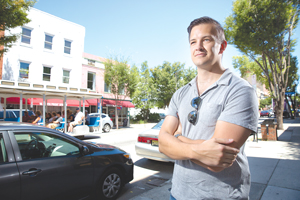
Two-thirds of the staffs were hired locally, but most of the tech talent came from elsewhere. Downtown’s amenities – and relatively low real estate costs – have been a big draw. A software engineer recruited from Hong Kong told the Taylors he could have taken jobs in New York City or San Francisco, but with stratospheric living costs and professional anonymity. Here, he expects to make a big difference in his company, and to live a great lifestyle for not much money. “He said our place was the coolest office he’d ever worked in,” George III said.
That validates their landlord’s ambition to create a technology hub along South Front Street. James Goodnight (
above right), a Research Triangle-based entrepreneur, is counting on downtown’s appeal, and space rates a fraction of those in New York, Los Angeles and other tech hubs, to attract exactly that kind of talent. In the same block, buildings at 1 and 9 S. Front St. will soon be available for the Taylors to expand into as growth demands.
Businesses like theirs, George III said, need a “critical mass” of other tech people nearby to consult. So attracting more tech companies will make it even easier to recruit ambitious young workers. They, in turn, will be an asset for future technology entrepreneurs.
The millennial generation, Wolverton observed, are “drawn to something that gives them an authentic experience.” Diverse downtowns with carefully restored old buildings meet that standard. But imaginatively conceived new buildings are also vital.
North End Development
A key player in downtown’s recent growth is LS3P Architects, which incorporates the former Boney Architects firm. Chris Boney, part of his family’s third generation of architects, sees great potential in the north end.
A design imperative, Boney said, is retaining “the spirit of place” on sites stripped bare during urban renewal in the 1960s. The Convention Center, for example, includes elements referring to the city’s maritime heritage. CFCC’s Union Station was designed to be a bridge between old and new, a direct reference to the city’s railroad history. The design echoes the Atlantic Coast Line buildings that once dominated that end of town. A high-ceilinged lobby is like the former “grand terminal.”
The Wilson Center, with its prominent glass façade along North Third Street, is meant to welcome people entering the city from the Holmes Bridge or MLK Parkway. “It’s the front porch for Wilmington,” Boney said. The soaring columns recall an old Southern verandah, and through the transparent front wall, “You could see a little of the life that goes on inside.”
LS3P designed its new home, the building developed by Brian Eckel with GHK Cape Fear Development and Cape Fear Commercial. It replaced an obsolete bank building from the early 1970s.
Alongside his new Class A office space in downtown’s heart, Eckel foresees mixed-use “in-fill” projects and “an explosion of residential.” This will include the proposed River Place, replacing a waterfront parking deck from the 1960s.
The most likely targets for redevelopment? Surface parking lots. One brake on development, though, is construction costs, which have risen 35 percent in the past few years. “You’re going to have to see some slowdown in prices before we see a whole lot of infill,” Eckel said.
In spite of such complications, “It’s an exciting time for downtown,” Eckel said. “There’s opportunities here.”
Clark Hipp is an architect, builder and developer with an office on North Front Street. He has designed new structures on empty sites, such as the 720 N. Third St. office tower in the early 2000s, but has also extensively renovated existing buildings. A striking recent example is 216 N. Front St., an art gallery and museum in a century-old building a few doors from his own office called Expo 216.
Downtown’s benefits, Hipp said, include the street grid, which accommodates vehicles while “calming” traffic; the “human scale” that makes walking convenient and pleasant; and being able to live and work in the same neighborhood. “I’ve walked to work for 28 years,” he said. “That’s a wonderful lifestyle, to not be car-dependent.”
More businesses are deciding to locate downtown.
“It’s a dynamic environment that has anything they need,” Wolverton said. “It’s the region’s economic engine, its commercial, entertainment and cultural center.”
- John Meyer