WHEN BROOKLYN, N.Y.-BASED ACME SMOKED FISH NEEDED TO EXPAND, it initially looked at 11 locations.
The Cape Fear region wasn’t on the list.
That changed when Charlotte-based Duke Energy learned about Acme’s search in early 2013. “They had not looked at anything south of Virginia,” said John Nelms, Duke’s senior economic development manager in the region.
Nelms’ team proposed several North Carolina sites, from which Pender Commerce Park on U.S. 421 “rose to the top.” The local business-development agency, Wilmington Business Development, quickly got involved, as did Pender County and the state Department of Commerce.
“We flew down and looked at the site” when it was just a sandy expanse of pine trees, said Richard Nordt, who led the search, building and opening of Acme’s new facility. “The more we explored the locations, Wilmington
was starting to make the best sense.”
Acme produces a range of seafood specialties, including smoked salmon and pickled herring.
Criteria for a new production facility included being near a seaport — Acme imports its raw materials —and an airport. “When the owners first came down from New York,” Nelms said, “the proximity of ILM airport was another plus.” The chief rival site’s airport is more than an hour’s drive away.
The choice narrowed to the Pender site and Southampton, Va. Virginia looked good economically, Nordt said, but Wilmington offered advantages not easily reduced to numbers. Those included transportation and the local labor market. Cape Fear Community College offered a “partnership and relationship” to help Acme educate its work force, Nordt said. “That was pretty important. Paramount.”
Training may have clinched the deal, said Scott Satterfield, WBD’s chief executive. “Nobody does a better job” of worker training than CFCC, he added.
A CFCC delegation visited Acme’s Brooklyn plant to study its operations. In 2014, the college set up a pre-employment program to help fill 85 openings. From 1,500 applications, Nordt said, it reviewed 800. The idea, he said, was “finding people who want to work with us,” with the necessary mental habits and work ethic. CFCC also customized training in leadership and food safety, and offered a certification course for skills specific to food processing. Applicants who passed moved to the front of the hiring line.
Those collaborations conclude this year, according to Mark Council, now a CFCC dean, who helped create Acme’s training program. Such customized training, through the community college system, is a vital part of the state’s industrial recruiting efforts, he said.
Wilmington Business Development was another essential partner. WBD “really held our hands through the process,” Nordt said.
CFCC’s training and WBD’s ability to actively involve key players “separated us from quite a few of the candidates,” Satterfield said. One example was bringing the state secretary of commerce to an early meeting.
While the site is just on Pender’s side of the county line with New Hanover, jurisdictional boundaries blurred as agencies worked together on the entire region’s behalf.
A team from WBD traveled to New York to make the final pitch. Acme chose the Pender site in August 2013.
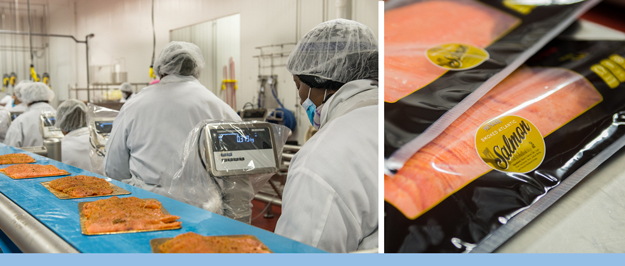
Ground was broken in October, and the 100,000 square-foot plant opened in February 2015. It is now the largest smoked salmon facility in the U.S.
WBD helped Acme find grants and loans, Nordt said. The state awarded a Job Development Investment Grant, which sets hiring and investment targets. Over 12 years, that grant could be worth up to $975,000. Four-County Electric Membership Corp. made a $2 million, zero-interest loan to help Acme buy equipment. A private grant from the Golden LEAF Foundation helped develop the park’s infrastructure.
Infrastructure was crucial to Acme’s tight timeline. Roads, utilities and a wastewater treatment plant had to be built from scratch.
Acme had to meet performance goals. Pender County committed to the wastewater plant only after being assured Acme would invest $30 million and create 125 jobs, a $4 million payroll. That qualified the county for $9 million in federal funding. “Acme was the catalyst,” Williams said.
As it turned out, the Pender plant now employs 140 people, exceeding Acme’s commitments.
- John Meyer