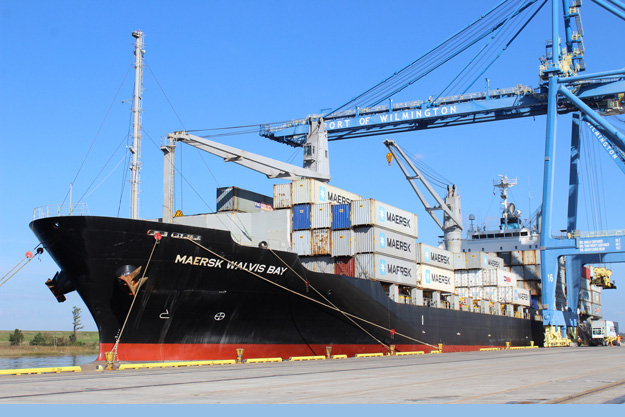
PORT CITY’S NAMESAKE IS EXPANDING
The Port of Wilmington is getting significant upgrades as part of a $120 million investment by North Carolina Ports to increase the speed and efficiency of loading and unloading vessels.
Wilmington’s port stretches across 284 acres off Burnett Boulevard. Linking North Carolina directly to Asia, Europe and Latin America, the port is a vital economic center for the region.
Currently, the Port of Wilmington moves around 300,000 Twenty Foot Equivalent Units (TEUs) each year, with more than four million tons of general cargo. A TEU is equal to a standard 20 by 8 foot shipping container. It is a common unit of measurement to judge the capacity of a container ship.
“As we continue to invest in new infrastructure and innovations over the next few years, the expectation and the goal is to double our container business,” said Cliff Pyron, spokesman for North Carolina Ports. “Our five-year strategic plan calls for us to move over 600,000 TEUs and significantly expand the business of our general cargo terminals.”
Doubling the capacity of any business is an ambitious goal. Considering North Carolina Ports currently supports more than 76,700 jobs for the state and more than $700 million in annual tax revenues, as well as an estimated $14 billion in economic contributions associated with the movement of goods, the impact would be substantial if the business at the port were to double.
The expansion of the Port of Wilmington is viewed as a key to accomplishing that goal. A multi-pronged approach is being applied to meet new industry standards put in place by the expansion of the Panama Canal, and to increase the speed and efficiency that the port can load and unload vessels. To accommodate what are known as “Post-Panamax” container ships, which can be longer than 1,200 feet, the Port of Wilmington widened the turning basin in the channel of the Cape Fear River last summer to increase the turning radius to 1,400 feet. This allows the giant vessels to make what is essentially a three-point turn in the river to call on the Port of Wilmington. As a result of this added capability, the port can accommodate vessels up to 10,000 TEUs.
Work is already underway on a project to expand and improve multiple berths. A study is also being conducted to determine the feasibility of further enhancing the Cape Fear River. And two “New Panamax” cranes with a combined value of $27.4 million are expected to arrive in mid-2018.
The shipping world is on notice. Last summer the record for largest ship was broken when a vessel more than 1,100 feet long and 150 feet wide visited Wilmington. Because of these advancements, container carriers will bring more services to the port this spring.
A new partnership with ZIM Integrated Shipping will commence in June, providing access to South China, Southeast Asia and India. “The ZIM service will support legacy apparel, furniture and hardware industries throughout the Carolinas,” said Paul J. Cozza, North Carolina Ports’ executive director. “It’s a unique offering that shows our commitment to provide reliable and flexible shipping solutions.”
Another new partnership set to begin soon is with The Alliance, which includes container carriers NYK Group, “K” Line, MOL, Yang Ming and Hapag-Lloyd. This will bring some of the largest vessels to ever visit the Carolinas to the port on a consistent basis, as well as provide direct access to the markets of Qingdao, Ningbo, Shanghai and Busan.
Since the North Asia service will traverse the expanded Panama Canal on its way to the East Coast, officials at the port think this will decrease transit times and encourage the use of more efficient, modern ships.
“These new services help further establish the port as a major gateway,” said Chief Commercial Officer Greg Fennell. “We’re excited to welcome these new carriers, and for the return of “K” Line and Yang Ming.” The port was home to Yang Ming for over 35 years and “K” Line has a long history there as well. They left the port last fall as a result of the collapse of then partner Hanjin, a major container carrier.
“We are truly the port of competitive advantage. The capital investments in our infrastructure continue to drive the decisions of these container carriers,” said Tom Adams, chairman of the Board of Directors for the North Carolina Ports Authority.
The port is hoping the new container services will bring more agricultural exports through the brand-new, 100,000 square foot cold storage facility. Port of Wilmington Cold Storage is a refrigerated warehouse operation with approximately 11,000 pallet positions. The facility offers a broad range of services, including freezing, cooling, storage, shipping and receiving. Officials at the port believe combining the new container services with the cold storage facility will add synergy, giving farmers in the Southeast a chance to grow their export business to Asia.
“This is the first cold storage facility located on a port in North Carolina and one of the first of its kind in the nation,” said Chuck Schoninger, CEO of USA InvestCo, which developed the facility. “We recognized there was a valuable need for this, since our state is number one in sweet potatoes, number two in pork and number three in turkey production nationwide. It just didn’t make sense there wasn’t a cold storage facility here.”
Another recent development that could expand port traffic is the introduction of intermodal rail service. Cozza notes the service will play a significant role in the port’s future, particularly with these two projects:
Queen City Express - This is a new service that will operate between Charlotte and Wilmington on the existing CSX rail network. With the capability to double stack containers, it is expected this new shuttle service will reduce the costs associated with moving goods to the Queen City.
Carolina Connector - This is a $270 million intermodal rail terminal that CSX is building in Rocky Mount. It will serve as a transportation hub that the port will have direct, daily access to upon completion. Officials at CSX believe the new rail terminal will be a practical solution for reducing logistics costs and minimizing the environmental impact of transporting freight.
As the word implies, “intermodal” refers to the movement of freight in multiple forms of transportation. Being able to move containers directly from the port and over the rail to major distribution hubs takes a lot of trucks off the road. In fact, recent estimates found putting one intermodal train into use can remove as many as 280 trucks from the road.
“Implementing new rail service is friendly to the environment as well as business owners,” notes Cozza. “It has the potential to drive down costs, reduce air pollution, improve safety, and decrease wear and tear on the highways.”
- Fritts Causby