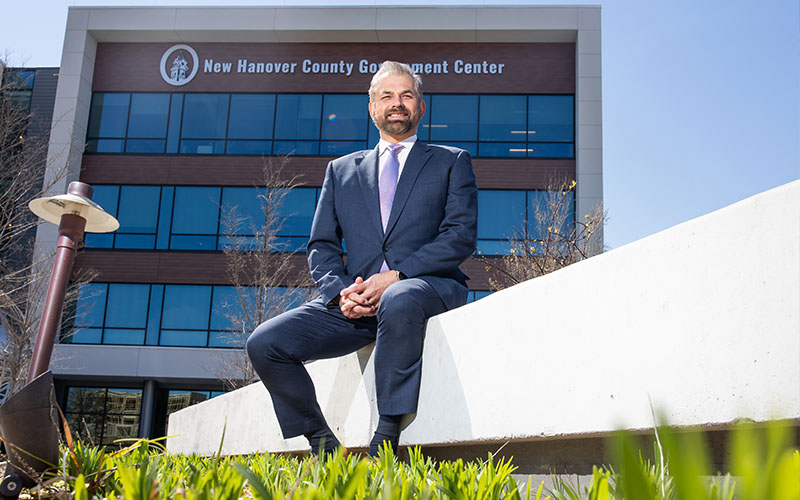
When Sam Franck is out and about, he can see the products of his clients’ work.
“Ours is a service business, and I would never claim my clients’ achievements. If I do my job well, I play a small part in helping to facilitate or achieve the vision that someone who trusted me had at the at the outset,” said the Wilmington attorney, who leads Ward and Smith’s real estate practice. “That said, it is absolutely gratifying to drive by a development that I’ve been a part of, or a building that I’ve been a part of, and feel a connection to that.”
In the two decades he has worked for Ward and Smith’s Port City office, Franck has represented some of the area’s most prolific developers and high-profile projects, particularly during community and government meetings as they work toward needed approvals. About 70% of his caseload involves development.
One client example is Cape Fear Development, a Wilmington-based firm with a long list of projects completed and underway in the area, including the New Hanover County Government Center and adjacent mixed-use development, Project Grace in downtown Wilmington and Proximity Carolina Beach, a complex with luxury apartments and commercial space along Carolina Beach’s main thoroughfare. Proximity, Franck said, is “an additional project that I am proud to have been a part of.”
Franck declined to talk about specific client challenges for the most part, citing the need for their permission to do so.
But in certain cases, Franck’s job includes navigating some fierce opposition. News stories have detailed one of those instances – a company’s proposal to build thousands of homes in the Sledge Forest area of New Hanover County.
Addressing development disagreement in general, Franck said opposition can be inevitable.
“When people find a place where they have peace and comfort in an environment that they appreciate, it’s an instinctive human reaction to reject anything that would disrupt or change them,” he said. “I think the biggest challenge in what I do is helping to bridge the gap between those who are choosing to invest their resources into the positive growth of our community and the natural and instinctive resistance to change from those that live or work somewhere nearby and would prefer to keep things exactly the way that they are.”
It’s not an impossible task.
“There are times when we succeed in that endeavor. … We can bridge the gap, assuage fears, with just knowledge, with just facts,” Franck said, “and there are times that we can’t. I think the most significant challenge, in my day-to-day anyway, is identifying the right approach to achieve the best chance of bridging that gap.”
Franck’s training in solving complex problems goes way back. He grew up in Williamsburg, Virginia, and studied civil engineering at Virginia Tech before returning to his hometown for law school at William & Mary. He married his wife, Karen, a woman he’d known through high school and college, and the couple eventually decided to find a new home along the Eastern Seaboard. Their search brought them to the Port City, and he remains a Wilmington fan.
“Wilmington is a community that’s growing inward. We still have significant opportunity for our community to grow towards the center of town from the existing commercial centers on the edges,” he said. “I mean that literally, and I also mean it philosophically, that people here tend to be inviting and curious, and so not only does the lay of our land afford the opportunity for people new to the community to participate and be a part, but so does, in my opinion, the cultural philosophy of our town.”
In his attorney role, Franck has a close-up view of the area’s concerns and possibilities.
“Some of the biggest challenges for each of the jurisdictions where we work are availability of housing, affordability of housing and overburden of infrastructure. And what the planners tell us, and what makes sense to me, is that height and density are not the enemy,” he said. “Quite the contrary – if we build more small homes, more closely located to existing infrastructure, meaning roads, pipes in the ground, public transportation, commercial amenities and the like – that is far more effective than sprawl as a mechanism to accommodate a growing population.”
Lumina Station developer Joel Tomaselli, owner of Sea Horse Management and a client of Franck’s, said Franck “is one of the best and the brightest, and very responsive.”
As for his role in Tomaselli’s projects, he couldn’t do it without him. “He knows more about zoning and development issues than anyone we have ever worked with.”
Franck credits his employer with creating a culture that allows attorneys to explore their interests.
“I’ve become more grateful for that every year for two reasons. One, it’s allowed me to find something that’s really interesting to me and that I enjoy doing very much day in and day out,” he said. “But two, it’s kept my practice dynamic and so kind of feeds the intellectual curiosity bug to have new angles to pursue from year to year, without being forced into a role where you’re just making the same widget time and again.”
See other stories on Law:
Lawsuit Continues Over PFAS Impacts
Opinion: Opioid Funds Driving Real Change
Attorney Gets Law of the Land
Area Attorneys Chosen for 2026 Legal Elite List
Area Attorneys Chosen for 2026 Super Lawyers List
Attorneys Carve Out Legal Niches