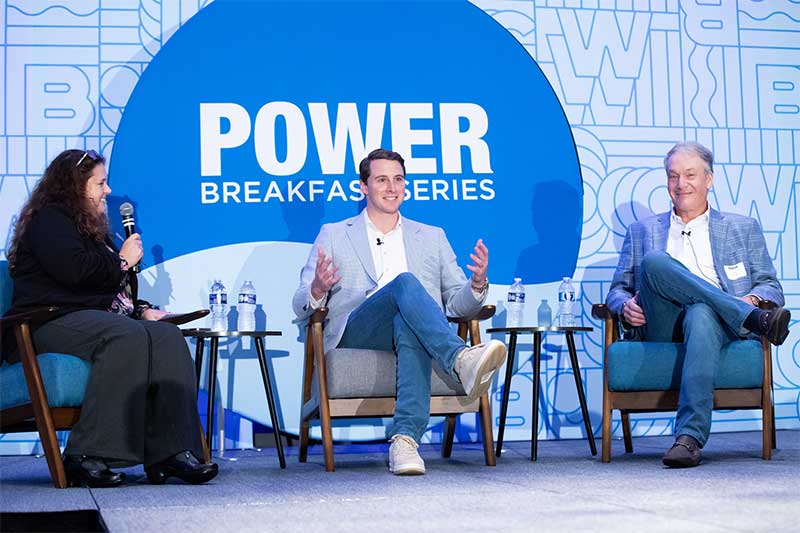
Vantaca CEO Ben Currin, center, and founder Dave Sweyer, right, answer questions during the Greater Wilmington Business Journal's Power Breakfast on Wednesday. (Photo by Madeline Gray)
The board of the New Hanover Community Endowment plans to wait until early 2026 to begin discussions around the search for a permanent leader, chair Shannon Winslow said Wednesday during the Greater Wilmington Business Journal’s Power Breakfast.
Dan Winslow, the endowment’s most recent president and CEO, resigned in July after less than a year in the role. Since then, Sophie Dagenais, the endowment's vice president of programs and grants, has served as the organization’s interim CEO.
Winslow said Wednesday that the board met in August and decided to focus on key endowment initiatives, including an ongoing strategic refresh that will guide its work through 2030.
“We really decided that it was in the best interest of the endowment and the community that we spend the rest of the year really focusing on the work and setting us up for success,” she said, “and with that, we delayed any discussion and decisions until Q1 of 2026, and so we are still tracking with that plan.”
The $1.7 billion New Hanover Community Endowment was created from the sale of New Hanover Regional Medical Center to Novant Health in 2021. Since its inception, the endowment has committed $176 million in grants, with $53 million committed in 2025 alone, Winslow said.
One part of that strategic refresh involves a new “discovery process,” according to Dagenais. The endowment plans to work with various partners to analyze New Hanover County’s existing programs and gaps in specific focus areas such as recreation, youth development and innovation and entrepreneurship. Endowment leaders, for example, announced a partnership with the University of North Carolina Chapel Hill on Tuesday to study the local entrepreneurship ecosystem.
“We are taking what is the strength of this region, and we are wondering, how may we augment that strength? And how can we make entrepreneurship and innovation accessible to all in New Hanover County?” Dagenais said. “What this will do is it will help us better understand the ecosystem that is shaping entrepreneurship and innovation.”
Watch Winslow and Dagenais speak at the Power Breakfast here:
Winslow and Dagenais were among the speakers who addressed a sold-out crowd at Wilmington’s Convention Center on Wednesday. The others included Thalian Hall CEO Shane Fernando, Umar Bowers, chair of the NC Health Talent Alliance and medical director at Dawson Med Primary Care and Urgent Care, Brooklyn Café owner Tara English and Vantaca founder Dave Sweyer and CEO Ben Currin.
Transforming Thalian
During his presentation, Fernando highlighted plans for the transformation of Thalian Hall, following the city of Wilmington’s exit from the building’s former city hall wing.
The 167-year-old building has endured since its construction, Fernando said, because “the community has always lifted her from one generation to the next.” Plans for the $25 million project fall into three areas – facilities, entrepreneurship and education.
Facility upgrades will involve converting the former Wilmington City Council chambers into a 300-seat immersive theater called the Hippodrome, along with the addition of a new listening room in the former city hall lobby and the creation of a new outdoor, amphitheater-style space in Innes Park.
A new recording studio, incubation space and scenic lab will house programs to support the development of new works of theater, music and dance, along with workforce training.
“We will also be developing an entrepreneurship program for artists,” Fernando said, “being able to give them toolkits to treat their work like small businesses.”
To support the project’s education piece, Fernando said, the Pied Piper Theater will expand its reach to more first- and second-grade students, and Thalian is also piloting a continuing education program for local teachers, called the Pied Piper Institute.
“Construction begins in 2026 with a completion date in 2028,” he said about the planned renovations, “and we will not be shutting down our operations. This is for our commitment to our community, but also our commitment to the dozens of organizations that call Thalian home.”
Watch Fernando speak at the Power Breakfast here:
Creating a pipeline
As chair of the NC Health Talent Alliance, Bowers said the group has worked since its inception to build a pipeline of nurses and other health care professionals to fill gaps that became apparent in the years after the COVID-19 pandemic.
“I don't know if we've ever seen more vulnerability in our health care system, and I hope we never see it again,” Bowers said, “because not only were there struggles in essentially every emergency room and every hospital in America due to shortages of staff, we also happen to be in an area that was growing.”
He said the shortage of health care workers forced local stakeholders to realize that they couldn’t operate in siloes, but instead, needed to work together.
“The collaboration was not an aspirational goal,” he said. “It was an indispensable necessity to stop the hemorrhaging.”
That required identifying positions with the highest level of churn and the biggest shortages, Bowers said. In recent years, the NC Health Talent Alliance has implemented an array of measures to expand offerings and increase the capacity of the nursing classes and education at the college and secondary levels.
“As excited as we are for all of the growth and all of the exciting things happening in other sectors,” Bowers said, “it is incumbent upon us in the health care community to work together … to make sure that our communities are healthy, so that our businesses can be healthy, so that we can continue to thrive.”
Watch Bowers speak at the Power Breakfast here:
Supporting the district
English helped spearhead the development of Wilmington’s first social district in the Brooklyn Arts District earlier this year. Social districts allow people to buy an alcoholic drink at a participating establishment (not bring one from home) and consume it anywhere within a designated district.
“The purpose of a social district is to allow and move people through a designated area to increase the economic opportunities for businesses within a social district,” English said, “it also encourages exploration of that area and enhances an overall experience.”
English said the restaurant industry was hit hard during COVID and has faced headwinds from inflation, tariffs and labor shortages.
“We've had to weather so many storms the last few years,” she said, “which has encouraged us to get very creative in ways to continue our businesses.”
A pilot social district was held in the Brooklyn Arts District on three Saturdays in February, bringing 8,000 people through the district, English said. The Wilmington City Council approved a social district framework in July and approved a social district in the Brooklyn Arts District in September.
The social district currently runs on the first and third Saturdays of each month from noon to 5 p.m., and, English said, after the first six months, business owners plan to push to hold the social district weekly.
“For the social district to have continued success, consistency will be key,” she said, “and we hope that the new administration and council members will continue to support the small business community and allow the social district to continue every Saturday in 2026.”
Watch English speak at the Power Breakfast here:
Building a unicorn
In October, Vantaca, a Wilmington-headquartered community association management software firm, announced it had secured a $300 million growth investment and a valuation of $1.25 billion.
Currin said on Wednesday that he sees the funding infusion as “business as usual” in the company’s growth trajectory. He added that it will allow the company to invest in AI and expand into new parts of the market.
“We really think this is a market that needs our solution everywhere, so we want to rapidly go scale to meet that need,” he said, “and so it's more of the same and just continued growth, both here and across the country.”
He added that it could result in more jobs in the Wilmington area. Just over 50% of Vantaca’s workforce is currently based in Wilmington, Currin said.
More than 40 million homes in the U.S. are part of community associations, and Vantaca currently serves 6 million of them, according to Sweyer, and the company sees the potential to expand its reach within the market.
Currin added that the firm is looking to grow the types of products it offers and their uses within the property management ecosystem.
“Traditionally, it's been a technical solution for this professional property management industry,” Currin said. “We're starting, especially with AI, to go pretty far beyond that and go touch the rest of the ecosystem that is community living.”
As Vantaca continues to grow, Sweyer said they plan to maintain ownership of the company.
“We're not hitting anywhere near a point where we're sitting there questioning, ‘Will we continue to be able to grow this thing at a terrific rate?’” he said. “And so I think as long as that potential still exists, I think we want to retain control, if you will, of the agenda and where we're going.”
Watch Currin and Sweyer speak at the Power Breakfast here: