The Wilmington City Council has approved a set of guidelines and standards for establishing and maintaining social districts.
In a 5-2 vote, council members approved two companion resolutions on Tuesday that outline the process and standards for creating a social district and establish a district advisory committee. The council’s approval comes months
after business owners in the Brooklyn Arts District put on a
pilot social district during three Saturdays in February.
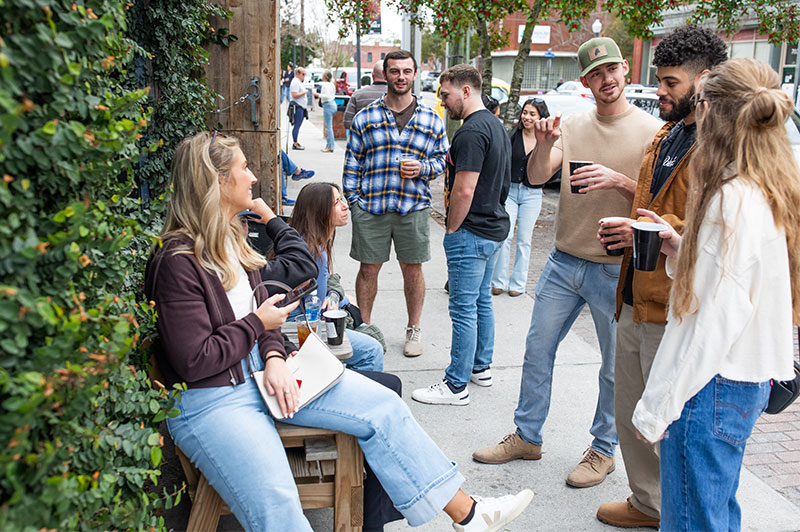
Social districts allow people to buy an alcoholic drink at a participating establishment (not bring one from home) and consume it anywhere within a designated district. At least 55 North Carolina cities currently have a social district, including 15 of the state’s 20 largest cities by population.
Wilmington’s pilot social district encompassed a 10-block radius along Fourth Street, from Walnut to North Front streets, and a one-block section of Red Cross Street. Overall, feedback on the pilot program was “overwhelmingly positive,” Deputy City Manager Chad McEwen told council members on Tuesday.
The city received some complaints about on-street parking, panhandling and the need for more robust notification and public engagement efforts, McEwen said. Feedback from the pilot program and research on social districts in other North Carolina cities helped local officials shape the proposal presented Tuesday, he added.
Other communities have generally focused either on multiple districts or on a single district in the city center. McEwen said Wilmington officials modeled their policy proposal on a multiple district approach since business owners and developers in several emerging districts have expressed interest in the social district concept.
To be eligible for a social district designation, an area must be within the Wilmington city limits, have a contiguous footprint, have participation from at least 60% of the businesses within that footprint, include at least three brick-and-mortar businesses with ABC permits and two or more food-oriented establishments, according to the approved social district guidelines.
To establish a social district, stakeholders would have to follow a multi-step application process that includes gauging the community’s interest, drafting district boundaries, going through a pre-application review process, creating signage and drafting a district management and maintenance plan.
Once a social district’s pre-application is approved by the advisory committee, applicants would then have to gather community support.
An applicant must get signatures from at least 60% of businesses within the district, provide notice to all property owners within 500 feet of the district’s boundaries, submit at least three letters of support from business organizations and neighborhood groups and hold an in-person community meeting.
The applicants would then submit a formal application to the city, which would be made available for public comment and reviewed and voted on by the Wilmington City Council.
Once approved by local leaders, the district would then be submitted for registration with the North Carolina ABC Commission.
The Social District Advisory Committee will be tasked with monitoring and ensuring each approved social district complies with local and state laws and regulations, McEwen said. Social districts would be subject to compliance and annual review from the committee, which will meet quarterly, he said.
“These social districts are permanent, but there are parameters under which they could be revoked, suspended or amended,” McEwen said.
The committee’s voting membership would include:
- Police chief, or designee
- Fire chief, or designee
- City manager, or designee
- Parking and downtown services coordinator
- Park and recreation director
- Public works director
Non-voting membership would include:
- One local ABC Commission representative
- Executive director of Wilmington Downtown Inc.
- One participating, non-permitted ABC establishment business owner from each approved social district
- One participating, ABC permitted establishment business owner from each approved social district
- One member of the Cape Fear Coalition
Mayor pro-tem Clifford Barnett and council member Kevin Spears voted against approval on both social district items. Both had voiced support for adding a community member to the Social District Advisory Committee, a position that was not part of the final motion. Spears also expressed concerns about bringing a social district into residential communities like the Brooklyn Arts District.
“I’m opposed to this because I don’t feel like we’re considering the community and the ramifications of what can take place by this free-for-all of alcohol from one establishment to the other just for the sake of economics,” he said.
McEwen said business owners in the Brooklyn Arts District have notified the city that they intend to apply for a permanent social district in the area. That measure could come before the city council as early as Aug. 19, he said.