On May 21, the UNC System Board of Governors gave the University of North Carolina Wilmington the green light to begin planning a medical school.
The decision marks the beginning of a multi-year journey, which, if completed, could help transform regional healthcare.
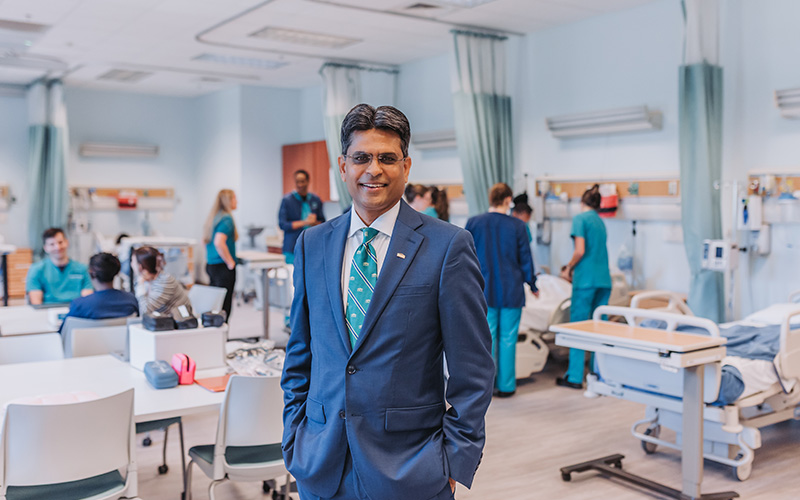
The standalone medical school was proposed in April by UNCW Chancellor Aswani Volety as a solution to a statewide shortage of physicians. The medical school would feature a distributed clinical model, consisting of built-in pipelines for medical students to work alongside local providers.
“We’ve simply got to produce more doctors for us to meet the needs of New Hanover County and Southeastern North Carolina, including in the rural areas where you’re not seeing a sufficient number of doctors,” UNCW Board of Trustees member Dane Scalise, who is also a New Hanover County commissioner, said in April.
In addition to an accredited four-year medical degree program, UNCW is also proposing an accelerated three-year track, which, according to Volety, is intended to reduce debt burden for qualified students and create an accelerated workforce pathway.
Here’s what to know about the UNCW proposal and the last time officials created a medical school in North Carolina.
 Instead of a traditional clinical model, the proposed medical school will be a distributed clinical model that allows students to train and rotate across a collaborative network of healthcare sites in the region, rather than relying on a single teaching hospital. According to Volety, local healthcare providers such as Dawson Med, Novant Health New Hanover Regional Medical Center and MedNorth have expressed support for the project.
An example of a medical school following a distributed clinical model includes the Sam Houston State University College of Osteopathic Medicine in Conroe, Texas, which includes over 200 sites from Corpus Christi to Texarkana.
As for how the project will be funded, Volety cited a mixture of philanthropic support, state and federal funding and tuition as the general makeup, with $100 million expected to come from donations.
The entire budget – and exactly where the facilities will be located – is not yet known.

While the submitted timeline describes milestones from 2026 to 2033, Volety said the process, from planning to preliminary accreditation and to graduation of the charter class, could take more time, possibly 10 years.
After the UNC Board of Governors approved UNCW’s Request to Establish, an application that included metrics such as student demand, workforce alignment and return on investment, UNCW’s next steps are to hire a founding dean through a national search and prepare for accreditation through a self-study.
The Liaison Committee on Medical Education (LCME) is an independent, national accrediting body for educational programs at schools of medicine in the United States. In addition to ensuring a medical program is meeting national standards, LCME accreditation allows potential eligibility for federal grants and programs, like Title VII funding.
Prospective medical schools conduct an LCME self-study, which must be submitted within 18 months after being admitted to “applicant” status by the LCME.
 Establishing a medical school isn’t a quick procedure. The path of East Carolina University’s Brody School of Medicine is an example. ECU first established a one-year medical school, with students matriculating to UNC Health in 1972. The one-year medical school was authorized by the General Assembly in 1965, leaving seven years for funding and planning.
In 1975, the General Assembly granted ECU funds to establish a four-year medical school, with a charter class of 28 students admitted in 1977. In 2021, ECU announced a joint operating agreement with Vidant Health, including the 974-bed Vidant Medical Center, where medical students complete clinical training and residency programs.
Volety said tuition could likely be in line with ECU and University of North Carolina at Chapel Hill. Those medical schools charge about $22,200 and $35,000 per semester for in-state tuition, respectively, according to each school’s office of student affairs website.
Volety said the UNCW medical school’s distributed clinical model could help reduce costs compared with a traditional model.
“When you look at the Wilmington area, Southeast North Carolina in general, it is growing a lot faster than the rest of the state,” Volety said, “and therefore the need is going to grow.”
Editor's Note: While UNCW's per-year enrollment is estimated to be between 60 and 120, officials expect total enrollment to be in line with ECU, at around 450 students.

The Takeaway: Disc-o Fever
Staff Reports
-
Oct 2, 2026
|
|
Investors Buy Leland Apartments In Nearly $58M Deal
Staff Reports
-
Oct 2, 2026
|
|
Big Projects Having Or Set To Have Major Local Impacts
Emma Dill
-
Oct 2, 2026
|
|
Comfort Food In Burgaw
Beth A. Klahre
-
Oct 2, 2026
|
|
Trends To Watch: Economic Development
Emma Dill
-
Oct 2, 2026
|
|

The expanding footprints of Perennial Harbor and Blossom Bay are among the latest examples of growth in the Soda Pop District, which stretch...

At $1 million and above, buyers have more choices than they did during the pandemic-era market, and they have more time to make decisions, a...
Funded by donations, offerings and grants, Hope Recovery is permanently housed in the former Devon Park United Methodist Church and hosts mo...

The 2026 WilmingtonBiz: Book on Business is an annual publication showcasing the Wilmington region as a center of business.