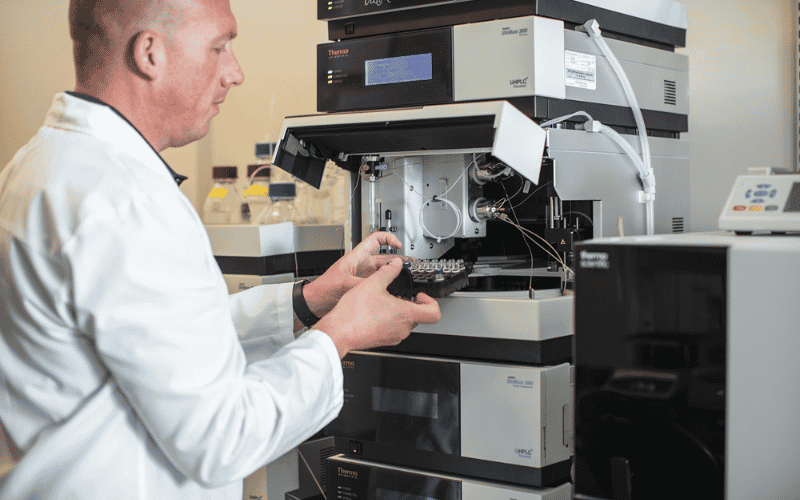
University laboratories are where ideas are born, yet they are often the most overlooked economic engines in North Carolina.
These labs are incubators for the next generation of biotechnology. As a faculty member who transitioned from academia to the world of startups, I have learned that the journey from a discovery to a real-world product is about more than just brilliant science. The real challenge lies in navigating a complex commercialization pathway – one that demands both strategic rigor and significant capital investment.
For many researchers, the idea of commercializing their science can feel daunting and certainly secondary to the academic mission of discovery. I never initially planned to be an entrepreneur. I quickly realized, however, that for my research to truly impact lives, it needed to reach the market.
I am a firm believer that science does no one any good sitting on the bench. It must be offered to the public, where it can have an impact outside of the scientific community.
I call myself an “accidental entrepreneur” because starting SeaTox Research Inc., a firm dedicated to discovering new innovations from ocean resources, was simply the next logical step in turning the test I created, which can identify toxins in certain marine life, into a kit. In my journey, I have learned that to do this successfully, we don’t just need funding; we need a strategic approach tailored to the unique life cycle of high-tech innovation.
TAKE ADVANTAGE OF ‘AMERICA’S SEED FUND’
The cornerstone of my own success was the SBA’s Small Business Innovation Research (SBIR) program.
Often called “America’s Seed Fund,” this federal program is a powerhouse for small businesses and university spinouts. It provides nondilutive capital, which allows innovators to prove their technology works without giving up too much ownership of their company too early.
In the high-stakes world of biotech, research-and-development cycles are long, and the technical hurdles are high. As my business partner likes to say, you can sneeze and lose $10,000 on an experiment.
SBIRs are the perfect partners for this stage because they value the science as much as the business. By securing these grants, we can focus on the critical technical milestones to de-risk the innovation, thereby making the company more attractive to private investors and partners. It is the bridge that allows a discovery to survive the “Valley of Death” and become a commercial reality, and it allows innovators to retain significant ownership of their company and thus have a voice in how it is managed.
If you are considering SBIR grants, success generally boils down to a few strategic pillars.
First, align your innovation with the federal agency’s specific mission. Don’t guess – reach out and talk to the program manager to ensure your project is a true fit.
Second, view the process as a marathon, not a sprint. It is rare to be funded on a first attempt, so treat your initial submission as a baseline. Use the reviewers’ feedback as a free roadmap to refine and resubmit.
Finally, you must know your market and how your potential product fits in. If a similar solution is already commercially available, then you must clearly articulate why the world needs your better mousetrap.
Yes, there is a specific craft to writing these proposals, but no, you don’t need a third-party grant writer. No one understands the heart of your innovation better than you do, and that authenticity is exactly what reviewers are looking for.
A SPECIALIZED HIGHWAY FOR HIGH TECH
As our local innovation ecosystem in Wilmington and beyond continues to grow, we have a beautiful opportunity to support a new generation of “accidental entrepreneurs.” However, one of the most important lessons I have learned is that high-tech startups require a different kind of patience and a specialized playbook.
In the broader startup world, there is often a rush to “scale fast” or “hire now.” While that may work for software or service-based businesses, high-tech thrives on a leaner, more focused philosophy.
I have seen more than a few high-tech startups fail from simply too much bloat early in the process, before the science could be validated. Success in our field comes from prioritizing the experiment over the office space, and the data over the marketing plan. …
When we emphasize technical milestones and patient growth, we create an environment where brilliance can actually scale. We aren’t just building companies; we are building a legacy of regional expertise that keeps our best minds and our best ideas right here in North Carolina.
THE PATH AHEAD
The transition from academic research to startup founder has been one of the most difficult but also rewarding challenges of my career. It has allowed me to see my work through a new lens and connect with the community where the science can make a difference.
Science entrepreneurs are doing more than just starting businesses; we are ensuring that the next great North Carolina discovery doesn’t just stay on a shelf but finds its way into the hands of the people who need it most.
Jennifer McCall is the co-founder and chief scientific officer of SeaTox Research Inc. Her work focuses on bioassay development for marine toxins and drug discovery from marine natural products. She received her Ph.D. from the University of North Carolina at Charlotte and her MBA in the business of biotechnology from the University of North Carolina Wilmington.
See other stories on Technology:
Betting on a Startup Movement
Cybercrime Ramps Up Sophistication
nCino CEO Eyes AI Future