In 2024, the University of North Carolina Wilmington launched an index to measure the global blue economy, and it has taken off since then.
The Blue Economy Index measures the sustainable use of ocean resources for global economic growth. Like other indices – the S&P 500, for example – the Blue Economy Index is a benchmark designed to track the financial performance of publicly traded companies.
While there are indices for different economic sectors, and even some regional blue economy indices, there are none that measure the global blue economy.

Since its launch, the index, which trades under the ticker BLUEECO on the Bloomberg Terminal, has consistently outperformed major indices, including the S&P 500. And the experts working on BLUEECO say that this growth is just the beginning.
Last year, the Blue Economy Index was up by about 38%, said Miran Hossain, associate professor of finance at UNCW. That’s more than double the gains that the S&P 500 made in 2025, he said.
The idea of measuring ocean-related economic growth originated with the Alliance for the Blue Economy, a program led by UNCW’s Center of Innovation and Entrepreneurship.
Richard Keary, a financial consultant who first proposed creating the index and serves as an adviser to the project, told the Business Journal in 2024 that he expected the index to grow by 50% by 2030. According to Hossain, the index may already have outpaced that measure, as it grew by 40% from 2024 to 2025 alone.
The term “blue economy” was first coined in the 2000s by the World Bank, and UNCW’s Blue Economy Index uses the same definition, emphasizing sustainability.
“If you look at the World Bank’s definition of the blue economy, that’s the definition that we follow; it embeds sustainability and environmental impact,” said Heather McWhorter, director of UNCW’s Center for Innovation and Entrepreneurship (CIE).
Sustainability is a key metric of determining which publicly traded companies to include in the Blue Economy Index, which currently includes 83 stocks.
If a global shipping company has heavy greenhouse gas emissions, for example, it’s not included in the index, even if it participates in the blue economy, Hossain said. The index also excludes companies that don’t disclose greenhouse gas emissions.
While oil and gas companies might be massively profitable companies contributing to the growth of the blue economy, their looming environmental impact overshadows financial impact, Hossain said.
Constructing the index took several years, but after it was added to Bloomberg Terminals and launched in 2024, BLUEECO began to see widespread growth and recognition, Hossain said.
After developing the methodology, the next step was to create a finance elective course focused on the blue economy and the BLUEECO index. After the class ends, one or two students are selected to take charge of index reporting, a paid position supported by the Cameron School of Business.
Jack Holland, a student at UNCW who writes the monthly reports analyzing the Blue Economy Index, said the index’s top performers include cruise lines, such as Carnival and Norwegian Cruise Line Holdings, whose performance has remained steady since the 2020 pandemic. On average, industrials are probably the most consistent performers, Holland said.
Notably, since the blue economy is not dependent on any one economy in the world and, as it doesn’t feature many tech companies included in the S&P 500, it has remained resilient amid AI concerns shaking up the tech industry.
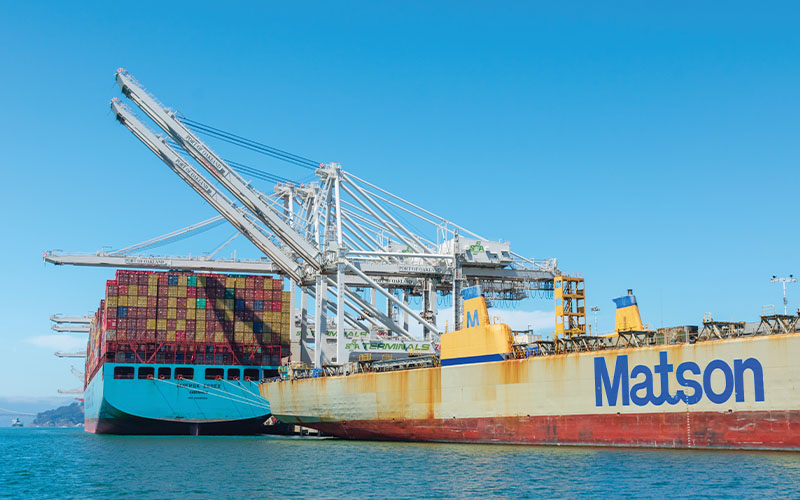
“Transportation will always be there,” said Hossain. “AI won’t make a cargo vessel disappear.”
Justin Streuli, director of UNCW’s Office of Innovation and Commercialization, said that the next natural step is to license the IP (intellectual property) for the Blue Economy Index, which UNCW currently owns, and partner with the private sector to make the index investable.
“There could be potential revenue that comes back to the university that can be reinvested in creating new indexes down the road and provide new opportunities for students,” added Streuli.
If the Blue Economy Index becomes investable, Streuli said that UNCW students would still be involved in reporting and learning about the index through classes and internships. At the same time, the private partner would handle SEC regulations and hedge-fund responsibilities associated with the index.