Underneath the bridge on the way to Leland sprawls a vast assortment of wetlands and a handful of industrial sites known as Eagles Island.
It lies at the confluence of the Cape Fear and Brunswick rivers and comprises over 3,000 acres, which, in addition to wetlands, includes a patchwork of old rice paddies, historic shipwreck sites and dredging spoils.
“People drive across the bridge, and they see it, but they have no idea what’s there,” said Larry Sackett, president and chair of the board of directors of the Eagles Island Nature Park group.
“It’s a huge undisturbed area with a tremendous history going back to the slave trade and the Gullah Geechee people and the building of the rice paddies,” he said.
Enslaved Africans and their descendants hand-dug and maintained the area’s rice plantations, and the region is part of the broader Gullah Geechee Cultural Heritage Corridor.
The Eagles Island Nature Park nonprofit is dedicated to preserving about 1,600 acres of land that make up Eagles Island. Though it gained 501(c)(3) nonprofit status just three years ago, conservation efforts began as early as 2001.
Five years ago, the group collaborated with the N.C. State University Coastal Dynamics Design Lab to create a study and vision book interpreting what a potential park could look like, with consideration for the sensitive habitats, flooding and cultural and historic resources.
“The vision has always been to sort of turn it into the Central Park of Wilmington and without any buildings over there,” said Sackett. “We want blueways and greenways – walking paths and raised boardwalks.”
“The whole idea is just to really make it a little bit easier for people to know what’s available there and to be able to participate in a little bit better fashion,” said Roger Shew, a board member, conservationist and geology and environmental science lecturer at the University of North Carolina Wilmington.
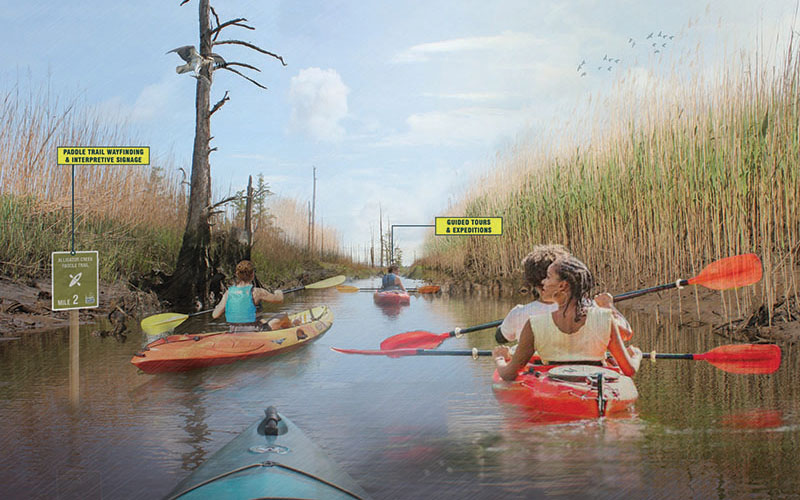
The group’s original goal, to establish a visitor center near the Battleship North Carolina, has since shifted to a less complicated immediate goal: establishing four kayak or canoe landing sites on Eagles Island.
“I think us finally getting a focus on opening the island up to kayaking and canoes is a really good first step for us,” Sackett said.
The patchwork of land ownership that makes up Eagles Island has posed the majority of the project’s challenges. In addition to 520 acres owned by the New Hanover Soil & Water Conservation District, about 485 acres of the island are held under conservation easements by state agencies, with various parcels held in private ownership. The largest single parcel of land is owned by the U.S. Army Corps of Engineers and is used as a dredge spoil site.
The Eagles Island Nature Park group doesn’t own any of the land it seeks to conserve, and according to Sackett, it probably never will.
Rather than acquiring land, the nonprofit wants to partner with the New Hanover Soil & Water Conservation District and seek permission to build kayak landings on district-owned property.
While there’s no formal memorandum of understanding yet, the group has mapped out four locations where kayak sites would work best, with the goal of connecting the landings via marked paddle trails to existing kayak launch points in the Belville, Navassa and Leland areas. The next step is to seek approval from the New Hanover Soil & Water Conservation District board, refine overall concepts and then pursue regulatory approval.
Shew also serves on the New Hanover Soil & Water Conservation District Board of Supervisors, and although he’s optimistic the project will be greenlit, he anticipates it will be a lengthy process.
Even though the proposed kayak landings are minimally invasive structures, the project is expected to require permits from the state’s Division of Coastal Management, among other regulatory approvals. The waters surrounding Eagles Island are designated primary nursery ground for endangered Atlantic and shortnose sturgeon, as well as a registered Natural Heritage Area designated by the N.C. Natural Heritage Program.
Although the distinction presents a web of regulatory red tape, the island’s ecological significance is another reason to keep moving forward with the project. In addition to preserving the land, the nonprofit hopes to install signage to educate kayakers and canoeists.
“For instance, on Sturgeon Creek, we could mention that this is the site of rich marshlands and primary nursery grounds that support our endangered fish species,” Shew said. “(We’re) not putting just a little yellow marker, but (we’re) also going to be putting up some signs to highlight for people some of the educational aspects.”
According to Sackett, the group has started picking up momentum again, first with the official change to a 501(c)(3) nonprofit organization a few years ago and now with a reconstituted board.
“We just wanted to get a representative board that would do things, not just talk about it, who had expertise in what we needed,” he said.
The Eagles Island Nature Park board currently includes Eulis Willis, former longtime mayor of Navassa; Chuck Bost, current mayor of Belville; Jim Bucher, former parks director for Belville; John Wessell, former town attorney for Leland; and Dana Sargent, former executive director at Cape Fear River Watch and director of community building at Audubon North Carolina.
While the group is starting with the proposed kayak landings on land owned by the New Hanover Soil & Water Conservation District, it eventually hopes to move forward with other visions – including a raised boardwalk and an observation deck.
“One of the visions is to build an elevated boardwalk over the shipwrecks or the derelicts on the shore of Eagles Island. Long term, we would do walking paths between (the dredge spoil islands),” Sackett said, “but we gotta do one thing at a time, and the focus is on kayaks.”
For Shew, the conservation of Eagles Island has been personal – just as much as it is about preserving an ecological heritage site.
During World War II, Shew’s father worked on ships that were mothballed, or decommissioned, on the Brunswick River – and was part of the team that helped settle the Battleship North Carolina into the area.
“The water is an important part of our history, and our land is an important part of what we’ve experienced in the past with the rice canals, the naval stores, the causeway,” Shew said. “There’ve been many, many changes to this area. What we need to do is take a step back and make sure we preserve and appreciate some of these things that we still have before we (lose them).”

Leland Shopping Center Signs On 11 New Retailers, Restaurants
Emma Dill
-
Aug 19, 2026
|
|
Tech Wilmington: Upcoming Events Calendar
Staff Reports
-
Aug 19, 2026
|
|
Creative Outdoor Solutions Acquires Local Hurricane Shutter Company
Emma Dill
-
Aug 20, 2026
|
|
UNC, Atrium, Novant Pitch Competing Hospital Plans At CON Hearing
Cierra Noffke
-
Aug 20, 2026
|
|
Affordable Housing Project Secures $2M In Gap Financing From City
Emma Dill
-
Aug 19, 2026
|
|

Access to gluten-free food in Wilmington has evolved from a few niche shops to a growing industry....
"The bond is about refreshing our infrastructure, not for the next couple of years, but for the next several decades,” said Christopher Barn...
"Our goal is to preserve teeth that might otherwise need to be extracted and replaced with implants. Saving a patient’s natural tooth is alm...

The 2026 WilmingtonBiz: Book on Business is an annual publication showcasing the Wilmington region as a center of business.