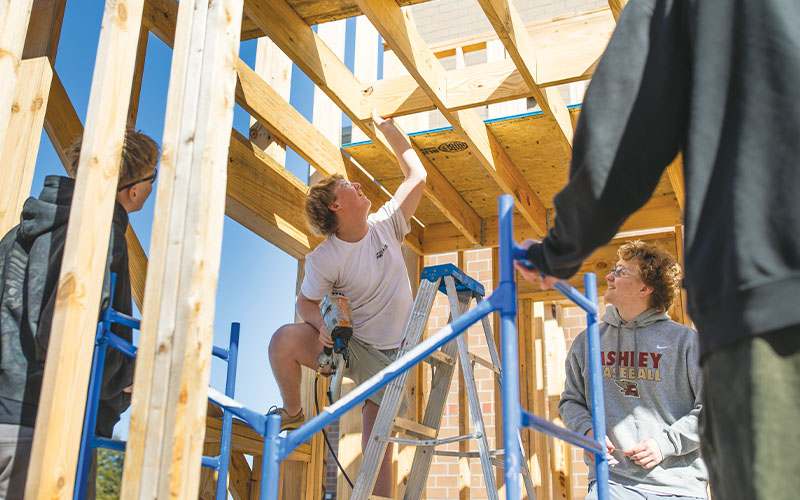
Students in carpentry classes at Ashley High School have built backyard sheds before, but the structure taking shape outside their classroom this semester is next level.
And, on a recent Thursday, the teenagers looked high-key serious about it as they sawed 2-by-6 boards and climbed ladders with nail guns. The project is a tiny house, a 320-square-foot, stick-built home that will be auctioned off when it’s complete.
The students are responsible for most of the major aspects of the home, from framing and flooring to drywall and interior finishes.
The carpentry advanced studies class “has really opened up a lot of opportunities,” said Jenna Smith, a carpentry student and senior at Ashley. “And especially this thing (the tiny house) – this is crazy that kids are building this.”
Carpentry is part of a long list of Career and Technical Education (CTE) classes available through New Hanover County Schools and Cape Fear Community College.
Officials said CTE programs are designed to prepare students for a post-graduation pathway, including college or direct entry into the workforce. They can also provide a leg up on industry credentials.
“When students take our classes, it sets them up to go to whatever their next level is,” said Mandy Mills, director of CTE for New Hanover County Schools. “If they are going to college, CTE is still for them. For students who are going directly into the workforce, we offer opportunities to earn credentials that position them for early success in their chosen field.”
Smith said the carpentry classes she’s participated in have helped her as she considers which career she might want to pursue. Recently, she was preparing to meet with a local architect, and she’s been applying to colleges with architecture in mind.
“It really opened me up to a lot of things,” Smith said. “Now I’m going to shadow somebody that I wouldn’t even have the opportunity (to shadow) before.”
CTE programming is informed by local workforce demand, Mills said.
“Part of our CTE program requirements is that we align our programs to the local industry needs,” she said. “So that is something that we focus on. We do a local needs assessment every two years, where we look at labor market data, we seek feedback from local employers, and we try to align our programs to those needs.”
Construction trades and medical fields consistently rank among the highest-demand areas, she said.
In New Hanover County, career discussions with students begin as early as 10 and 11 years old.
“Our students start career development plans in the sixth grade,” Mills said. “They even start career exploration in the fifth grade. And the hope is that they start narrowing down their interests as they get closer to high school, and then we can guide them based on their interests.”

NHCS seventh graders participate in the Career and Leadership Development Academy (CLDA), which began in 2022. CLDA is a collaboration between the Greater Wilmington Chamber of Commerce, New Hanover County Schools and local businesses, with goals that include developing and retaining young workers, showcasing fast-growing career pathways in the community and building leadership and employability, according to the chamber’s website.
Fast forward to high school, and many students in the county also take Cape Fear Community College classes before graduating.
Erin Easton, vice president of economic and workforce development at CFCC, said the schools have found success with CFCC classes on the high school campuses, including small engine mechanics, aviation and more.
“I think there’s a changing of mindsets. Years ago, there used to be a lot of folks in these trades and hands-on type programs that led to careers, and then we had a pause, and now we realize there’s a huge demand for electricians and boat motor mechanics,” Easton said, “and we’ve got to change their mindset young while they’re thinking about these careers.”
CFCC has “partnered heavily with the school district to make sure that we’re both doing things to share these well-paying careers and training opportunities with these students,” Easton said.
Enrollment data shows growth, she said. From academic year 2023-24 to 2024-25, “we were up 10% for continuing education,” Easton said, with fall enrollment alone up 21%. Dual enrollment participation, through which students can earn high school and college credit, is especially notable, she said.
“One out of every five high school students in our service area is dual enrolled at Cape Fear,” Easton said.
“The biggest thing with carpentry and a lot of the trade programs is finding instructors who are qualified and willing to teach,” Mills said.
The CTE carpentry teacher at Ashley, Hugh Hirth, has been teaching for 20 years. He said he has seen teenagers’ career hopes and training lead to results.
“I have former students who own and operate their own company,” Hirth said. “I have many students working for general contractors that have been part of my program and part of my class.”
Read more on Workforce + Recruiting:
Schools Aim to Build Career Paths
Opinion: How Collaboration Boosts Health Care Talent Pipeline
Governments Race to Recruit, Keep Workers
Schools Have Manufacturing Mentor