It has been more than a decade since Uber and Lyft entered the Wilmington market, with Lyft having debuted services in 2016, two years after Uber. How are local taxis faring these days?
If you were to judge by the ground transportation options at Wilmington International Airport, you might think that small business owners were at least holding their own against the powerful pair, which are currently listed among 15 taxi, limousine or ride-share options.
But local companies complain that they’re not getting enough government support as the nationwide providers continue to flood the market with gig workers.
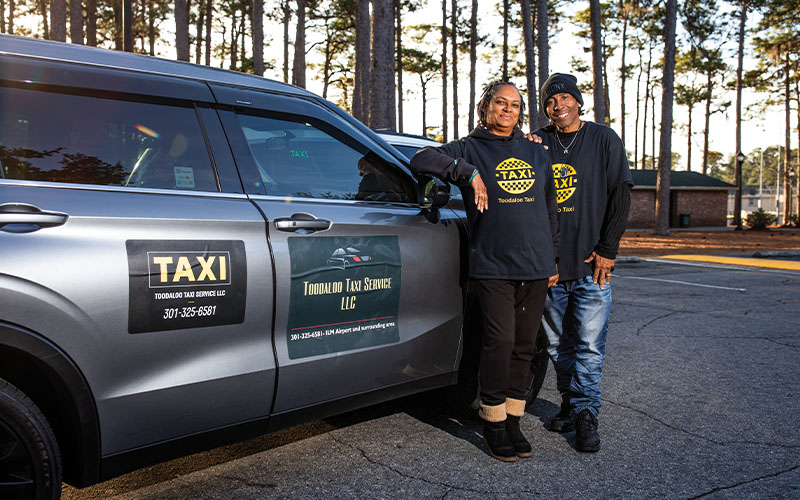
“Their population is enormous,” Toodaloo Taxi Service co-owner Monica Robbin-Lewis said of the Uber and Lyft drivers. “Since we’ve been (at the airport), I’ve only noticed a couple of new taxis come out. Most of the customers, when they see us out here, they’re like, ‘We didn’t even know taxis were here.’”
Airport service appears to be one of the last remaining lifelines for local companies. Like other local transporters, Robbin-Lewis and her husband, Douglas Lewis, don’t wait on city streets for riders in need or do random pickups, because their set-rate fares can’t compete against Uber’s and Lyft’s dynamic pricing models, which adjust fees based on such factors as supply and demand.
“Basically, it’s just word of mouth,” Douglas Lewis said of his company’s approach.
In fact, the days of traditional taxi availability on city streets are largely gone, according to Pyramid Taxi owner Mohamed “Mo Mo” El Henawy.
El Henawy has long been an outspoken advocate for his industry. He said that Uber and Lyft have benefited from an uneven playing field.
The number of gig drivers is uncapped in Wilmington and surrounding areas, as it is for most of the country – New York City being the prime exception.
Additionally, El Henawy noted, taxis are highly regulated by state and local regulators, who enforce stricter vehicle age limits, higher insurance coverage requirements and greater licensing requirements. Regulations include frequent and extensive inspections, as well as driver fingerprinting.
Uber and Lyft officials say they don’t let safety slide. Javi Correoso, spokesperson for Uber, stated in an email, “Uber must undergo various regulatory requirements set by the state of North Carolina. These include background checks for all drivers and $1 million in insurance coverage while an Uber driver is on a trip with a rider, substantially higher coverage than what is required of the taxi industry.”
Correoso said many Uber riders are located outside of central areas – often the same areas that are traditionally underserved by other modes of transportation.
“These riders use Uber because they need a reliable, convenient way to get from A to B, at all times of day or night, wherever they are, with no discrimination based on location. Limiting the supply of cars makes it harder to service soaring demand, which will in turn mean higher prices and/or longer pick-up times – and in some cases no ride at all
He said the majority of Uber drivers drive less than 20 hours a week, “valuing the flexibility that the Uber platform provides them.”
Locally, Joshua Price, who owns Price is Right Transportation, said skyrocketing insurance rates due to the number of drivers on the roads, which have led to more accidents, led him to downsize from five cars in 2018 to just one.
Price switched to a for-hire driving approach in 2020 because the insurance policy was cheaper. But the cost to insure his one vehicle has now grown to about $5,000 a year, he said.
Like many drivers, he does what’s necessary to make ends meet. “I do UberXL on weekends when I have no private bookings,” he said.
El Henawy, who operates 15 cabs, said that, by law, he must operate vehicles that are 12 years old or newer and are routinely inspected. In 2021, the city of Wilmington relaxed the taxi age requirement by two years to the current dozen as a way to try to help out.
El Henawy said the consideration doesn’t go far enough.
“If (regulators) open the years of the vehicle for us and allow us to have older vehicles, it will lower our insurance,” he said.
El Henawy insisted he will keep slugging it out. He has to “keep feeding my drivers.” He also has a teenager interested in college. Helping Pyramid stay afloat, he said, are loyal customers and contracts with organizations that frequently need transport.