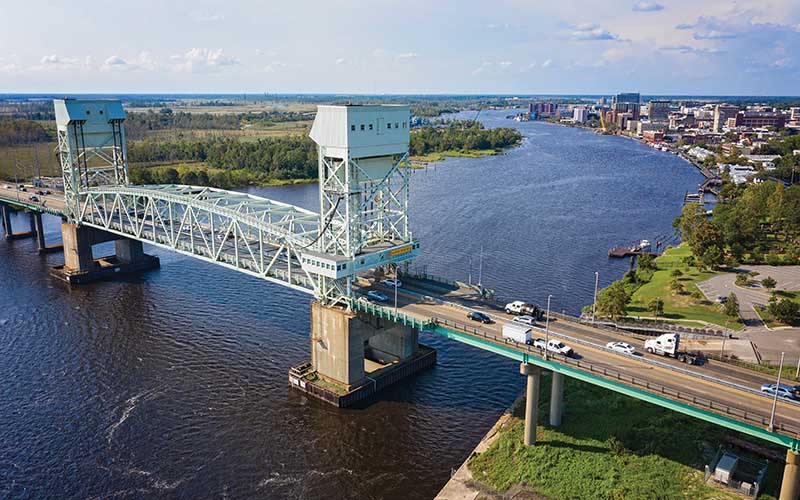
In a letter sent to lawmakers this week, the New Hanover County Board of Commissioners outlined its preferences related to replacing the Cape Fear Memorial Bridge.
The letter, signed by all five commissioners and sent Thursday to Sens. Thom Tillis and Ted Budd and Rep. David Rouzer, requests that Congress authorize a study of current and future navigation needs on the Cape Fear and Northeast Cape Fear rivers north of the bridge.
It also asks Congress to authorize additional funding for the bridge replacement. Although officials announced a $242 million federal grant for the project in July 2024, the two replacement options under consideration by the N.C. Department of Transportation are estimated to cost between $1.03 billion and $1.11 billion.
The two alternatives are a 135-foot-tall fixed span and a 65-foot movable span that can be raised to 135 feet. The Wilmington City Council has also recently expressed its own misgivings, stating in an
opinion piece signed by all of the members that the impact of both options “deserves greater consideration before North Carolina makes a decision that Wilmington will live with for generations. We do not support advancing the proposed 135-foot fixed-span bridge because of its projected cost and the magnitude of its impact on Wilmington.” The council also repeated its opposition to a toll as a way to fund the replacement.
The county commissioners’ letter notes that the U.S. Coast Guard and U.S. Army Corps of Engineers determined the need for a 135-foot vertical clearance based on a 1996 federal authorization for a depth of 38 feet north of the bridge.
“The federal agencies concluded that a lower span would be injurious to that project,” the letter stated. A later report conducted by the NCDOT “primarily examined the potential impact the bridge could have on access through the waterways and did not provide an assessment of the waterways’ actual navigational needs.”
The commissioners state in the letter that the more recent report also found that vessels using that part of the river do not require clearance that would necessitate raising the span. Additionally, the letter says bridge openings declined from 188 in 2019 to 63 in 2025.
“An updated analysis of navigational needs north of the bridge could provide critical information to preserve federal interests in navigation,” the letter stated. “Our suggestion is that this assessment should focus on current and future economic activity rather than be based on an analysis performed 30 years ago. As you may know, New Hanover County has prioritized conservation and preservation in this area, including through direct purchases of land north of the bridge with the intent of maintaining it as undeveloped property. Additionally, waterways north of the current bridge are shallower than the river channel south of the bridge.”
NCDOT public information officer Veronica Scott recently told the Business Journal, “Anything that delays our ability to meet the necessary milestones to obligate the $242 million federal grant could result in the loss of the federal grant.”
The grant has an obligation deadline of Sept. 30, 2027.
The county commissioners’ letter stated that they believe “a navigational needs assessment would not conflict with the progress made toward the bridge’s replacement and are supportive of project timelines to meet deadlines to protect federal investments that have been committed. We would further support an extension of the Large Bridge Project program to accomplish such an assessment.”
If the assessment does prove to be harmful to the project’s timeline, the commissioners said, they support “replacing the bridge with the movable span alternative that provides a similar structure to the existing Cape Fear Memorial Bridge. NCDOT’s recent environmental assessment of the alternatives notes that the movable span would have fewer impacts to neighboring properties, the bridge’s new footprint and the viewshed.”
The NCDOT is accepting public comments on the bridge replacement alternatives through Oct. 15 via phone, mail and the department’s
public input portal.