For many Wilmington residents, the city’s heartbeat lies in the historic district.
While it has evolved countless times over the decades, Wilmington’s downtown remains an attraction in its own right, with historic architecture, brick-laid streets and a vibrant mix of dining, nightlife and culture.
“Between our historic buildings and our riverfront and the locally owned businesses, a large part of why people come downtown is to shop, to dine, to explore our community,” said Christina Haley, CEO and president of Wilmington Downtown Inc.
Investment in downtown commercial real estate continues, and many leaders are optimistic about changes on the horizon. Some people, largely longtime residents and small business owners, worry about preserving the city’s character.
The Wilmington City Council adopted the Greater Downtown Plan on June 16, establishing a framework for growth across the 18 neighborhoods within the 1945 city boundary. The plan is intended to guide future policies, projects and programs.
Developed with input from thousands of residents through surveys, focus groups, open houses and community events, the plan organizes its recommendations around four themes: local character, economy, small business and mobility.
During public engagement, preserving the city’s historic character emerged as a priority, alongside supporting local businesses, expanding economic opportunities and improving how people get around downtown.
“The plan recognizes that a thriving Greater Downtown requires ensuring that existing local businesses have opportunities to remain, grow and succeed as the area evolves,” Travis Henley, community planning and design manager at the city of Wilmington, said in an email.
The city has seen significant growth in the commercial real estate market in recent years.
“Back in 2014, (the central business district’s) taxable value was a little over $395 million,” Haley said, “and today, according to the 2025 tax year, it is $1.18 billion – and that’s just based off real estate values alone.”
James Goodnight, a real estate developer who has invested millions in restoring historical commercial buildings in downtown Wilmington and the Castle Street district, said the city’s real estate market has become more competitive over time. In May 2025, Wilmington Downtown Inc. estimated that downtown retail occupancy was about 98%.
“There’s demand for good space down here, but it’s hard to find,” he said. “Compared to 10 years ago, we’re seeing fewer of the legacy landlords.”
Goodnight has renovated and upfitted several major buildings in downtown Wilmington, including 1 S. Front St., which houses Seabird, 21 S. Front St. and 23 N. Front St., the future home of Floodplain Books, an independent bookstore co-owned by Wiley and Mallory Cash.
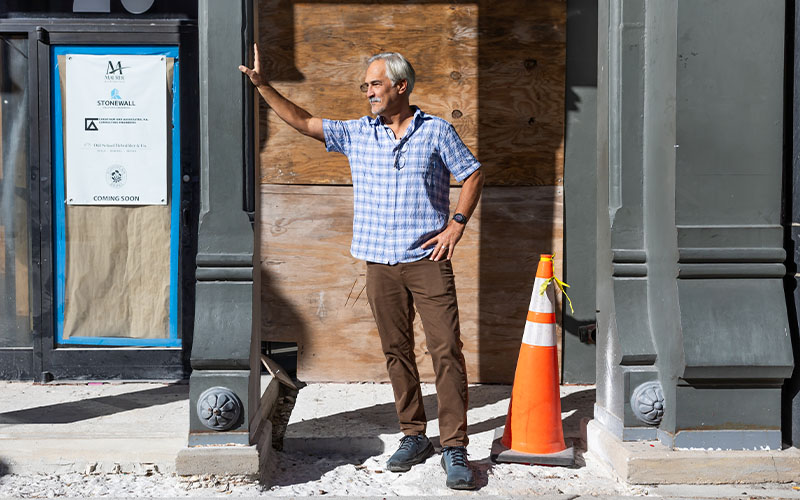
Chris Yermal, president of Old School Rebuilder & Co., a contracting firm specializing in existing buildings, has also helped improve Wilmington’s historical buildings.
While Old School Rebuilder has worked extensively on Goodnight’s properties, the firm has also renovated many other iconic Wilmington structures and retail spaces, including the Trust Building, Cape Fear Apartments, Bespoke and Finkelstein’s.
The renovations don’t come cheap, and Yermal emphasizes that even after a historical building is renovated, it still requires maintenance. One of Yermal’s biggest concerns about downtown Wilmington is the ongoing repairs its aging buildings require, he said.
“There are currently a lot of buildings around town that have facades that are troubled, like rusting lintels that support everything above,” he said.
Haley said investors with access to capital will take a prominent role in guiding Wilmington’s growth.
“A key component in how downtown evolves in the future is really going to lie in the hands of the large investors that are going to come in and bring about those large-scale development projects and infill developments that we need to grow in the future,” she said.
For some small business owners, including Joe Apkarian, owner of The Eagle’s Dare, The Pour House and TacoBaby, Wilmington risks losing unique qualities as it opens its doors to big development projects.
“If we are not careful, we will be King Street of Charleston … (where) big money backing hospitality groups, larger businesses came in, set up shop, and the minute the numbers don’t make sense, they’re done; they closed up,” he said.
At the same time, Apkarian acknowledges that development has vastly improved Wilmington’s storefronts and prompted growth for the city.
“It’s a double-edged sword,” he said. “You’d be ignorant not to acknowledge some fantastic things that some of those developers, like (James Goodnight), are doing.
“How do we also protect and maintain our identity as a historic downtown arts and entertainment district and still maintain the identity of these small business owners?” he added.
The Greater Downtown Plan outlined recommendations for downtown Wilmington, including improving the pedestrian environment, strengthening business support services and making city regulations and permitting processes more friendly, Henley said.
“While these strategies can help local businesses succeed, rising costs across the board pose broader affordability challenges that the city has less power to address alone,” he added. “The city does not control commercial or residential rental rates.”
Read more on Spaces + Places
Industrial Spaces Look to Grow
Downtown Wilmington Weighs Growth
Broker Builds on Industrial Growth