Driving into Wrightsville Beach, it’s easy for visitors to see shops, restaurants, bars, and people walking around the loop and on the beach. However, tucked away on the island is a little space dedicated to marine science, research, and the business of aquaculture that could provide a future for the over-harvested fish swimming off the North Carolina coast and beyond.
Looking trough a microscope at UNC-Wilmington’s Center for Marine Science and Aquaculture, researchers study a single microscopic rotifer (a type of food source), the beginnings of the complex cycle of life this facility recreates not only for research and education, but also for the promotion of the business of aquaculture, or fish farming.
At the aquaculture facility, the goals are to develop cost-effective, environmentally-sound technologies for marine food production and to mitigate depletion of marine populations through commercial cultivation, or stock enhancement.
The facility is dedicated to taking a holistic approach to fish farming. Everything from providing the right environment for a particular species to grow based on light, water turbulence, salinity and temperature, to developing specific blends of dry fish foods that use less protein from smaller fish that are also being depleted from the ocean.
It’s no secret that the seas are currently being depleted of many species of fish. The species studied at the aquaculture facility include black sea bass, red porgy and flounder, all of which are decreasing in number because they’re unable to reproduce as fast they’re being harvested for human consumption.
The hatchery is trying to reproduce these high-value species that are being threatened by over-fishing to grow to a size of 1 to 2 pounds and sell them into the market, said Wade Watanabe, research professor and Aquaculture Program Coordinator.
To propel this process, brood-tanks simulate seasonal change, which governs the breeding cycle while controlling the breeding to provide eggs and larva year-round. The fish in the tanks are injected with hormones to facilitate the last stage of reproduction. A single female produces approximately 200,000 eggs.
In the first two weeks of a black sea bass’s life, the fish are given live food produced in the same area as the larva. Then they are placed into tanks as fingerlings and and fed dry food until they’re ready for shipment to a buyer who wishes to farm them to their pound to 2-pound market size to sell.
“Sustainability is the big goal here” said Watanabe. While the aquaculture facility tries to produce a large amount of fingerlings (young fish) for sale, it also produces rotifers for sale all over the country via Reed Mari-culture Supplies online, and Aquatic Eco Systems. Growing live food for the larva is an expensive process, so producing live rotifers for the center and for sale, allows the facility to recoup some of the money it spends and to put it back into the program, said Patrick Carroll, facility supervisor.
“This is very expensive to do,” Carroll said. “Dry food is cheaper, so it is more advantageous for us to get them on dry food quickly.”
After 35 days of a gradual weaning process, young fish begin to feed off dry food. Eventually, they are put into 3-foot-deep tanks ready to be shipped off to a grower.
Now that the facility is able to produce tanks full of fingerling fish, “we will be able to show them that we can produce this many fish,” said Carroll.
“With the BioTech Grant, now we are able to produce commercial numbers,” he said. In the first run, 26,000 black sea bass were produced and they are expecting totals of more than 30,000 in the future.
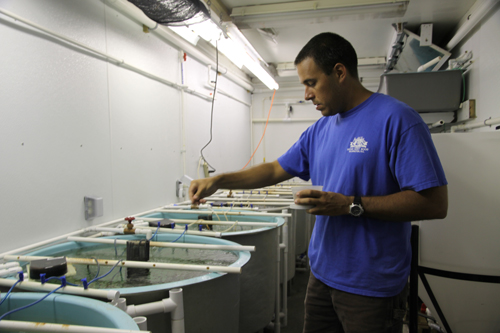
Scattered throughout the facility, are tanks holding 35,000 liters of water with a capacity to hold up to 70,000 fingerlings. The water used is a mixture of 90 percent recycled water and 10 percent new water pulled from the Banks Channel.
The facility is a hybrid research and commercial operation. The Center for Marine Science is “a precursor to a full commercial scale hatchery,” said Watanabe.
“We are helping the aquaculture industry by supplying farmers with fingerlings while also helping UNCW students in their research.”
But because of the complexity involved in spawning and rearing marine fish, it’s not something that just anyone can do.
“This is not a turn-key business,” Watanabe said. “There are too many technicalities to get started on your own.”

Sound Off: A Hospital Built To Match Wilmington’s Growth
Ernie Bovio
-
Jun 22, 2026
|
|
Mayfaire West On Hold As Developer Focuses On Other Projects
Emma Dill
-
Jun 22, 2026
|
|
Working Waters: A Look At A Day In The Life Of The Cape Fear River
Emma Dill
-
Jun 22, 2026
|
|
Trends To Watch: Healthcare
Staff Reports
-
Jun 22, 2026
|
|
Chronic Gaps: More Rural Counties Grapple With Shortages In Healthcare
Randall Kirkpatrick
-
Jun 22, 2026
|
|
This spring and summer have been a rough time for the city of Southport’s Parks & Recreation Department....
University laboratories are where ideas are born, yet they are often the most overlooked economic engines in North Carolina, writes Jennifer...

Need a Fence Company is a residential fencing company that provides Wilmington and the surrounding areas with fence materials, installation...

The 2026 WilmingtonBiz: Book on Business is an annual publication showcasing the Wilmington region as a center of business.