Two vessels arriving in Wilmington this fall could help shape the next generation of marine research and technology training at the University of North Carolina Wilmington and Cape Fear Community College.
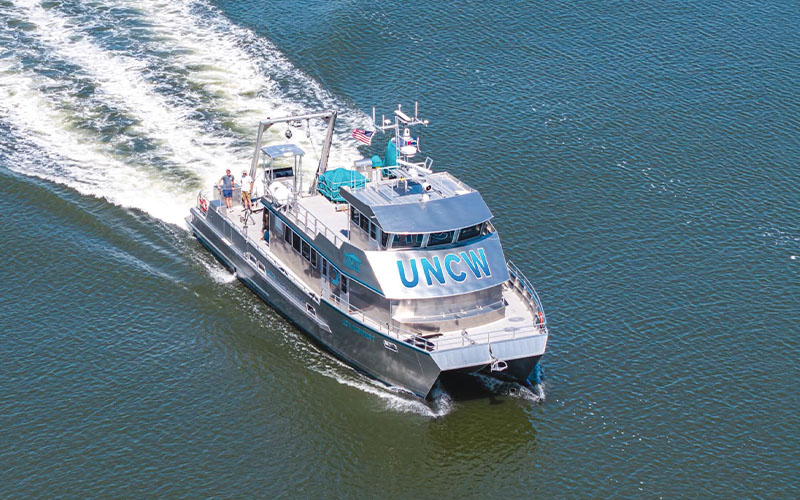
The newly built R/V (Research Vessel) Osprey, which arrived at UNCW’s Center for Marine Science in early September, replaces the R/V Cape Fear. At CFCC, a new vessel slated to arrive in mid-November will replace the college’s R/V Cape Hatteras. The vessels are each purpose-built with research and workforce development needs in mind, officials say.
At UNCW, the R/V Cape Fear was a repurposed commercial fishing boat, said Jay Styron, assistant director for marine operations at the university’s Center for Marine Science (CMS). The university purchased the vessel in 1997 and retrofitted it for research.
“The R/V Cape Fear is coming up on 38 years old, and it’s reached the end of its useful life for us,” Styron said. “The science that we did back when we got it compared to the science now has totally changed.”
The new $7.5 million ship has a wet and dry lab and is equipped with features that can help map the seafloor and look at what’s happening in the water column. It’s also equipped to handle more sophisticated electronics, CMS executive director Ken Halanych said.
UNCW’s new vessel is larger – 78 feet long versus the 65-foot R/V Cape Fear – and nearly double the width. It has a maximum speed of 24 knots – double the former vessel’s top speed.
“A lot of the places our researchers want to go are out on the edge of the Gulf Stream and the shelf break, and that’ll be 50 to 80 miles offshore,” Styron said. “So, you can imagine you’re spending a lot of time just transiting on a slow boat. The faster you can get to your station, that’s (more) time scientists have to actually do their science.”
Part of the vessel’s increased speed comes from its design – it’s a catamaran versus the former monohull boat. With its parallel hulls, a catamaran offers more stability, especially in the shallow, sometimes choppy ocean off the coast of Wilmington, Halanych said.
“The catamaran design is just much more stable,” Halanych said, “and makes it easier for the scientists to work.”

BALANCING ACT
Kameron Knight, captain of CFCC’s R/V Cape Hatteras, likes to describe the vessel that the college has had for more than a decade as either a really tiny ship or a really big boat.
“She’s a beast,” Knight said about the 135-foot-long vessel. “She can go and stay for a long time. She carries a lot of fuel. She can carry a lot of food … and she can do a lot of things.”
But the ship is overkill for the college’s needs, said Shawna Rowe, CFCC’s marine technology program director. The vessel primarily supports the four- to seven-day offshore cruises that are part of the marine technology program’s curriculum.
The new vessel has been a long time coming, Rowe said. She remembers hearing discussions about designing a new ship for the college when she was a student in the early 2000s. That project never came to fruition, she said, and in 2013, CFCC purchased the R/V Cape Hatteras when Duke University retired the vessel.
The R/V Cape Hatteras was intended to fill a gap while CFCC designed its next vessel, but finding funding for the project took longer than expected, Rowe said. In 2023, the state legislature allocated $7 million to CFCC for the project, and officials awarded the contract in June 2025, according to Knight.
“That’s the unique thing here is that we get to start with a new vessel that’ll be in operation for decades to come,” said Brandon Guthrie, CFCC’s senior vice president of academic affairs, “and really will be designed and cater to what the workforce wants to see out of our graduates.”
At 86 feet long, the new vessel – a catamaran made out of aluminum – will have less space than the R/V Cape Hatteras. The new ship can accommodate 40 passengers for day trips and 24 for overnight trips, while the R/V Cape Hatteras could accommodate up to 27 people for an extended period, Knight said.
“That was certainly a very tricky and delicate balance we wanted to maintain,” he said, “with being able to get a certain amount of racks on there so that we don’t have to run this boat constantly.”
The new vessel will be twice as fast as the R/V Cape Hatteras, Knight said, which could allow the ship to take advantage of shorter windows of clear weather to get onto the ocean. The smaller vessel is also expected to have lower maintenance and dry-docking costs than the R/V Cape Hatteras.
STUDYING THE COAST

From studying shipwrecks and examining water-quality issues to surveying the ocean floor for sand deposits to fuel beach nourishment, the R/V Cape Fear and a handful of other small vessels based at CMS have supported a range of marine research.
One such project involves monitoring water and weather conditions using buoys along the Atlantic Coast. UNCW’s Coastal Ocean Research and Monitoring Program (CORMP) maintains a network of buoys, spanning from Jacksonville, North Carolina, to Florida.
The buoys collect a range of information about marine weather conditions, including air temperature, humidity and wind speed, along with wave information and data about the surrounding ocean, said Lynn Leonard, director of CORMP and the associate director of research and innovation at CMS.
A range of users, including the National Weather Service, port authorities, river pilots and fishermen, use the real-time data to gauge conditions along the coast, and researchers use the data to study ocean trends, according to Leonard.
The new vessel’s size and speed will help make it easier to maintain the buoy network, Leonard said. The buoys are swapped out once a year for service, and while the R/V Cape Fear could carry just one buoy at a time, the new ship can carry several. The ship’s larger range will also allow UNCW to service more buoys without relying on other partners along the coast for help.

“From a logistical standpoint, that is going to make things so much easier. It’s going to be much more efficient for us because we don’t have to spend quite as much time at sea,” Leonard said, “and we’ll be better poised for rapid response.”
Leonard sees the vessel as a catalyst for collaboration across UNCW and beyond. Halanych said he expects researchers from other universities, along with federal and state agencies, will want to use the vessel for their research.
“This is going to be a go-to vessel,” he said, “not just for UNCW, but for people who want to study what’s going on in this region of the Atlantic Coast.”
WORKING OFFSHORE
It’s rare for a marine technology program at the community college level to have its own vessel, Rowe said, but for CFCC, that plays a key role in preparing students for a career in the marine technology field.
An offshore trip is built into every semester, Rowe said, and each trip has a different mission that teaches students new skills, from collecting water and sediment samples to using various oceanographic instruments. That experience prepares students for a range of careers.

“Our graduates walk out the door knowing that if they’re signing up for an offshore job, they can say they know what they’re signing up for, and that is very, very valuable,” Rowe said.
“Having a vessel that is available to us to make sure that our students are ensured that piece of their education is vital to the industry continuing to want our graduates.”
Photos by Daria Amato and c/o UNCW and CFCC
p