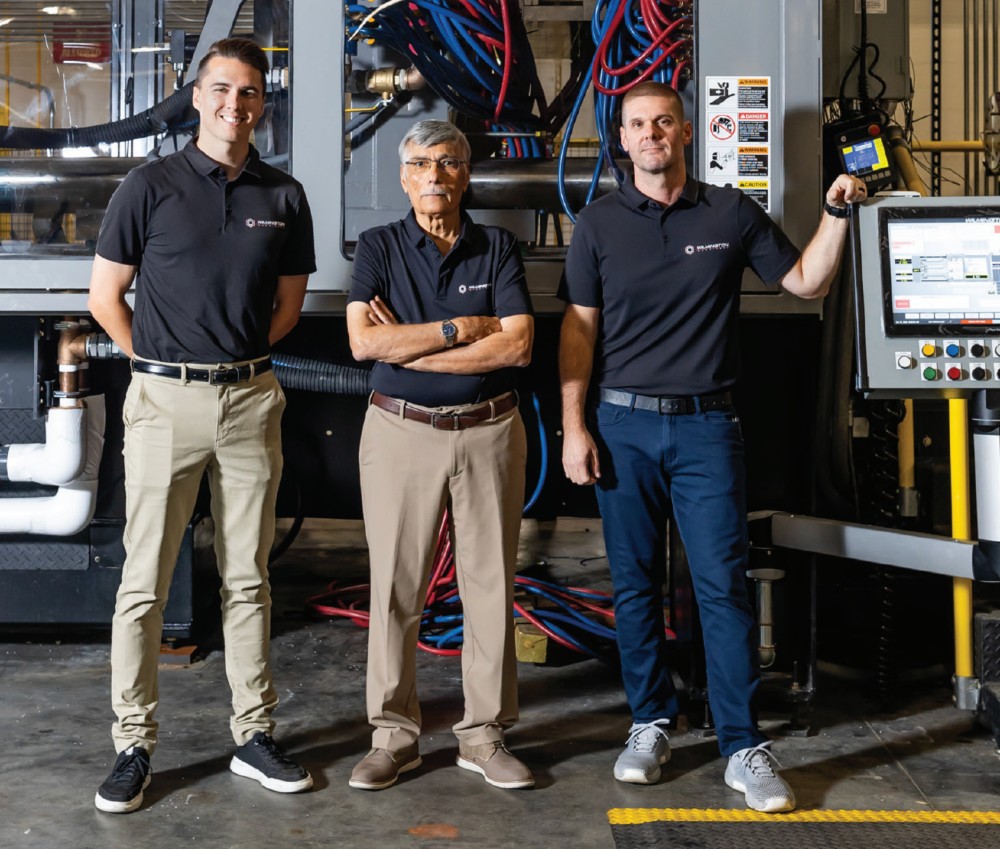
At Wilmington Machinery, workers build the machines that turn melted plastic into an array of everyday items, from coffee canisters and bottles that hold drinkable yogurt to pallets and bins.
The company, 4628 Northchase Parkway NE, specializes in designing and manufacturing large low-pressure injection molding machines and rotary blow molding systems. Now under the ownership of Yousry Sayed, the founder of Quality Chemical Laboratories, Wilmington Machinery is eyeing business growth and the expansion of its nearly 58,000-square-foot facility.
Sayed purchased Wilmington Machinery in January 2025 from Russ LaBelle, who founded the business in 1972. Quality Chemical’s offices are next door to Wilmington Machinery, and over the years, the two became friends, Sayed said.
As LaBelle’s health started to decline, Sayed said he saw buying the business as a way to honor LaBelle’s legacy and keep the company in Wilmington. At the time, Sayed knew little about the machines made by the company, but he saw room for future growth.
“I really see a lot of potential,” Sayed said, “and I would love to see this company to be maybe one of the most valuable in this area. And I think it can be, looking at the products we’re making and the market.”
The machines made by Wilmington Machinery cater to customers who need to mold customized plastic products at high volumes. For example, one machine making containers for drinkable yogurt can churn out 1,200 each minute, said Sam Baker, the company’s vice president of finance and marketing. Each machine takes between 32 and 46 weeks to build, costs millions of dollars depending on the size and type of machine and can run for decades.
Low-pressure molding allows the production of lighter-weight products that require less material compared to high-pressure molding processes, said Justin Appleton, the company’s vice president of operations and strategic growth. Low-pressure molding also allows customers to more easily use and reuse ground-up recycled plastic materials to form their molded products. The company recently, for example, manufactured and shipped a machine to Iceland that allows used fishing nets to be melted down and molded into pallets.
LaBelle started the company in 1972, making machines that manufactured plastic parts for the furniture industry. When resin prices spiked during the oil embargo in the early 1970s, the industry shifted away from plastic parts, and LaBelle pivoted to making machines that molded plastic handles for paintbrushes, according to Baker.
“That was his start into structural foam molding,” he said, “and from there it evolved.”
While LaBelle, who died in November, was focused on producing the company’s mainstay plastics molding machines, Sayed approached the business looking for areas of growth, said Appleton.
“When Dr. Sayed bought the place, that was one of the first things he said is, ‘What else can we do? How can we grow?’” he said.
One of his goals is to help keep business steady, Sayed said. Throughout Wilmington Machinery’s history, the business has seen ups and downs, said Baker – one year, the company might sell six machines and the next it might sell just one. They traditionally staff up during busy times and want to maintain staffing levels regardless of machine sales, Baker said.
The company has just under 30 employees, but officials have set their sights on employing up to 100 people in the coming years, Appleton said, amid the business’s growth.
Wilmington Machinery recently expanded its contract molding offerings, using machines built by the company to produce parts on a contract basis.
“Contract molding’s consistent,” Baker said. “You can take jobs and produce parts every month, every year.”
Since Sayed acquired the business, he’s invested $6 million in the facility and its infrastructure. Wilmington Machinery has expanded its machine shop, giving the company the space to make parts for other local businesses when employees aren’t making parts for their own machines. According to Appleton, the firm also plans to offer its technical expertise, ranging from engineering, controls and hydraulics design capabilities to other local companies.
To accommodate more contract work and add space for machine construction, Wilmington Machinery plans to add about 33,000 square feet to its building footprint, Appleton said. Plans for the expansion are currently in development, and the company expects to break ground on the project within the next six months.
“We’re not busting out of the seams right now,” Baker said, “but we want to be prepared as contract molding’s growing, as the machine shop grows and as we continue to have machinery sales, that when we do need the space, we have it.”
Wilmington Machinery is also exploring new products and markets. In recent years, Baker said, the company has witnessed success in the telecom market, making the plastic boxes that hold fiber cables, and they’re looking at other areas of growth.
“I think it’s going to be up to us how we expand,” Sayed said. “I see a lot of potential here.”

The Takeaway: Disc-o Fever
Staff Reports
-
Oct 2, 2026
|
|
Investors Buy Leland Apartments In Nearly $58M Deal
Staff Reports
-
Oct 2, 2026
|
|
Big Projects Having Or Set To Have Major Local Impacts
Emma Dill
-
Oct 2, 2026
|
|
Comfort Food In Burgaw
Beth A. Klahre
-
Oct 2, 2026
|
|
Trends To Watch: Economic Development
Emma Dill
-
Oct 2, 2026
|
|
Among the races this year is the contest between incumbent Sen. Michael Lee, R-New Hanover, and newcomer Jessica Bichler for N.C. Senate Dis...
Mitchell is facing many of the same struggles as other restaurants. Despite the challenges, Mitchell said she won’t compromise on food quali...
Uncertainty hangs over the hemp industry, including businesses in Wilmington that depend on the sale of hemp-based THC products....

The 2026 WilmingtonBiz: Book on Business is an annual publication showcasing the Wilmington region as a center of business.