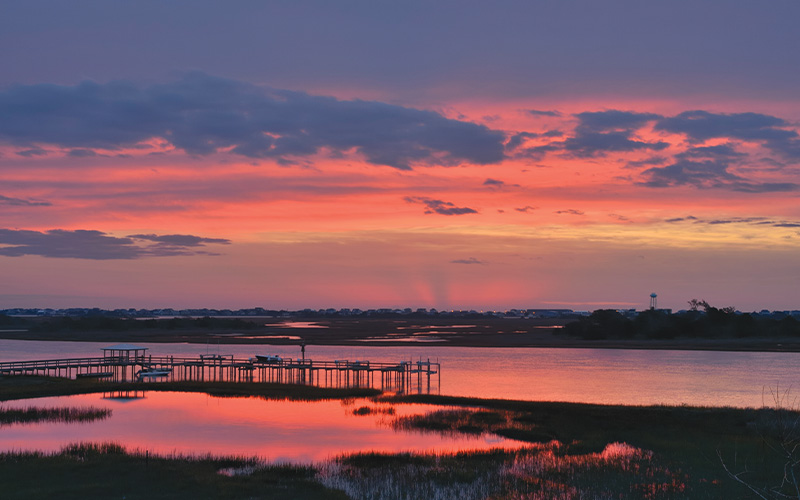
Pender County’s new comprehensive plan, Imagine Pender 2050, includes a category called “coastal neighborhood.”
The plan, adopted by the Pender County Board of Commissioners in November and certified by the Coastal Area Management Act in December, states that the coastal neighborhood category “provides unique single-family housing options near natural coastal habitats.”
Such areas are located east of U.S. 17 and are generally close to estuarine waters, according to the plan. “Much of the area within this category includes established neighborhoods with a low to medium density development pattern. Low-impact development methods are encouraged for new development to reduce stormwater runoff impacts and support adjacent coastal surface water quality.”
The recommendation applies directly to communities like Hampstead, an unincorporated area along U.S. 17 that has 38 miles of coastline along the Intracoastal Waterway, according to the website Hampsteadnc.com.
To those who advocate for the area’s businesses and tourism, coastal neighborhood category methods make sense.
“We need to protect the environment that attracted us to beautiful Pender County,” said Tammy Proctor, executive director of the Greater Topsail Area Chamber of Commerce and Tourism.
It’s a sentiment some residents also expressed as government officials were putting together Pender County’s latest comprehensive plan.
“Supporting the County’s coastal character and natural habitat is a top priority for Pender County residents. Conventional subdivisions or clustered conservation subdivisions that permanently protect open space are appropriate forms of development,” the coastal neighborhood category description states."
At the same time, growth continues in Hampstead.
A proposed development that would hold more than 350 residential units on 147 acres in Hampstead, off Country Club Drive and Olde Point Road, has drawn opposition from residents. They started a petition on Change.org titled, “Stop development threatening Hampstead’s marsh ecosystem.”
The Pender County Planning Board approved the plan in January, and the county staff’s report said the development complies with the coastal neighborhood category’s residential development pattern recommendation of three units per acre or less.
While a comprehensive plan can encourage lower-impact development, the plan itself and categories such as “coastal neighborhood” are not regulatory, said Virginia Norris, senior planner in Pender County’s long-range planning division.
Private property rights limit what county officials can do.
“We have to work within our legal boundaries,” Norris said. “And especially when it comes to property owners … if it’s legal for them to do, then we are not allowed to deny them their legal rights.”
Beyond the comprehensive plan, Norris said the county uses another tool to encourage environmentally sensitive coastal development: a preferred development guide derived from the Green Growth Toolbox from the N.C. Wildlife Commission.
While it is also nonregulatory, Norris said, “we can provide that to people, especially people who are trying to develop in environmentally sensitive areas, to help them think about a better way to design what it is they’re trying to do to protect some of those resources that really have drawn people here over the years.”
More on Hampstead:
Area Continues to Draw Homebuyers
Plan Depicts Coastal Development Ideal