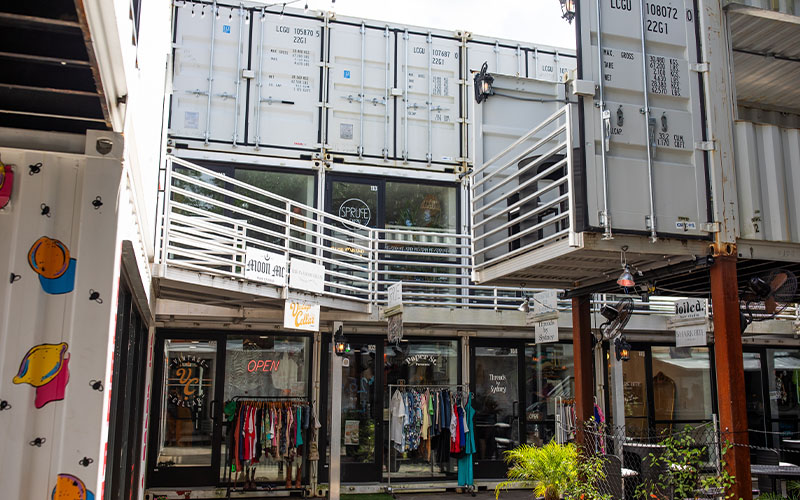
A business district along Wilmington’s Queen Street made exclusively of 20- and 40-foot shipping containers. How?
Some Port City residents might have said as much a decade ago before the arrival of the city’s Cargo District, which was founded in 2017.
Cargo District developer Leslie Smith, owner of LS Smith Inc., said realizing his vision for a container community housing small, locally owned businesses while connecting different parts of town began with a city technical review committee (TRC) meeting. The TRC works with developers to ensure that development plans and activities meet required standards.
“My proposal to the city was, ‘You want to connect downtown with Forest Hills? Well, you’re going to need a really big bridge,’ … and (one of the committee members) started laughing, and I said, ‘Well, if you’ll let me use shipping containers, I’ll give you that bridge.’”
Smith said the city’s planning and development department was very receptive of and helpful about his plans.
“There were obviously a lot of questions when we initially started …,” he said, “but they didn’t make it hard on me. If I had a question, they were good about answering it. They basically said, ‘Tell us what you’re trying to do’ and let’s see if we can get you to that point.’”
Using containers in construction offers benefits such as material reuse and potential overall cost savings, said city of Wilmington spokesperson Amy Passaretti Willis. “However, meeting building design standards in the UMX (urban mixed use) and CBD (central business district) districts has posed a challenge.”
Willis said the use of containers in the Port City is not without precedent, noting that there are “several instances where containers have been used as ADUs and homes,” including one on Castle Street. ADUs, or accessory dwelling units, are separate residential living spaces on the same lot as a primary dwelling. ADUs, which must have a full kitchen and bathroom, range from backyard cottages and carriage houses to above garage apartments and free-standing tiny houses.
While not yet widespread by any means throughout the city, “the planning department has received a few requests for their use specifically in the Cargo District …,” said Passaretti.
Planting a container doesn’t mean special treatment, including passing inspection.
“There’s a lot of inspections even for a small space,” said Smith, “so even though you’re using a container, you still have to go through the electrical, plumbing, mechanical, insulation, framing, foundation, above ceiling and all the rest.”
So far, the bridge Smith is building to give local businesses a home, with the prospect of many more containers in the future, he said. And it seems the word on container life is out.
“I have been contacted by a number of municipalities, from California to South Carolina to the Republic of Guinea,” Smith said. “It’s been crazy.”
Read more on The Cargo District:
Owner, Developer Sees Room to Grow
Container Use Has Benefits, Challenges