The arts have always had their generous patrons.
These days, however, patrons like the National Endowment for the Arts (NEA) and other government arts agencies that distribute millions in arts funding are experiencing sizable budget cuts, forcing some organizations to reimagine their canvas while others wait to see what happens after the paint dries.
With federal lawmakers proposing to chisel away $72 million from the NEA’s $207 million budget in fiscal year 2026, the independent government arts agency founded in 1965 could be looking at a 35% funding cut. The budget discussions are being watched closely by countless nonprofit arts organizations, public arts agencies, museums and individuals nationwide that rely on the organization.
“These are very interesting times,” said Rhonda Bellamy, president and CEO of the Arts Council of Wilmington & New Hanover County. “We have never been a community that had a lot of federal support. Larger organizations like the Cameron Art Museum and Cucalorus (Film Festival) have received NEA grants … (but) we’ve mostly relied on the state, and we’re very fortunate that North Carolina has one of the most extensive networks of local arts agencies in the country.”
Still, Bellamy said, arts-related budget cuts are happening.
“We’re seeing it on a number of fronts, of course – reduced state and local support,” she said.
Unfortunately for Bellamy, one of those fronts just happens to be in her own backyard.
“The arts council did not receive funding in the (fiscal year 2025-26) county budget,” she said. “We’d applied for $100,000, as we’d gotten the year before last, and we were just totally cut out of the budget.”
Then there are the public art projects at downtown’s Project Grace and Smith Creek Park in Ogden, overseen by Bellamy and her colleagues on New Hanover County’s Public Art Selection Committee.
“They were defunded,” she said. “They’re off the table.”
Despite budget cut realities, however, Bellamy said that fairly ample arts funding does exist for state and local arts groups and artists.
“North Carolina is so fortunate to have had steady increases in grassroots funding,” said Bellamy, referring to the Grassroots Arts Program (GAP), a state entity that distributes arts funding for all 100 counties of the state.
In 2024, the Arts Council of Wilmington & New Hanover County distributed $100,000 in grants to 55 organizations across Southeastern North Carolina, with the grants falling into two main categories – grassroots arts and artist support.
In addition, a recent alliance with the New Hanover Community Endowment as its first nonprofit sub-granting partner allowed the arts council to distribute $172,000 in grants to more than 30 nonprofit arts organizations in the county, ranging from $2,000 to $10,000.
Findings from a local impact study titled Arts & Economic Prosperity 6 found that more than 1.2 million people attended arts and arts-related events in New Hanover County in 2022 (nearly 39% of attendees were from outside the county), with an overall economic impact of more than $75 million that helped support nearly 1,300 jobs.
“This is big business,” said Bellamy of the report’s findings.
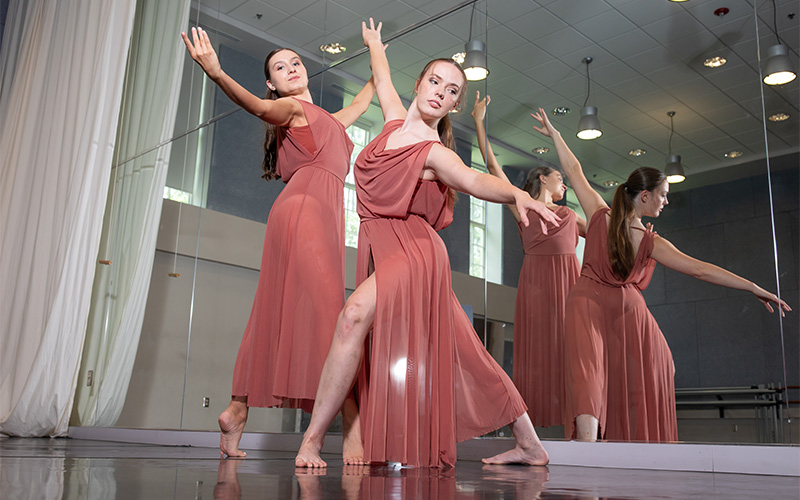
That the arts in Wilmington continue to thrive and show economic impact despite budget cuts strikes a chord with local dance instructor Sue Meier of The Dance Cooperative. The Wilmington-based nonprofit organization offers affordable dance classes and performance opportunities to the city’s underserved.
Meier said choreographing ways to secure more funding is always a priority, but since most of the organization’s backing comes from smaller entities, looming budget cuts might not hit as hard.
“Because we’re a smaller grassroots nonprofit, our grants typically come from folks like the Landfall Foundation, the Arts Council of Wilmington & New Hanover County, the N.C. Arts Council, and we’ve been fortunate to receive two grants from the New Hanover Community Endowment,” she said. “Because of our setup, it’s a little bit more challenging to go after the larger grants, so we wouldn’t be affected necessarily directly by the cuts.”
Where The Dance Cooperative might just feel the federal funding pinch is in the classroom, said Meier.
“If it comes down to funding dance classes or funding school lunch, then feeding kids will always come first, as it should,” she said. “Extracurriculars like dance and other arts are unfortunately the first things to go.”
As the head of a 42,000-square-foot facility with multiple exhibitions and more than 4,400 pieces from creators around the world, Heather Wilson, executive director of the Cameron Art Museum, knows well the economics of the arts.
“What’s happening at the federal level just reinforces how important it is that arts organizations have diverse funding streams and community support of the arts,” said Wilson, who started at the museum in 2006 as its development officer.
Wilson said the Wilmington museum, which sees upwards of 70,000 visitors a year, has not been largely impacted by the slings and arrows of federal budget cuts.
“So we’ve been very fortunate,” she said. “We are still getting funding from the N.C. Arts Council. We have gotten funding over the past two years from the Institute of Museum and Library Services – we were able to complete our grant funding request before those grants were rescinded, and we didn’t have any current National Endowment for the Arts grants.”
And without one of the more traditional museum structures at work, keeping the spotlights on, so to speak, gets more challenging.
“Most museums have some sort of umbrella institution, whether that be federal, state, county, city or a university,” she said. “At the Cameron Art Museum, we don’t have any of those. We don’t have an umbrella.”
But in some ways, that’s a strength, said Wilson.
“People often say, ‘Oh, go after the corporate funding,’ but the real giving powerhouses are individuals, so we make do with a combination of contributions and earned income.”
Wilson said having a diversified funding base, which at the museum includes event revenue, art class fees and food sales, among others, is crucial to staying alive in the current arts climate.
“It’s the way to survive,” she said. “It’s the way forward.”
See more stories on Creative Economy:
Art funding shifts keep groups on their toes
Opinion: The arts paint a powerful economic picture
Local publishers book local topics
Gravity Records keeps on spinning