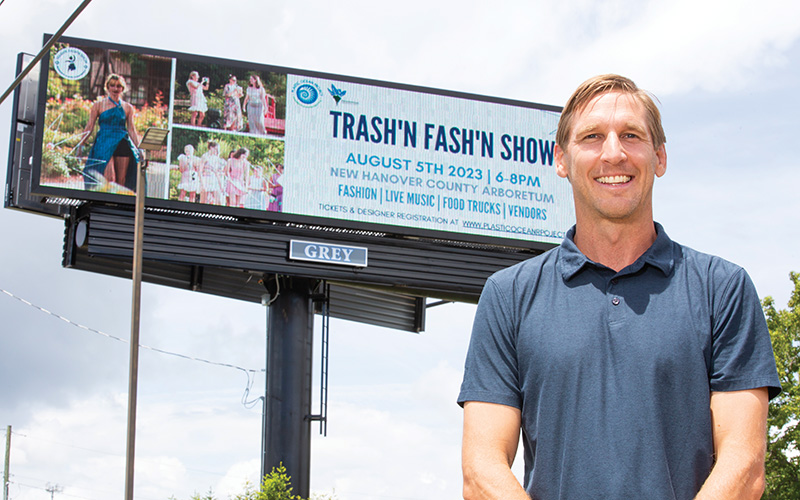
In a world saturated with online and social media ads, Grey Vick, the owner of billboard company Wilmington-based Grey Outdoor, still sees billboards as the key to business branding.
“Having your name on a billboard, it’s like that brand recognition of being like the prominent player in the industry,” he said.
Ideally, ads on billboards push potential customers toward a business or product through regular and repeated exposure, Vick said. The hope is that the next time they need a certain product or service, they’ll be more likely to Google the brand they’ve seen advertised on the billboard.
When Vick started his career in outdoor advertising around 2007, the first digital billboards were just coming online. Since then, a digital revolution has swept across the billboard industry. Vick said he now sees digital billboards as his company’s future.
Grey Outdoor owns 310 billboard structures, the beam and frame that support the advertisement, and nearly 700 faces, the often-two-sided advertising spaces, across North and South Carolina. Twenty-four of those billboard faces are digital, Vick said. He plans to convert four static faces into digital faces by October and aims to eventually own 100 digital billboards.
Digital billboards allow advertisers to adjust and change their messaging daily. Compared to traditional vinyl billboard ads, digital ads are less “cumbersome and time-consuming” to produce and change, Vick said.
“I am pretty bullish about the digital part of our business because a lot of times that’s the only place we can grow,” he said. “We can only have so many signs.”
Born in Wilmington, Vick moved to Goldsboro in his teens before returning to the Port City for college at the University of North Carolina Wilmington. There, he earned a degree in accounting, but he discovered during an internship at an accounting firm that it wasn’t for him.
“I just didn’t love accounting,” Vick said, “but I saw the tax returns of the wealthy people and went, ‘Oh man, that’s what they’re doing. I gotta figure out how to get in and do that.’”
Vick then began investing in real estate, rehabbing, flipping and selling houses. Around that time, he began considering a career in the billboard business. With a business partner, he established Waterway Outdoor in 2007.
A few factors prompted Vick’s move into outdoor advertising.
He liked that billboard deals typically produced a “win-win” for everyone involved. He made money by leasing the billboard space and the advertiser got positive exposure for their business. In his real estate dealings, one side often had to lose equity for the other to gain it, he said.
“It was just a much more attractive business to me,” Vick said.
He liked that the billboard business provided a more stable, recurring income compared to flipping homes. He also felt that it combined his sales and advertising skills and said it was part of “God’s path” for his life.
Vick’s billboard business took a few years to find its footing. The company erected its first billboard in 2008, and then the recession hit. In the next two years, the company struggled to find advertisers.
“We almost went under for a little while,” Vick said.
They made it through by staying “super scrappy,” he said.
Vick’s forte was the sales side of the business while his partner took care of the construction side of things, making the pair a “good complement,” he said. At its height, the company owned approximately 80 structures and 160 billboard faces, according to Vick.
Then in 2014, Vick started Grey Outdoor. He officially separated from Waterway Outdoor in 2016.
Although Vick took half the company’s signs with him, it felt like he was starting from scratch. For the first few years, he operated as a largely “one-man show,” he said.
Today, the company has five employees who help sell ads and run the business. Vick contracts with other companies for billboard installation and maintenance, he said.
In recent years, Grey Outdoor has acquired a handful of smaller local billboard companies – a trend that’s being seen across the billboard industry, he said.
“The industry is consolidating more and more and more,” he said. “Small operators are getting consumed by the bigger operators.”
Still, Vick sees himself as the “little guy” in Wilmington’s billboard scene compared to industry giants like Lamar, the company that owns many of the billboards inside Wilmington’s city limits. In the Wilmington area, most of Vick’s billboards are located on the outskirts of town, he said.
“Permitting-wise, it’s a little bit harder when you get into cities,” he said. “We’ve gone out farther into the growth areas.”
The company owns multiple billboards along Interstate 95.
In addition to businesses, Vick’s billboard space is sometimes purchased for political messaging and ads from nonprofits, he said.
Looking into the future, Vick said he expects his business to continue growing by converting its traditional, static billboards into digital ones. He also aspires to grow his business into other states beyond the Carolinas.
“The market has been really strong for us,” he said. “We’ve had really high demand, and so we’ve been really lucky and blessed to have as many people that want to advertise with us.”