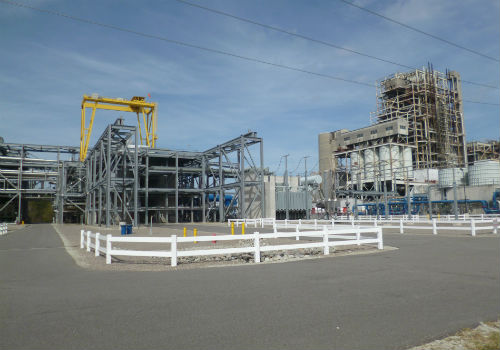
Two events this spring will continue the evolution of Duke Energy’s Sutton plant, located in northwest New Hanover County.
A demolition company has been hired to raze the original 1950s-era coal-fired facility, which sits next to Duke Energy’s new combined-cycle natural gas plant. The company will conduct four low-level implosions to destroy the structure and will then haul away the scrap materials for recycling, officials said Thursday.
The two iconic red-and-white smokestacks are already partially down, the upper portions having been jackhammered to pieces and the concrete scrap hauled away.
Next month, Duke Energy also expects to break ground for the installation of two black start combustion turbines that will provide additional power, when necessary, or serve as a backup source of power if the gas-fired plant is out of operation. The term “black start” refers to the use of an internal source of power to start the machinery. At Sutton, a diesel generator will be used to start the combustion turbines.
The new equipment, expected to be commissioned in the summer of 2017, will replace aging combustion turbines currently in use.
Thursday morning, Sutton operations superintendent Thomas Hanes and other staffers led a tour of the L.V. Sutton Energy Complex, as it is formally known, for media representatives. Plant spokeswoman Kim Crawford said the timing was right “to see the old and the new side by side, before the old is demolished, and to see the technological evolution of our company.”
The tour provided an overview of operations at the newer plant, which began commercial operations in November 2013. Except for the back-up combustion turbines, which will be replaced by the new black-start units next year, every aspect of the coal-fired operation has been superseded by new, more efficient equipment in the natural-gas-fired plant.
Should the natural gas supply be interrupted, the plant would run on stored fuel oil, Hanes said, pointing to two 300-million-gallon fuel tanks on the site.
The switch from coal to natural gas has had multiple environmental benefits, according to Hanes. The new plant operations reduce sulfur dioxide emissions by 99 percent. Nitrogen oxides are down by 97 percent, carbon dioxide by 41 percent, and mercury by 91 percent.
There’s an additional benefit to Sutton Lake: Water discharge from the new plant is cooler than from the old one, a boon for aquatic life.
The energy complex is called a combined-cycle plant because it makes electricity from two sources: from the gas itself, which runs the combustion turbine, and from steam, a byproduct. Heat from the combustion process is captured by two heat recovery steam generators and combined with water to create the steam, which then runs a steam turbine.
Sutton works in tandem with Duke Energy’s Brunswick Nuclear Plant to provide electricity to southeastern North Carolina, said Karen Williams, spokeswoman for the nuclear plant. Electricity coming from the Brunswick facility is the basic power source, she explained, but the Sutton plant’s output provides additional capacity, especially during peak-demand times and during planned maintenance outages at the nuclear plant.
“That’s why the smart gri

d is so important, so we’re making just enough power,” Williams said. “We don’t want to waste energy.”
Inside the Sutton plant’s control room (
shown at left), employees “talk to the grid,” Crawford said, meaning that they check a number of monitors and adjust the level of output needed from the natural gas plant at all times. Depending on the weather, Sutton can produce a continuous output of between 625 and 740 megawatts of electricity.