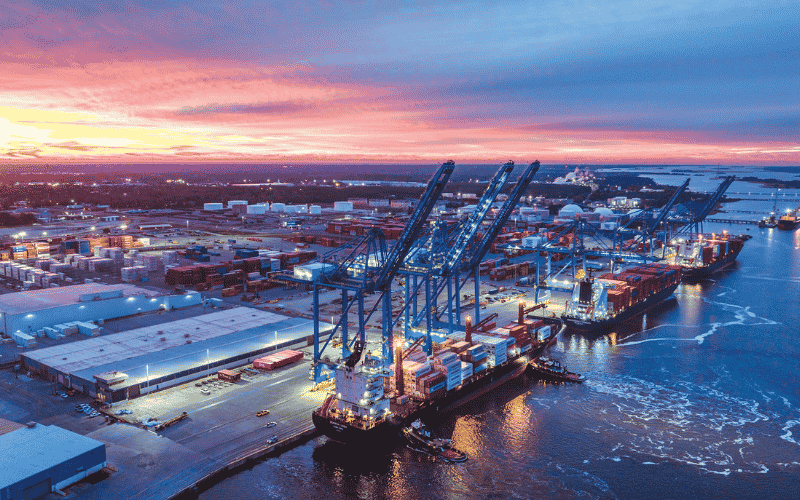
Last spring, the Port of Wilmington saw some of its largest container ships on record coming from ZIM Integrated Shipping Services, an Israeli cargo shipping firm.
According to Brian Clark, executive director of the N.C. State Ports Authority, the massive vessels were 1,200 feet long, with a capacity of around 15,500 TEUs or 20-foot equivalent units, a standard unit of measurement that’s based on the volume and capacity of one 20-foot-long container.
By June, just a few weeks into its service to Wilmington, ZIM temporarily paused its East Coast services, including at the Port of Wilmington, due to a drop in import demand, Clark said. While some of that service has since restarted, the shipping line’s weekly service hasn’t returned to Wilmington.
“The carriers are going to go to the ports that have the largest volume, the largest demand,” Clark said, “and so they basically restructured their services to call the larger ports.”
In July, neo-Panamax vessels, the largest class of ship capable of traveling through expanded locks in the Panama Canal, also stopped calling at the Port of Wilmington. Clark said he views the service changes as a “direct impact” of a broader downturn in consumer demand across the U.S. economy, prompting shipping companies to shift services to more profitable trade routes.
“Consumer sentiment is down,” Clark said. “People are not buying as much as they used to buy.” He cited rising costs in general and tariffs as possible causes of the decline in cargo volumes entering the U.S.
Since January 2025, the Trump administration has relied on tariffs, saying it aimed to bring manufacturing back to the U.S., reduce trade deficits and achieve other goals. In February, the U.S. Supreme Court struck down many of the previously imposed tariffs, ruling against the administration’s use of the International Emergency Economic Powers Act.
The Trump administration then invoked a section of the Trade Act of 1974 to impose a 10% global tariff, but another court struck it down in May, calling it unlawful. The administration is appealing the ruling.
Just as calls from the massive container ships dropped off, port officials began drafting a new strategic plan to guide N.C. Ports, which includes deep-water ports in Wilmington and Morehead City and an inland facility in Charlotte, over the next five years through 2031. Before they could start, port officials worked with plan consultant Raleigh-based Implement Consulting Group to create a new baseline for container volumes and plan for future growth.
The resulting strategic plan projected a more than 30% drop in container volumes moving through the port in the last year, decreasing from 289,000 TEUs in fiscal year 2024-25 to a projected 193,000 TEUs for the current fiscal year, which ends June 30.
N.C. Ports saw some drops in container volumes in recent years, including a nearly 8% decrease between fiscal years 2023 and 2024. In contrast, the port’s general cargo volumes are expected to grow from 4.5 million tons in fiscal year 2025 to nearly 4.7 million by the end of the current fiscal year.
Clark acknowledges the drop in container volume is significant but said he plans to use the figure as a starting point.
“You never want to see lost volume,” he said, “but really where our focus is it’s … understanding where we can have the greatest impact across the state for importers and exporters moving cargo in and out of the state.”
The strategic plan outlines an ambitious 9% growth rate in container volumes over the next year. The port’s strategic plan, which the N.C. Ports Board of Directors adopted a resolution to support earlier this year, outlined a path for growth in both container and general cargo volumes through four focus areas.
The first involves attracting new cargo carriers, identifying anchor customers and strategic partnerships across the state’s economic hubs such as Raleigh, Charlotte and the Triad, developing integrated inland shipping solutions and enabling more growth in agricultural cargo. Between 2026 and 2031, activities described in that initial focus area are expected to generate 120,000 additional TEUs for the port and $5.3 million in revenue.
Clark said he sees the refrigerated or reefer trade as an area particularly ripe for growth. A mix of perishable imports, including bananas, pineapples, plantains and grapes – which recently returned for the first time in several seasons – is already moving through the port.
“We are seeing significant growth in the refrigerated trade right now,” Clark said. “Volumes have been hitting new highs almost every month.”
The port is also seeing an uptick in the import and export of pharmaceutical components. Many pharmaceuticals are transported by air freight due to their temperature sensitivity, but certain segments can be shipped in refrigerated containers, Clark said. It’s key for port officials to understand the industry’s needs, according to the strategic plan, as the port aims to become the Cold Gateway of the Mid-Atlantic.
The refrigerated cargo goals include a continued focus on year-round fruits, a readiness to invest in value-added services such as cold-fresh fumigation, irradiation and other tools and the establishment of strategic partnerships within the life sciences and healthcare fields. Those cold chain activities are expected to generate 24,000 TEUs and $20 million in revenue over the next five years for the port.
When it comes to general cargo, the port aims to drive integrated bulk solutions, which will mean attracting outside investment, Clark said. He pointed to a $35 million investment by Silvi Cement to construct a new import terminal at the Port of Morehead City as an example of recent private-sector investment.
By 2031, the port aims to grow its general cargo volumes by nearly 40%, from more than 4.6 million tons today to 6.4 million. That will require a rethinking of the port’s systems and facilities, Clark said.
“We can’t continue to handle cargo the way we do today, which is very manual,” he said. “How do we drive that investment to grow the volume, to shrink the footprint that we actually need to handle that volume and to modernize the general cargo facilities at both ports?”
Specific cargo growth areas identified in the strategic plan include expanding bulk cement, fertilizer and forest products, along with developing a monitoring system to identify emerging commodity areas. The breakbulk focus is expected to add 3.2 million tons of general cargo to the ports, along with $13 million in revenue over the next five years.
The final focus area involves seizing breakbulk opportunities, including targeted growth in paper products, steel, lumber and project cargo. That’s expected to generate an additional 1.4 million in tonnage and $28 million in added revenue by 2031, according to the strategic plan.
Clark sees breakbulk potential in North Carolina’s status as a top growth state.
“The construction industry is not slowing down anytime soon here, whether it’s residential, commercial,” he said.
The strategic plan is intended to be a “living document,” according to Clark, with project managers responsible for implementing each focus area.
The specifics around implementing the plan are being finalized and are subject to change as industry trends and policies shift.
“If the world changes, and all of a sudden all these services start streaming back to the U.S.,” Clark said, “and we’ve got an opportunity to add multiple services, obviously it’s going to reset the baseline.”
Port officials are also waiting to see how a proposed deepening of Wilmington’s harbor will play into the strategic plan. The proposed $1.35 billion project, spearheaded by the port and the Army Corps of Engineers, would increase the existing 42-foot harbor depth to 47 feet. Officials have said a deeper harbor would allow the port to accommodate larger vessels, making it more competitive with other East Coast ports. An initial report on the project received pushback from residents and state officials earlier this year. An Army Corps spokesperson said the organization is working on revising the report, with public hearings scheduled to take place this month.
Despite the recent drop in container volumes, Clark said that doesn’t change the port’s “vision for long-term growth.”
“Regardless of near-term market conditions, we remain focused on our mission to strengthen North Carolina’s economy by serving as a gateway to global markets,” he said. “That means not only maximizing the opportunities and cargo volumes available to us today, but also ensuring our investments and operations align with the future of maritime transportation.”