The state budget signed into law by Gov. Josh Stein on Tuesday morning includes funds earmarked to address local issues, with some of the highest Wilmington-area amounts going toward the University of North Carolina Wilmington, Wilmington International Airport (ILM), coastal storm risk management and substance use recovery efforts.
"This budget delivers for New Hanover County. It puts more than $17 million into local organizations doing addiction treatment and recovery work, including a new behavioral health urgent care facility. It invests nearly $11.5 million in storm protection for Wrightsville Beach, Carolina Beach and Kure Beach, more than $29 million in UNCW's campus, ... It also protects what matters most to our region's future: our water. The budget puts a moratorium on new transfers out of the Cape Fear River basin and creates a $45 million fund to help local utilities address PFAS and other emerging contaminants," stated Sen. Michael Lee, R-New Hanover, in an email Tuesday afternoon.
"This budget delivers massive wins for the families of House District 19,” said Rep. Charlie Miller, a Republican who represents parts of Brunswick and New Hanover counties, in a news release. “I’m proud to work with my colleagues to bring these hard-earned tax dollars back home to Brunswick and New Hanover counties where they belong.”
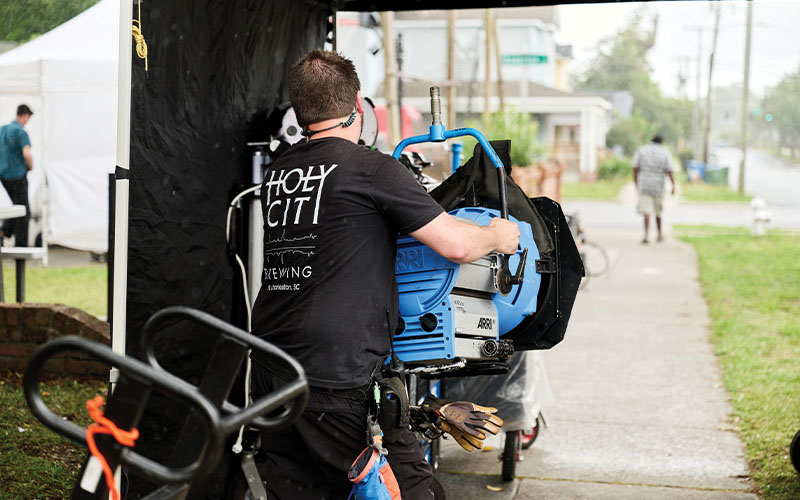
The budget, which is the state's first full spending plan in more than two years, also holds some potentially good news for the Wilmington-area film industry, which has lagged in recent years. It increases the maximum state grant for a feature film from $7 million to $20 million and the maximum state grant for a TV series or scripted streaming service series from $15 million to $25 million per season.
The plan includes a new micro-budget production grant fund of about $1.2 million annually for N.C.-based productions with budgets between $50,000 and $1.5 million.
"These are the most significant improvements to our film program in years. Raising the per-project caps to $20 million for feature films and $25 million for a television season makes North Carolina genuinely competitive for the kind of large productions Wilmington's crew base is built for and the new multi-production bonus rewards studios that keep coming back," Lee stated in the email. "The new micro-budget grant program is just as important: it invests in homegrown North Carolina filmmakers so the next generation of this industry gets its start here at home."
Lee also highlighted a new 5% bonus for production companies investing $80 million or more across multiple N.C. productions within 24 months.
"All of this has the potential to be promising," said Johnny Griffin, director of the Wilmington Regional Film Commission, in an email Tuesday. "A response at this time would be premature."
That's because the industry will be waiting on guidelines, interpretations, etc., "to determine the functionality and real-world application. Hopefully that won’t take too long," Griffin said.
Millions of dollars are going to Wilmington International Airport: $5 million from Regional Aviation Grants and $7 million from the Commercial Services Airport Improvement Program (AIP), Lee said.
"We are very grateful to our New Hanover County legislative delegation, led by Majority Leader Michael Lee and Rules Chair Bill Rabon in the Senate and Reps. Charlie Miller, Ted Davis and Deb Butler in the House," stated Jeff Bourk, ILM director. "They have continued to make ILM a priority for investment by the state of North Carolina. ILM continues to justify these investments by being one of the fastest-growing airports in our state and the United States over the last several years."
The Wilmington airport has been in the midst of construction on numerous improvements, and ILM officials
have been focused on planning for the future, with capital projects expected to cost more than $240 million.
Lee's email listed additional local items of interest in the spending plan:
- UNCW: $29.2 million in continued capital funding for Cameron Hall, Kenan Auditorium and DeLoach Hall; athletics' annual share of sports wagering tax revenue has risen to an estimated $3 million
- Fort Fisher: $5.5 million to support the N.C. Aquarium at Fort Fisher through its construction closure and expansion staffing, $500,000 in capital improvements and new visitor center staffing at the historic site, and $2.5 million for the dredge disposal area cleanout
- Community grants: Arts Council of Wilmington and New Hanover County ($150,000), New Hanover County Community Justice Center ($200,000), Communities In Schools of Cape Fear ($100,000), Cucalorus Film Foundation ($150,000), YMCA of Southeastern NC Midtown Wilmington expansion ($500,000)
- Water: statutory moratorium on new interbasin transfers out of the Cape Fear basin and a $45 million Emerging Contaminant Mitigation Fund for PFAS and other contaminants
While local and state officials lauded many parts of the budget, some pointed out what they say the delayed spending plan lacks.
“There is some genuinely good news in this budget. Several provisions align with priorities I have advocated for, particularly protecting our drinking water, investing in PFAS research, supporting behavioral health and funding important local projects,” wrote Wilmington
City Councilwoman Salette Andrews on Substack. “But this proposal also reminds us that progress is often incremental. While there are meaningful wins worth celebrating, some of Wilmington’s biggest challenges – affordable housing, public transit, climate resilience and permanent protection of the Cape Fear River – remain largely unresolved.”
Overall wins, according to Stein, included the largest starting teacher pay raise in nearly 50 years and overall teacher pay raise in 15 years, fully funding Medicaid for the year and historic salary increases for public safety officers.
In terms of local wins, Miller also highlighted specific amounts in his office’s news release. The following are for substance use recovery efforts in the Wilmington area or involving Wilmington-based organizations, according to the release:
- $6 million for the Coastal Horizons Center to expand community care networks. Coastal Horizons is based in Wilmington but "serves more than 25,000 individuals annually across more than two-thirds of North Carolina's counties," according to the nonprofit organization.
- $4 million for Tree House Recovery NC to construct a new, modern recovery facility.
- $3.5 million for Easterseals PORT Health (Wilmington), including $2.5 million for critical campus renovations and $1 million split evenly between Wilmington and Greenville for localized opioid response initiatives.
- $3 million for the Cape Fear Recovery & Resilience Foundation to support community healing programs.
- $1.5 million for Christian Recovery Centers in Brunswick County to scale up critical treatment and recovery programs.
- $500,000 for Matthew's Ministry in Brunswick County for the acquisition, construction or renovation of a facility.
- $1.25 million for The Healing Place of New Hanover County ($250,000 for general operations alongside an additional $1 million from the Opioid Abatement Fund)
Miller’s release also pointed out coastal funding (some amounts have been rounded up or down):
- $6.2 million for the Kure Beach Coastal Storm Risk Management Project
- $2 million for the Ocean Isle Coastal Storm Risk Management Project
- $1.25 million for the Holden Beach Coastal Storm Damage Reduction Project
- $400,000 for the Oak Island Coastal Storm Damage Reduction Project
- $373,884 for the Carolina Beach Beach and Inlet Management Plan
- $1 million total for Fort Fisher, splitting $500,000 for long-term capital improvements alongside $559,131 to support state historic site operating costs and add staff positions
- $3 million for infrastructure improvements in the town of Caswell Beach
- $350,000 for the Village of Bald Head Island.
Stein said in the governor’s office release that the budget “reaffirms our commitment to western North Carolina’s full recovery and eliminates tax exemptions for data centers’ electricity use. The budget also makes meaningful investments in our community colleges, the DMV, childcare, cybersecurity, a new veterans’ home, clean drinking water and summer food programs for kids.”
But, the governor said, it also “has real flaws," adding that the legislature "slashed more than 1,000 state government positions, making it harder for us to keep people safe and healthy."