It’s not unusual to see throwback trends revived with a technology twist, from coin-operated games reborn through miniature Raspberry Pi-enabled computers, to vintage typewriters wired up to a USB connection. In many cases, the users of retro technology have taken an old idea, combined it with a dash of ingenuity and some new electronics, and made it new.
Even with the world full of cheap inkjet and laser printing, Emily Wismer, owner of Lady Pilot Letterpress, has found a way to get modern results with 100-year-old printing technology.
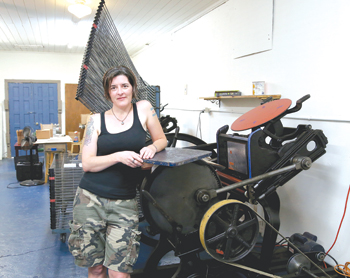
Wismer’s print shop, on Carolina Beach Road near Greenfield Lake, uses the original printing technology: raised type to print greeting cards, business cards and other work. Though the process has evolved over the past five centuries, Lady Pilot still does much of her work in the manner Johannes Gutenberg created in the 15th century, hand-setting individual pieces of metal type in a chase.
If you want to send an “Invitation to attend a wonderful celebration of life and love,” for example, it requires setting and aligning more than 60 individual letters and spacers. If you wanted text in different colors, you would need to reset the type between each color and clean the printing press.
Although Gutenberg used a screw-type press, Wismer uses a much more modern design of press. At only 107 years old, the Chandler & Price Pilot (the inspiration for the Lady Pilot company name) is the “newest” of her printing presses. Unlike another of Wismer’s presses, her “backup” 1897 C&P press, the 1907 model is motorized, adding a bit of technology to an otherwise manual operation. Though the inking and pressing process is powered by a small motor, there is no mechanism for feeding paper, so each card, invitation or flyer must be placed by hand on the platen.
For more complex designs that contain images, Wismer creates custom printing plates for each color separation. The process is similar to the original method of using hot lead to make a printing plate, but it uses a more durable and safer polymer material. Wismer uses various graphic design programs to prepare the artwork before sending it to another North Carolina-based shop that prints the negatives she will use to make the final artwork. From these negative films, Wismer uses the photopolymer platemaker in her shop to create a plastic plate, which is used to press her products. While many technological advances have been made, this process, called flexography, is still very close to its 1890 roots.
“There is not really new equipment that does the same thing, but the best part of using old equipment is the connection to the equipment. When using an old press you are really connected to the process,” Wismer said.
Letterpress produces a different result than more modern printing processes. Conventional printing methods of today lay ink or toner flat on the surface of the paper; letterpress printing actually presses the type and image into the paper, producing an imprint that you can feel.
Unlike printing that uses a four-color process, letterpress also cannot reproduce full-color images, such as photos, color fades, gradients or images that are too detailed.
But the combination of high-quality paper and spot color inks result in an impressive final product.
Wismer first fell in love with letterpress as a collector and English major, picking and saving characters that each represented a tiny piece of literature. After acquiring a small tabletop press, she printed as a hobby and to become more familiar and comfortable with the process.
After leaving a career as a schoolteacher to print full time, Wismer started as an apprentice, then managing Blue Barnhouse letterpress studio in Asheville. When Blue Barnhouse relocated to Wilmington in 2011, the presses were brought to Wilmington.
“The owner of the shop wanted to get out of the production end of it,” Wismer said.
So she bought the presses from Blue Barnhouse and started Lady Pilot. Wismer’s presses are made of solid cast iron and weigh between 800 pounds and one ton and require a great deal of care to move.
“They are cast iron, so they are really brittle,” she said. “I had a press fall out of truck once, and it completely destroyed the press.”
The majority of print runs are for Wismer’s greeting card line, although some printing is for clients’ custom work.
The cards feature a wide range of topics and images including Christmas sharks with Santa hats, dancing hot dogs and funny puns. Wismer produces a card for every occasion.
If you’re looking for the perfect card to tell someone you’re thinking of them (“Baby, let’s stay in bed and listen to some NPR”), you’re thankful for them (“I just wanna punch you with gratitude!”) or you love them (“I love you more than the internet”).
The cards are available online at
ladypilotletterpress.com or at handmade marketplace Etsy as well as locally at Edge of Urge and other retailers.