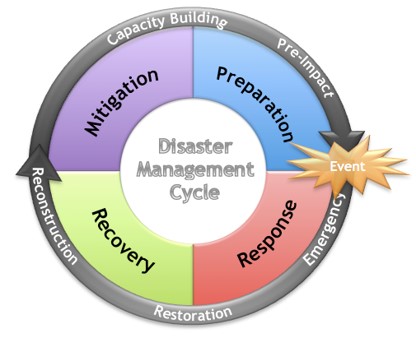
Ideally, Long Term Recovery Groups become permanent because communities are always in one stage of disaster management: Hazard Mitigation, Preparation, Response, or Recovery. (NHCR3 uses the term Readiness to describe Mitigation + Preparation)
Why do nonprofits work in silos and how can we unite to recover from Florence?
This is the second installation of a two-part series. Click here to read the first article.
Nonprofits confront some of society’s most difficult and pressing problems.
In many cases, the solutions can be most effectively developed and delivered by a single organization. With only one set of bylaws, procedures, and decision-makers focused on a single issue, nonprofit leaders can nimbly manage our resources and respond to changes in our environment.
For example, WARM’s one-and-only mission is to repair homes for low-income homeowners. When Florence blew through, we quickly organized our staff and volunteers into Tarp Teams and Assessment Teams to begin the hurricane recovery process.
Two months later, we have completed Hurricane Florence repairs for 15 homeowners and have another 16 underway.
However, repairing owner-occupied homes is only part of disaster recovery. For this reason, we are deeply committed to the Long-Term Recovery Groups (LTRG) forming in each of the counties we serve.
According to
National Volunteer Organizations Active in Disaster, the purpose of a LTRG is to “unite recovery resources with community needs in order to ensure that even the most vulnerable in the community recover from disaster.”
In practice, a LTRG invites nonprofits, churches, businesses, governments and other concerned citizens to the table. Representatives from FEMA and N.C. Emergency Management provide guidance, but locals run the group.
Here in the Cape Fear Region, faith-based communities have taken leadership roles in the formation of LTRGs. They have the strong hearts and brilliant minds required to unify and lead other leaders.
Each organization in the LTRG works in a committee based on our expertise (e.g., case-working, construction, education, etc.). As a group, we develop plans for holistically addressing community needs and provide a central point of contact for local government officials to call on community resources.
To be successful, I believe LTRGs need certain characteristics to attract and retain a diverse network of organizations whose personnel are accustomed to going it alone.
Valuable Benefits
Organizations are motivated to expend the extra resources required to coordinate with others when we believe in the benefits: resources are used efficiently, no one is overlooked, duplications are reduced or avoided, and the gaps are filled.
The New Hanover County Readiness, Response, and Recovery Network (NHCR3), which is the New Hanover County LTRG, is already realizing benefits. The City of Wilmington asked us to provide case management services at Jervay Communities when over
200 residents were issued a notice to vacate storm-damaged units.
Several NHCR3 organizations immediately sent personnel to help residents learn about local resources and understand their options. Everyone was served within a few days; no single organization could have done this alone.
Clear Purpose
Each LTRG creates its own leadership structure, bylaws, mission statement and goals. For example, the Brunswick County LTRG has already identified specific preparedness goals, such as setting up storage locations for relief supplies and developing a temporary housing plan.
Strength-based Planning
In the best partnerships, each organization is called upon to do what they do best and coordinate resources in ways that capitalize on our strengths. In our Construction/Housing Committees, WARM partners with agencies that do what we don’t do, such as housing counseling, furniture distribution, and new home construction.
The bottom line is Hurricane Florence presents an opportunity to create a network that will not only help get us back to normal but also has the power to make us stronger. By working together, we can better prepare for the next disaster and perhaps learn how to solve chronic social justice problems that are beyond the capacity of a single entity.
In the words of a Houston LTRG leader, “Don’t waste this disaster.”
Combining her professional experience in the Cape Fear region’s housing and real estate for-profit sector and volunteer experience with disaster recovery and housing-related nonprofits, JC Lyle (formerly Skane) was hired in 2009 to serve as the executive director of Wilmington Area Rebuilding Ministry (WARM). WARM is a grassroots nonprofit whose mission is to make homes safer by completing urgent repairs, accessibility upgrades and storm damage. Under her leadership, WARM has steadily grown from serving 44 households in 2008 to 155 households in 2016. Her public recognition includes Wilma Magazine's 2012 Woman to Watch in the Nonprofit Category, a 2014 Coastal Entrepreneur Award in the Nonprofit Category, given by the Greater Wilmington Business Journal and UNC Wilmington’s Center for Innovation and Entrepreneurship, and invitations to speak at NC Center for Nonprofits Conference and NC Affordable Housing Conference. She will graduate in May with her Master of Business Administration at UNC-Wilmington.