Travel along Interstate 40 from the congested maze of roadways that criss-cross Wilmington, and the landscape quickly transforms into a postcard scene of pure North Carolina country living.
Fields filled with grazing livestock and bumper crops of soybeans and corn provide a glimpse of simpler years when growing and raising what you ate was more convenient than a trip to the market.
But it may not be what’s growing on the surface of such acreage that has area brokers taking note.
Along the fringes of metro Wilmington, from Shallotte to Sandy Creek and from Burgaw to Currie, agricultural land prices and sales are surging– a product of rapid urban sprawl and higher commodity prices.
But despite the surge in land prices, brokers and agricultural bankers say the rural areas of greater Wilmington will not experience anything like the real estate bubble that preceded the housing crisis in 2008.
“Things are picking up,” said Frank Efird, Jr., a broker with Wilmington-based Efird-Morton Commercial Real Estate that currently represents the sellers of Foxmoor Farm, a 55-acre farming estate on Blueberry Road in Currie. “We do see people out of state that are seeing the light at the end of tunnel, and are looking at investing in the South.”
Land grab
Eric Bonnett, managing director of Netherlands-based Rabobank’s Rabo Agribusiness Finance division in St. Louis, said rapid development from the region’s core cities, and localized pockets of farm growth in the region, are hiking agricultural land prices.
“When we look at property, the agricultural values are elevated in North Carolina,” said Bonnett, whose division specializes in financing the purchase of agricultural land and farm equipment to a number of farmers in greater Wilmington. “Development pressures can contribute to agriculture land price increases, and sale comps and raw land changes can also drive prices up.”
Prior to the Great Recession, most real estate land transactions slowed across the region, but that began to change in late 2010.
Since the first quarter of 2010, grazing pastures and farmland have begun to sell, fetching exorbitant prices ranging from $3,500 per acre to as high as $10,000 per acre. That’s up from $1,200 and $3,500 an acre more than four years ago, according to local data collected from real estate tracking firms LoopNet and CoStar.
According to the reports, more than 1,700 acres of farmland have been sold in 26 agriculturally based land transactions between October 2010 and August 2013 in the greater Wilmington area. Many of the tracts sold range from 11 acres to more than 250 acres.
That amounts to roughly 74,000,000 square feet of land that could be repurposed for new or expanded agricultural growth, or to be converted into recreation or development parcels to meet future demands, Efird said.
Four more transactions totaling 1,293 acres of agricultural land are pending in the region.
Many of the transactions are occurring in southern Brunswick County and northern and eastern Pender County, according to the reports. New Hanover County has a couple of remaining farm tracts along its border with Pender County that have also sold.
But while agricultural land sales and prices are on the increase in the immediate area, that’s even more true in neighboring counties to the west.
W. Grayson Powell, managing partner and broker with Wilmington-based Coldwell Banker Commercial Sun Coast Partners, said areas such as Columbus, Bladen and Duplin counties are also fetching high prices.
Soaring demand
One main driver of the growing price of agricultural land is high crop prices.
Corn has seen its cost per bushel soar to nearly $7, reflecting demand overseas and increased use domestically for ethanol.
Wheat and soybeans are also seeing their value per bushel rise, prompting farmers to grow more and sell their crops at higher prices.
Bonnett said the jump in commodity prices has given farmers more cash on their balance sheets, allowing many of them to purchase neighboring farms, or seek additional land to expand and upgrade with better equipment and room for future growth.
In other cases, farmers are updating an existing livestock facility, which is also helping to fuel land prices because of the new technology being implemented on the site.
“In a lot of cases they are buying dated hog and chicken production facilities because of the moratoriums,” Bonnett said. “Some farmers will come in on that same footprint, and will convert the older technology to newer technology and expand the acreage.”
Since 2010, North Carolina has seen a 6.2 percent increase in the number of factory-farmed hogs, despite the state’s 1997 moratorium on building new Concentrated Animal Feeding Operations (CAFO), according to a N.C. Cooperative Extension Service report.
Bonnett added that farmers who are contracted by major investors or food-based companies like Frito-Lay and Smithfield are also helping to fuel land prices by reinvesting in their farms to meet the production demands stipulated in their contracts.
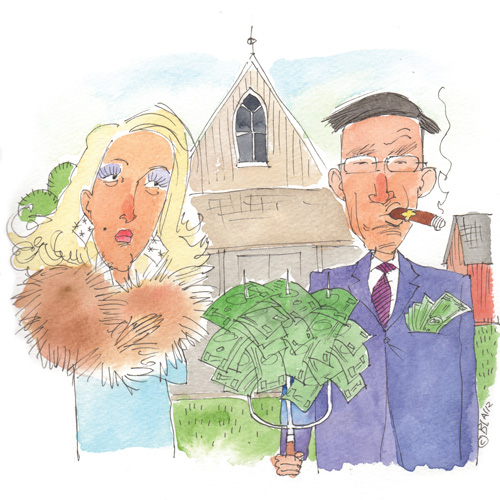
Other farmers are simply giving up the family farm in the hopes of selling high to a developer looking to add more housing or commercial inventory to the region.
Warning signs?
So will the continued selloff and price rise of agricultural land help create the region’s next unwanted real estate bubble?
Not likely, according to a number of area brokers and agricultural lenders.
However, for over-zealous individual farmers, as well as rural farming banks, the repercussions could be severe – especially if commodity prices tank, and the demand slows for new development.
Federal officials signaled such a warning nearly two years ago when land prices began to increase.
The Federal Deposit Insurance Corporation held a symposium in Arlington, Va., for bankers, regulators and investors called “Don’t Bet the Farm: Assessing the Boom in U.S. Farmland Prices.” The FDIC warned lenders and farmers of
the danger that over-lending and expansion could have on their banks and farms.
But that hasn’t stopped lenders, farmers or investors from doling out low-interest loans.
Debt held by the nation’s farmers has risen nearly 28 percent since 2007, to an expected $277.4 billion this year, according to the FDIC.

'Best Places To Work' In Wilmington Recognized
Staff Reports
-
Oct 13, 2026
|
|
Business Journal Announces WilmingtonBiz 100
Staff Reports
-
Oct 13, 2026
|
|
Bitty & Beau’s Expands Mobile Coffee Franchise Network
Cierra Noffke
-
Oct 12, 2026
|
|
Fox Named Partner, Summerlin Vp At Sun Coast Partners Commercial
Staff Reports
-
Oct 13, 2026
|
|
Landscape Equipment Business Buys Property In Winnabow, Opens New Location
Cece Nunn
-
Oct 12, 2026
|
|

“Our vision is to create a mini-golf experience that becomes a welcoming space for everyone who enjoys a fun adventure with friends and fami...
New buildings have opened or will soon open in Burgaw this year to support growing Pender County, including a new law enforcement center and...
Support for the lower, movable-span bridge dominated spoken comments at the public hearings, and city officials have thrown their support be...

The 2026 WilmingtonBiz: Book on Business is an annual publication showcasing the Wilmington region as a center of business.