When Built Environments relocated to Wilmington, the firm’s partners weren’t looking for the lazy tranquility one hopes for when on vacation.
Instead, they sought sultry heat. They wanted to understand whipping coastal winds and punishing precipitation – the kind that tropical storms produce. That’s because how materials degrade can reveal a lot about how they can be improved.

“We specifically chose the Wilmington market because it does fall within Climate Zone 3A, which is a coastal warm-humid climate,” said Jarrett Davis, who joined Built Environments in 2023 to lead the company’s building science practice. “There’s not a lot of product research in that climate zone, but there are a lot of structures here that get weatherized pretty severely.”
Built Environments has provided building science, material testing and code compliance consulting for 25 years, ever since principal materials scientist Steve Doggett founded the company in Minnesota.
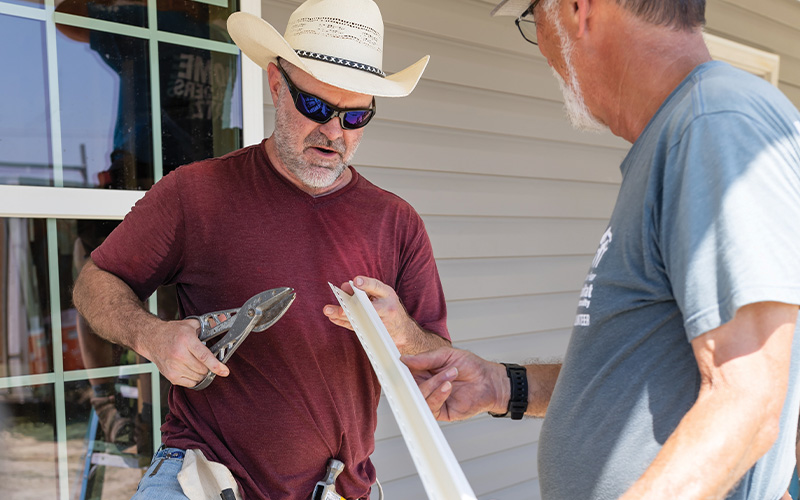
“There are very few manufacturers that understand fully how their own materials and products work, whereas we know their shortfalls and their benefits out in the real world on jobsites,” Doggett said. “That’s why the original Built Environments was formed, to make buildings better.”
He said the 15-employee company is just as comfortable on a jobsite, retrofitting a high-end beachside property, for example, as it is recreating some of the coast’s most intense weather conditions in the great indoors.
The company operates an A2LA-accredited ISO/IEC 17025 mechanical testing laboratory on Wright Street. The year-old facility has expanded Built Environments’ in-house capabilities, Doggett said.
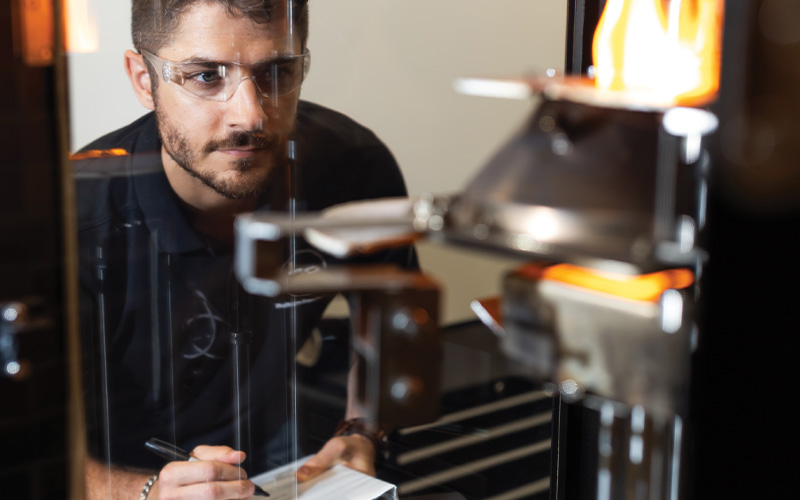
“We’re able to simulate that hurricane wind (and) rain and perform structural and impact testing on wall assemblies, roof assemblies and glazing assemblies,” he said. “There are certain requirements that those windows and doors need to meet as far as wind ratings and pressure ratings and things of that nature.”
Standard Glass Co.-Glass Depots, of Wilmington, is currently testing a new glazing system using Built Environments’ stress testing, the partners said. One method involves what’s called a “large missile cannon.”
“We take 8-foot two-by-fours, and we shoot them at assemblies, so they have to withstand that impact,” Davis said. “It’s pretty cool to see, I’m not going to lie.”
In many cases, the lab can run a full, wall-scale test of a product in a matter of weeks or months, whereas “it might take midrange manufacturers years,” Doggett said. “We’re nimble. We can cut that time in half.”
The lab also develops intellectual property. Doggett, for example, shares a patent with Sustant LLC, of Minnesota, on a fastener patch to increase the air and water tightness within building envelopes.
“We have too many ideas and not enough time,” he said.
But the partners noted that they or their fellow principals – of which the company has four total, including a principal engineer and a principal codes and standards expert – could be anywhere on a given day, including in the courtroom providing expert testimony in contentious insurance cases.
“Let’s say there is a fire on a structure,” Davis said. “We can analyze all the specific materials within that assembly – an exterior wall or something like that – because there are loads that require certain heat release. And so, we can measure each one of those materials, if need be, to say if this was likely or not a code-approved assembly.”
Despite what can be inferred in a lab, the partners said nothing beats learning from how materials change over time under real-world strain.
Take, for instance, the curious case of the creaking condo.
“We recently had a customer that came to us trying to assess a sound issue of a roof. It was making noises that no one could explain or account for. How do you tackle something like that?” Doggett asked rhetorically. “There’s really no generally agreed-upon methodologies.”
The problem turned out to be a faulty installation of a commercial roof system.
“The building in this particular case was not local,” he said. “In the initial installation, the commercial roofing contractor installed the wrong fasteners in the wrong locations into the deck, and essentially the solar radiation was causing the building to move quite substantially early in the morning when the sun initially hit that assembly after a quite cool evening, causing the threads on the fasteners to kind of jump within the material, within the metal.”
Built Environments designed an effective repair methodology that was within budget, the partners said.
“We get the bizarre,” Doggett said. “I will say that’s something that has stayed the same over 25 years.”
The partners said they are hiring, and that Cape Fear Community College is one of their main recruiting grounds. Davis and Doggett look for talented people who can understand traditional methodologies yet are open to on-the-job training and new understandings, they said. After all, it’s not just weather that can ruin a building.
“My favorite saying is,” Davis said, “‘What are the eight most expensive words in construction? That’s how my daddy used to do it.’”