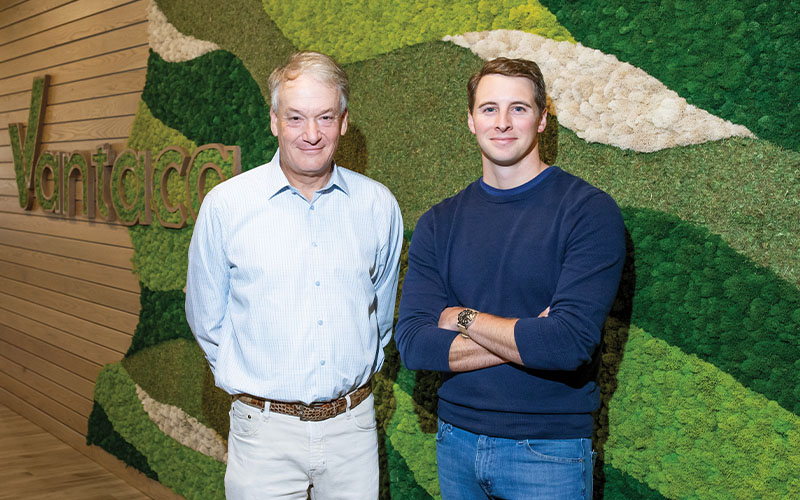
When Dave Sweyer looked around a little over a decade ago, he couldn’t find what he needed to expand his community association management company to the level he wanted.
“This is a very fragmented industry, typically small mom-and-pops. And that was intriguing to me, because I thought, ‘What will it take to grow a much larger organization?’ Because as you grew, a lot of the elements of the business became more profitable, more successful, and so it was definitely something worthwhile to pursue. And the governor of my growth always was technology,” Sweyer said. “I could never get the kinds of efficiencies or create the kind of service or interact with my customers – homeowners – like I wanted to. And so, I was always limited by what technology offered.”
Sweyer, former owner of Wilmington-based Community Association Management Services (CAMS), and his employees tested what options they could find.
“Then we got to a point where we were like, ‘It doesn’t exist,’” Sweyer said. “‘The things that we ultimately want for our purposes don’t exist. Let’s go create our own.”
That’s how Vantaca was born.
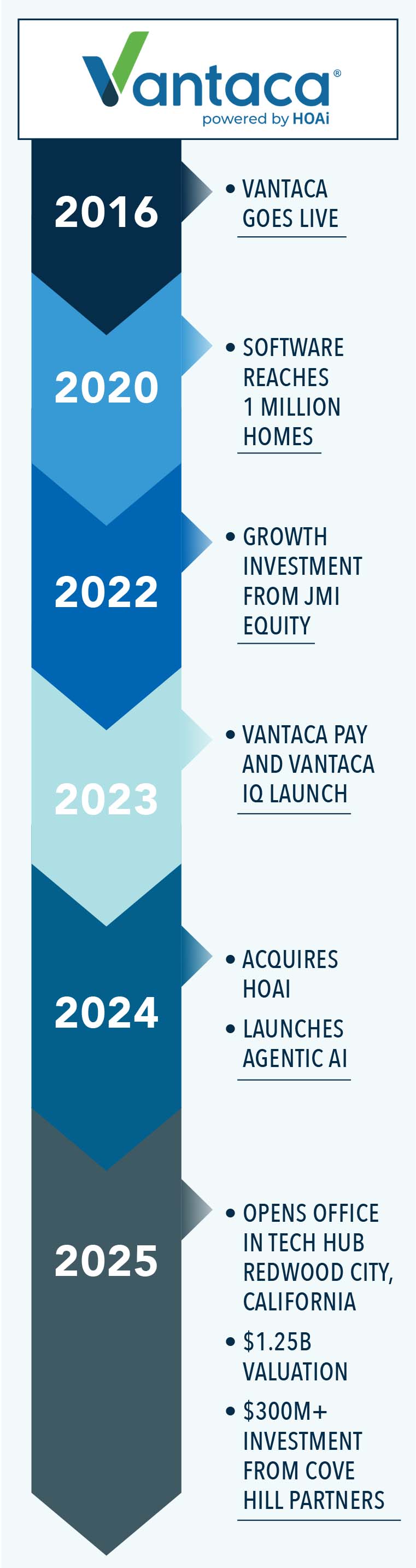
A software firm that integrates core community association management tasks – everything from dues collection to homeowner communication – into one cloud-based tool, Vantaca went from a spark in Sweyer’s brain to a financial unicorn valued at $1.25 billion with a more than $300 million minority investment in hand.
Nearly 10 years ago, Sweyer, two software developers and three CAMS employees spent about a year building the software, finding many mistakes during those early days.
“But the good news is, on a day-by-day basis, we incrementally addressed every little thing that was causing us problems, and it caused us to move at lightning speed to get it right,” Sweyer said.
Lisa Turner, founder, president and CEO of Silverleaf Management Group, became Vantaca’s first external customer in 2017.
“I didn’t want just a software platform,” said Turner, whose community association management firm is based near Atlanta. “I wanted a partner in what I was trying to accomplish, and that is a better way to manage community associations.
“They were unlike any other software provider,” she added. “They were invested in understanding how we as a company were operating and what we needed to grow and scale as an organization.”
Turner remains a Vantaca customer, and her firm continues to grow, she said. Her company had just under 60 community and homeowners associations when Silverleaf first started using Vantaca. She anticipates the number surpassing 260 by the end of 2025.
“We’ve had another record-breaking year. … We’ve implemented some of Vantaca’s new AI solutions, and in so doing, have been able to stretch our team a little bit. … We didn’t eliminate (any of Silverleaf’s workforce); we just expanded it and elevated it and added some value back to what we were doing,” Turner said.
As of press time, Vantaca had 500 management company clients, representing 50,000 community and homeowners associations and 6 million homes, said Vantaca CEO Ben Currin.
With its headquarters located on Wrightsville Avenue in Wilmington, not far from Wrightsville Beach, more than half of the firm’s 275 employees are in Wilmington.
From the beginning, Sweyer said, he felt 100% confident that the company would succeed “because the industry was really starving for a solution like Vantaca.”
Currin said the software doesn’t just serve “one little component of what a community association management company needs. We’re not just the portal that their homeowners use to submit requests. We’re not just their billing engine, we’re not just their accounting software, we’re not just their communication software – we’re all of those things for them. So really, everything in the back office of a community association management company happens within Vantaca. If it doesn’t happen in Vantaca, it’s really not happening in their business.
“Oftentimes,” he added, “we’re replacing what we’ll refer to as kind of the Frankenstein approach to all of that.”
On Oct. 15, Vantaca officials announced that the company had received a minority growth investment of more than $300 million from Boston-based private equity firm Cove Hill Partners.
“For us, we’ve been doubling in size and growing at a very rapid rate, and we still forecast in the future that we’ll grow at a very, very outsized rate. And so, it just takes capital in those interim years to really fuel that growth, and so we’ll use that capital primarily to hire talented people,” Sweyer said. “It takes a lot of talented people to continue to do what we do every day.”
Jane Levy Vance, co-founder and partner with Cove Hill Partners, said that for her company, “Vantaca represents the rare combination of market leadership, technological innovation and exceptional execution that we believe defines category-winning companies. We believe their AI-first approach has sustainable competitive advantages and delivers significant value to customers.
“We’re excited to partner with the Vantaca team as they scale their platform, introduce new capabilities and expand into new markets.”
Cove Hill Partners joined JMI Equity, which was Vantaca’s existing minority investor, in supporting the company’s vision and next phase of growth, officials said.
Cove Hill wasn’t the only firm interested in placing a big bet on Vantaca. In early November, Sweyer said roughly 25 firms had expressed interest in making such an investment in Vantaca.
Neither Currin nor Sweyer was interested in selling the company.
“Early on, we were always swinging really big. So, we had really big ambitions about what was possible. And that’s probably the thing that in the very early days drew Dave and I together, as we both saw a huge opportunity here,” Currin said.
Currin started at Vantaca in 2017, serving in various executive-level strategy and operational positions. In 2020, he became CEO, and in 2022, Vantaca raised $5 million from 16 investors. That same year, JMI Equity, a private equity firm based in California and Maryland that focuses on software companies, made an undisclosed investment.
“They’ve been awesome partners to us,” Currin said. “It was really important to us to maintain control of the vision of where we want to go and the strategic direction for what our company goals are, rather than sell the company to a private equity firm for them to then run kind of the private equity playbook and get a return for that firm. It was important for us to do that, and so we brought that same mindset to this transaction (with Cove Hill Partners) … to say, ‘OK, we want to do this, but we want to add fuel to the fire, add capital into the business, to capitalize the business in a way that we can continue on that mission and maintain control and confidence over our long-term direction.’”
Vantaca has appeared on the Inc. 5000 list of the fastest-growing private companies in the U.S. for the past five years. According to Inc. Magazine’s annual list, Vantaca ranked No. 1,575 in 2025, reporting 278% growth over the past three years. Vantaca also reported a revenue range of $25 million to $50 million and 133% growth in hiring.

The company continues to move forward, Currin and Sweyer said.
“We’re thinking really big about the next 10 years. I think one of the lessons we’ve certainly learned over the past seven or eight years has been the quality of the team and the people that we build will define the company that we build as well,” Currin said. “And so, we want to go recruit and retain and promote the best possible people we can and create an environment for them to be successful.
“So we’ll be hungry to go get great talent.”
A big part of Vantaca’s offering today is generative AI, Sweyer said. “In addition to developing and delivering that for our customers, we’re a big user of that internally,” he said.
Currin said AI is replacing inefficiency, not human labor.
“There’s so much inefficiency in how we work and how we spend our time, what we’re constrained with, and that’s where we go to attack those problems for our customers,” he said. “But internally, we look around and do the same thing and say, ‘Where’s the inefficiency in doing this? What could we delegate to AI?’”
Sweyer added, “I think for us, it’s really become more of an enablement to bigger opportunities. I think our message isn’t so much that we don’t anticipate hiring a lot more people. We’re creating new marketplaces and new products to expand our business. And we’re now hiring people into those businesses that we didn’t perfectly envision in 2016.”
In 2024, the company acquired HOAi, a California-based firm that provides AI technology for the HOA and community management industry, including tools to streamline financial analysis and automate document management. During the summer of 2025, Vantaca opened an office in Redwood City, California, a technology hub in the San Francisco Bay Area.
Sweyer and Currin see more growth ahead.
“I think the interesting thing about the most recent investment (from Cove Hill Partners) is the conviction that very sophisticated investors have that Vantaca has an even brighter future than where we are today. We’re massively proud of this moment and what we’ve accomplished,” Sweyer said. “They’re not investing for today. They’re investing in the future potential of this company, and that’s awesome for us. That gives us even more fuel to go after a much bigger future.”