Recent maintenance closures of the Cape Fear Memorial Bridge have given cross-river commuters a taste of what future traffic gridlock might feel like. Even under normal conditions, it’s slow going for drivers during rush hours on both that bridge and the Isabel Holmes Bridge.
Increasing bridge capacity has been on the region’s transportation agenda for several years. It will be the topic of a Nov. 26 workshop hosted by the N.C. Department of Transportation (NCDOT) for the Wilmington Urban Metropolitan Planning Organization (MPO) and its Transportation Advisory Committee (TAC).
Discussion will center on two primary options for increasing river crossing capacity, said Jennifer Harris, project development engineer with NCDOT. One option is to build an additional bridge, either north or south of the Port of Wilmington. The second is to replace the Cape Fear Memorial Bridge with a bridge that can handle more traffic. A variation on that second option is to add onto the current bridge, but Harris said she wasn’t sure how feasible that would be.
Traffic over the Cape Fear will only increase. The Wilmington urban area population, which was 221,755 in 2008, is forecast to rise to more than 326,000 by 2020 and to nearly 419,000 by 2035, according to the MPO. In planning terms, those benchmark years are just around the corner, given that transportation projects take years to complete.
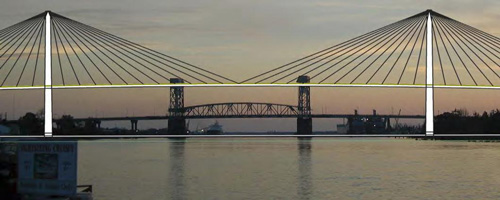
Until its prospects sank a couple of years ago, the favored bridge option was the Cape Fear Skyway, a proposed 9.5-mile toll connector between U.S. 17 in Brunswick County and a location near the intersection of Carolina Beach Road and Independence Boulevard in Wilmington. It included a new high-rise bridge over the Cape Fear River.
The Skyway was touted by planners as the best way to improve the flow of traffic and freight across the river, to speed evacuation in the event of a hurricane and to enhance vehicular access to the Port of Wilmington.
Skyway plans, with several alternate routes and a preferred bridge design, resulted from studies and projections of roadway capacity needs. New state legislation in July 2008 allowed for the corridor to operate as a toll road to address construction and maintenance costs.
Elected officials in Brunswick and New Hanover counties, as well as the TAC, gave the Skyway a nod of approval. In preparation for the Skyway’s construction, officials on both sides of the river placed a moratorium on development of land around each potential bridge terminus.
Then the project stalled.
The primary problem with the Cape Fear Skyway was its cost, projected at about $1 billion. Cost calculations showed that revenues from tolls would fall short of expenses of debt service and maintenance by roughly $50 million per year. Funds to cover the deficit would be needed for 40 years. The N.C. legislature, during its 2010 short session, declined to include this “gap funding” in its budget.
Leland’s then-mayor, Walter Futch, spoke up against the project, saying that he and many Leland residents questioned the cost and even the need for the additional corridor. Futch voiced concern about the preferred route for the Skyway, which would bisect Leland, encroaching on a housing development currently in the planning stages. NCDOT officials said they would not pursue the Skyway project if local residents opposed it.
With new leadership, Leland’s position has changed somewhat.
At its Aug. 13 meeting, the Leland Town Council agreed to push for the bridge adjacent to the Cape Fear River Memorial Bridge.
Leland Mayor Brenda Bozeman sees another option as well. “Additional crossing capacity will be achieved, first and foremost, if an emphasis is made on an expedited completion of the I-140 bypass before the commencement of the causeway widening,” she said. “Completion of I-140 will provide a third river crossing. The Skyway, as it was originally intended, is no longer viable.”
Bozeman added that she and other council members “are eager to listen to new strategies outlined at the upcoming workshop.”
MPO director Mike Kozlosky cautiously talks about the project formerly known as Cape Fear Skyway, calling it “a crossing over the Cape Fear River.”
“The Cape Fear Skyway name recalls a billion-dollar bridge structure,” he said. “Now, we’re trying to achieve the best solution for crossing the river in the most efficient way.”
“The Skyway nomenclature is passé,” said Wilmington City Council member Laura Padgett, who is also a member of the TAC.
Because of the width and depth of the Cape Fear River near the port, the only realistic bridge design is a cable-stayed bridge, Padgett said. The design would require a large tower or column to be built on each side of the river, with cables extending down from the tower to support the bridge deck.
Padgett said cable-stayed bridges were complex structures and not inexpensive to build, but she was hopeful that there were ways to shave some costs.
“DOT has been working on reducing costs through value engineering, but the structure should not be too cheap or be an eyesore,” she said. “Hopefully, we’ve driven home the need for an additional crossing of the Cape Fear. There’s no way to build one without sacrifice for somebody, especially as our community is built out.
“On the face of it, a partner bridge option [adding to the Cape Fear Memorial Bridge] is cheaper, but there are possible hidden costs,” Padgett added. “When you put it all together, you don’t come up with a huge difference in cost, I don’t think.”
There’s another wrinkle, Harris points out: the state’s toll legislation specifies that tolls can be levied only on new roadways. Even if the Cape Fear Bridge were replaced, that structure might not be considered “new” and therefore could not charge revenue-producing tolls.
Basically, the goal was to develop the best transportation solution for moving people and freight across the river, Kozlosky said, and that’s what planners and local officials will be discussing at the Nov. 26 workshop.
“There are many questions that need to be asked,” Padgett said about the upcoming workshop. “Hopefully, we’ll get more concrete, definite information. We’ll leave the work session better educated and prepared to give DOT our support.”

In Lawsuit, Luxury Homebuilder Accuses Defendants Of Defamation
Cece Nunn
-
Jun 5, 2026
|
|
Endowment Appoints New Community Advisory Council Members
Staff Reports
-
Jun 3, 2026
|
|
From A Grocery Store To Convention Center Growth, Officials Talk Downtown Priorities
Emma Dill
-
Jun 3, 2026
|
|
Endowment Fields Questions On School Bond, Food Co-op Funding At Public Meeting
Cierra Noffke
-
Jun 4, 2026
|
|
Amid Recent Sales, Independence Mall Owner Talks Real Estate Strategy
Emma Dill
-
Jun 4, 2026
|
|

Biggers Market’s roots run deep, tracing back to the 1940s when founder and partner Sven Wallin’s grandfather, alongside his brothers, opene...

While construction on projects like the Greenville Loop Trail, Greenville Loop Park and Wrightsville Beach Bridge Replacement causes short-t...

Meet this year's Coastal Entrepreneur Award winners, from manufacturing to technology....

The 2026 WilmingtonBiz: Book on Business is an annual publication showcasing the Wilmington region as a center of business.