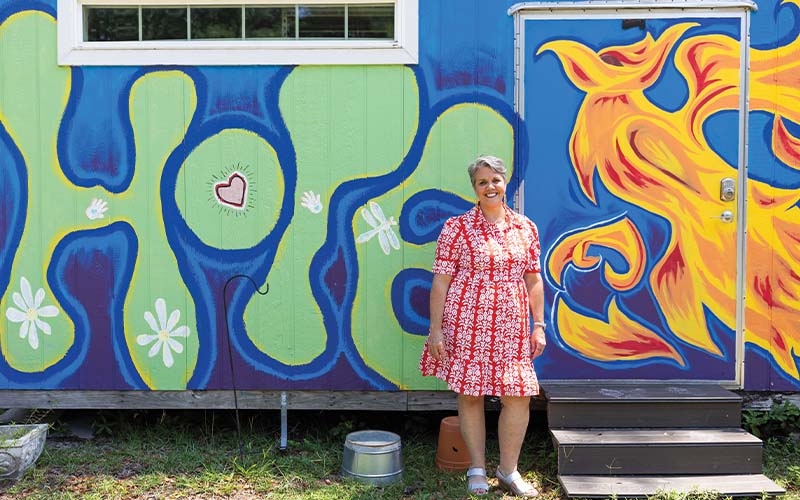
For a decade, Meg McBride lived by the unofficial U.S. Postal Service motto: “Neither snow nor rain nor heat nor gloom of night stays these couriers …” But when the Pennsylvania letter carrier moved to Wilmington in 2011, she traded her mailbag for a different kind of delivery.
Today, McBride serves as a courier of hope and care, guiding individuals through the challenges of substance abuse recovery.
After years of working jobs in social work, ministry and recuperative care in and around the Lower Cape Fear, the mother of two grown sons – herself recovering from a substance use disorder – landed a position in 2020 as pastor of Hope Recovery Church. Officially known as Hope Recovery Faith Community and affiliated with The United Methodist Church (UMC), Hope Recovery is a faith-based nonprofit organization in midtown Wilmington that provides gathering space, support and hope for people with substance use disorders.
“Hope Recovery is a church-plant, or new church startup, that started in July 2020,” said McBride. “As we began our work, we had a few dedicated people who were interested in starting a church for people in recovery and a check for $7,500.”
Then the COVID-19 pandemic hit, said McBride, a licensed local pastor in the UMC. “During that time, I was able to focus on my own spiritual formation practices, which was a real gift and prepared me for what was to come,” she said.
But that preparation wouldn’t have been possible without her past. On McBride’s postal route, she may have suffered through snow, rain, heat and gloom of night, but these inclement elements took on a whole different meaning in her private life.
“My earliest addiction memory was food when I was 3 years old,” said McBride. “I didn’t like nursery school, so my grandmother would come home and feed me and put me in front of the TV. The feeling of watching TV and having snacks was soothing. Then I discovered alcohol when I was 16.”
At 19, McBride got pregnant. Her husband, a hemophiliac with countless blood transfusions over his lifetime, learned he had HIV. The demands of early parenthood, the lack of resources and a spouse with a terminal illness eventually resulted in a divorce, which drove McBride to drink even more.
“So I bought a house, and I thought that that was, like, gonna be it,” she said. “Like, if I could buy a house, then I’m OK.”
But things weren’t OK. Within days of moving in, everything went south.
“I opened the refrigerator to get a beer at 10 o’clock in the morning,” said McBride, “and I had a (convicting) voice telling me something like, ‘You need to go to Alcoholics Anonymous and get help for this. This isn’t working anymore,’ so I got a sponsor and started seeking recovery … you know, old-school style.”
Funded by donations, offerings and grants, Hope Recovery is permanently housed in the former Devon Park United Methodist Church and hosts more than 25 weekly recovery meetings at various times. Meetings combine faith and peer support, utilizing the Alcoholics Anonymous 12-step recovery program. Weekly “11th Step” style gatherings offer side-by-side study of recovery steps and scripture with group sharing and informal conversation.
Meetings are free and open to anyone, including the pastor. McBride said, “As a member of Alcoholics Anonymous, I will attend the meeting, which gets a little weird sometimes because people are like, aren’t you the pastor here?”
She estimates between 1,500 and 2,000 individuals in recovery walk through Hope Recovery’s doors weekly.
According to McBride, the recovery program’s uniqueness lies in its format. Rather than a formal Sunday service, it features a midweek dinner and a recovery discussion that she leads. “We’re kind of like a meeting and sort of like church,” she said. “Most of them don’t see me in a pastor role, right? They just see me bopping around the building and know that I have an office,” she said. And it wasn’t the first time McBride had made the rounds inconspicuously.
McBride reflected on her letter carrier days: “The weather was terrible, right? But on the most beautiful days, I got to be outside all day. When I think about why I was at the post office for so long – you know what it taught me? It taught me to be in the neighborhood and pay attention.”
And she did just that.
“I knew every single person that lived on my mail route by name and address,” said McBride, “and they would come outside and confess things to me because I was a neutral person, right?”
McBride remembered one woman in particular.
“She lived on West 27th Street, I think. She’d say, ‘I’m getting ready to go lay down, and I want you to have this,’ and she would give me things from out of her house,” said McBride. “Within a year she died.”
Today, McBride’s ministry is on Winston Boulevard in a low-profile brick building with a community garden and fire pit in the back. It isn’t, in the grand scheme of things, that far from the house on 27th Street and all those along her mail route.
“I cared about my people. If I saw something that didn’t look right, I’d call or tell someone,” she said. “It made me aware of people, people that were going through things.”
Read more on Nonprofits & Fundraising:
Nonprofits Navigate Funding Shifts
Nonprofits Stretch to Meet Food Need
OPINION: A Look at What Nonprofits Need to Succeed
Habitat Chapters Expand, Explore Merger
Pastor Helps Those with Addictions