Uncertainty surrounding tariffs is driving current trends in the logistics sector, according to Brian Webb, president of port services at NFI Industries, a transportation and warehousing company with operations in Wilmington.
Since taking office earlier this year, the Trump Administration has implemented tariffs on imported goods from several countries to incentivize U.S. manufacturing and production.
Recent trade deals included a 15% levy on most imports from the EU and a 15% tariff on Japan – both struck days before the tariffs deadline of Aug. 1 was expected to go into effect for dozens of countries.
The deadline came after earlier delays but Trump administration officials said, as of press time, it wouldn’t be pushed back again.
Tariff talk has shaped recent day-to-day trends in the logistics sector, which helps transport goods from producers to consumers. NFI Industries, for example, saw its product volumes climb this spring because of the proposed tariffs, according to Webb.
“We experienced our peak early as shippers raced to get freight into the United States prior to the tariffs going into effect,” Webb wrote in an email to the Business Journal. “With the easing of the tariff percentage, there is an effort to balance inventory levels while anticipating how the consumer will behave with all of the market uncertainty.”
As of mid-July, the company remained “below normal non-peak volumes and well below peak volumes from last year,” Webb added.
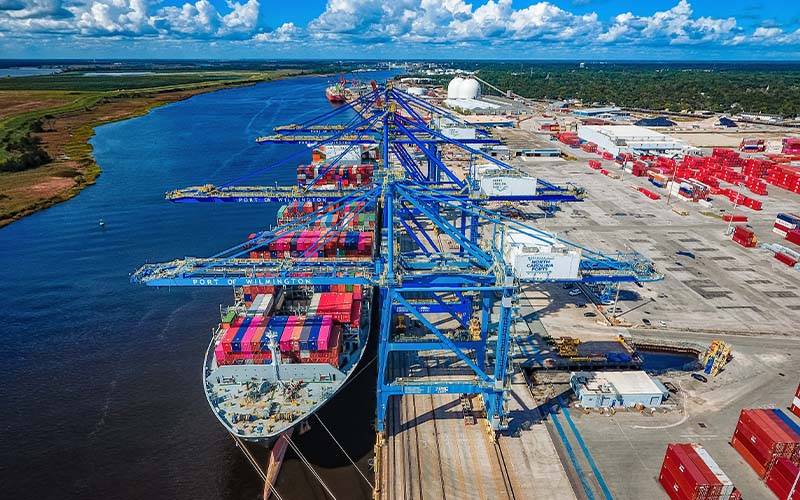
Ripple effects from the proposed tariffs are also playing out in the cargo values coming through Wilmington’s port, said Mouhcine Guettabi, regional economist with the University of North Carolina Wilmington’s Swain Center. The customs value of imported cargo coming through the port has been “bouncing around quite a bit” this year, he said. The latest U.S. Census Bureau data available ahead of publication was from May.
“In May of 2025, the value of the imports was about 15% lower than it was the previous year,” Guettabi said, “but it had jumped up a lot in February, which tells you that people were maybe trying to jump the tariff.”
The customs value of cargo moving into the Port of Wilmington increased from $1.2 billion in January to $1.4 billion in February, according to U.S. Census Bureau data. The value of imports spiked in March to $3.6 billion and then fell in April and May to $1.9 billion and $1.6 billion, respectively.
Since many of the tariffs discussed by the Trump administration are country-specific, tariffs impacts are largely dependent on a product’s origins. Wilmington’s port receives the most goods, based on value, from Ireland and China, Guettabi said. Other top importers include Germany, the UK and Nicaragua.
In a recently released recap of the past fiscal year, N.C. State Ports Authority Executive Director Brian Clark acknowledged the uncertain trade environment.
“Last year and forward-looking, obviously, there’s a lot of uncertainty,” he said. “The global trade dynamics are changing by the day almost, but through it all, we still had some very positive marks this year from an intermodal volume standpoint.”
Clark pointed to year-over-year growth in the port’s intermodal and general cargo volumes. He also noted ongoing projects aimed at increasing the port’s capacity and efficiency, including a new intermodal rail yard and a new north gate for the general cargo facility. Both are “well underway” and scheduled for completion in the coming year, he said.
Wilmington-based MegaCorp Logistics, a firm that acts as a middleman between goods producers and trucking carriers, is seeing a surge in demand for warehousing, “as businesses stockpile inventory in U.S. bonded facilities or shift production closer to home in anticipation of rising tariff-related costs,” according to Cameron Hughes, a marketing assistant with MegaCorp.
Proposed tariffs on automotive parts, steel, aluminum and electronics are driving up import costs and “squeezing profit margins across the logistics sector,” Hughes wrote in an email.
“In addition, a universal 10% reciprocal tariff and proposed duties on items such as pharmaceuticals, lumber, semiconductors and aircraft parts have introduced new layers of uncertainty into cost forecasting,” she wrote. “As a result, more companies are turning to domestic warehousing and increasing their inventory to hedge against future tariff impacts.”
Third-party logistics company Precision 3PL responded to ongoing demand by growing its local footprint. The company recently moved into a 214,000-square-foot warehouse space on North 23rd Street, nearly tripling the size of its former 72,000-square-foot facility.
Third-party logistics companies provide outsourced logistics services to businesses, managing day-to-day order fulfillment and shipping logistics.
McKenna Phillips, the company’s vice president of operations, said officials opted to make the move despite tariff uncertainty because it would help accommodate demand the company is seeing for 3PL services.
“The potential’s here, the opportunity is here, the appetite for 3PL services hasn’t diminished,” she said, “and so we decided to go ahead and do it and expand.”