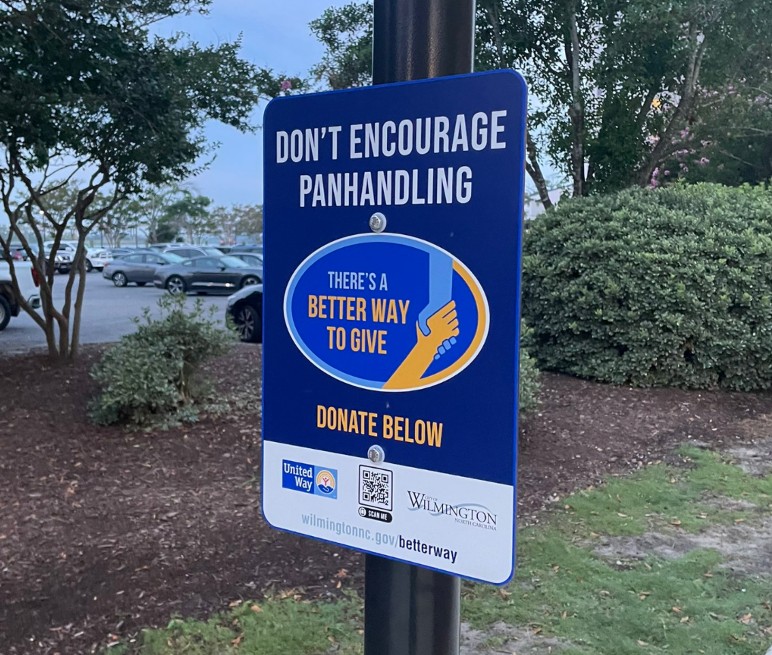
The city of Wilmington has launched an initiative to discourage panhandling in the downtown area. Newly posted signs ask residents and tourists to refrain from giving handouts, advising them that “[t]here is a better way to give.”
That way to give is through a new partnership between the city and United Way of the Cape Fear Area (UWCFA) designed to address the needs of homeless people and those who are looking for work. The United Way has established a fund to address critical needs of short-term shelter, food and health care: a QR code on the signs enables a person to make a donation to that fund rather than to offer money to a panhandler.
“The account is set aside to address gaps in services,” UWCFA CEO Tommy Taylor said Friday.
Contributions to the fund will expand the capacity of places like Mother Hubbard’s Cupboard and other direct service providers, he said, adding that shelter availability is especially strained since the Salvation Army shelter closed this spring.
If a person asking for money has access to a phone, they can be encouraged to call 211, a multi-lingual, 24-hour emergency service that can point the person to temporary food, shelter and health care. It’s also available online at NC211.org. A statewide system, NC 211 is part of the State Emergency Response Team. It’s flexible enough to guide a person in need to the appropriate resources in a specific location, but it’s also an information portal offering real-time information to the broader public during a natural disaster.
“If someone comes to you asking for food, [the 211 call] can tell them where the food resources are. If we can get them to a shelter, it’s a coordinated entry into a continuum of care,” Taylor said.
The panhandling initiative grew out of discussions between United Way and other local nonprofits and city officials focused on the problem of homelessness, Taylor said.
“Our ten-year plan to address chronic homelessness reduced the problem 68%, but the ten-year period ended,” he added. “Since Hurricane Florence and then the pandemic, the numbers have gone up, and it’s looking like we’ve lost all that progress. We asked ourselves how we can begin addressing these issues again.”
Wilmington officials saw a two-pronged problem: not only was there a need to address the root causes of panhandling – homelessness, addiction, mental health and hunger – but there was the perception by visitors that downtown was uncomfortable or unsafe because of panhandling.
Many U.S. municipalities, especially those with mild climates, have struggled with the problem of public begging. Some have enacted anti-panhandling ordinances, but those have been challenged. A few, like Wilmington, are employing the "invest, don't give a handout" approach. But encouraging panhandlers to look for help from local agencies and institutions rather than counting on loose change requires a basic shift in behavior based on trust, some experts have said.
Regardless, the institutions and agencies must have the capacity to help, Taylor said.
He hopes that residents and visitors alike will see the combined QR code and 211 strategy as a way they can provide help to individuals who need it, without supporting panhandling as such. Asked about rumors that some other cities pack the homeless onto buses and send them elsewhere, Taylor said he’s heard that, and thinks there might be some truth to that charge. If so, these relocated people have no familiarity with the social services they could tap into.
He said that many people migrate to cities like Wilmington looking for a better life, but with no job or plan. He knows: he was one of them a couple of decades ago. Fortunately, he found not only his feet, but also a career helping others.
“It’s hard to fathom how many additional homeless there are [in the area] now,” Taylor said. “Our services are strained right now, and there have been cuts in HUD [Department of Housing and Urban Development] funding. We need to make local investments.”