Soaring unemployment rates, ongoing layoffs, home foreclosures, failing businesses and wary lenders made life difficult for many people in Wilmington.
The year was 1930.
Civic leaders and ordinary citizens responded to the challenges of the Great Depression by digging into their own pockets and subsidizing work projects benefiting the unemployed, like the construction of Community Drive around Greenfield Lake. Then, as during the current recession, government eventually assumed its place in the recovery. Perspectives on what government’s role should be in 2009 vary widely.
Admiration for the efforts of an earlier generation do not.
Unemployment in the months and years following the October 1929 stock market crash climbed well into the double digits. Unemployment figures were not formally kept in the 1930s, but certainly far exceeded the 10.9 percent state rate in March recently released by the North Carolina Department of Labor.
The history
Chroniclers of local history describe what happened as the effects of Great Depression swept over the area.
“When the depression of the early thirties came, it brought considerable unemployment. The people of Wilmington decided to do something concrete to relieve existing conditions,” the late local historian Lewis T. Moore wrote in his 1956 book “Stories Old and New of the Cape Fear Region.”
An organization called the Wilmington Relief Association was formed to address the unemployment problem, well before the election of Franklin D. Roosevelt and the creation of programs like the Work Projects Administration.
An increasingly unpopular Herbert Hoover was still president as the Great Depression gathered steam. Hoover advocated small government and believed the business community could turn the economy around without federal intervention. Wilmington residents saw Hoover’s vision was not working, and took matters into their own hands.
“Over two winters, approximately one hundred and ten thousand dollars were subscribed. Rich and poor alike, employer and employee, all contributed on the basis of a monthly salary or payroll deduction,” Moore wrote. “It was a fine example of civic sympathy and cooperation, in the fullest extent of the words. With the total amount of money used in its entirety for the single purpose of providing the drive, with no deductions for salaries or expenses, employment was furnished to fifteen hundred or more persons.”
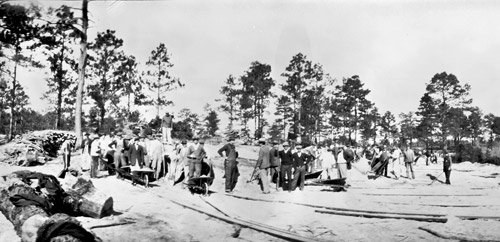
White and black workers from the ranks of the unemployed were given jobs building a 4.75-mile road on the densely overgrown land ringing Greenfield Lake.
One day’s pay
In his 1980 book series “Land of the Golden River,” Lewis Philip Hall recounts how elected officials and citizens joined forces and organized the work project.
“Thousands of the citizens arranged for one day’s pay to be deducted from their monthly salaries ... and over $110,000 was thus subscribed,” Hall wrote.
Clearing vegetation from the alligator-infested swamps and undergrowth around Greenfield Lake began in the winter of 1930.
“Crews of men, in five groups, were soon at work with bush axes cutting through this jungle, while the truck gang hauled the cut underbrush, stumps and trees away. Near the head and various arms of the lake bridges were constructed to cross those streams and marshy ground and dirt causeways were built,” Hall wrote.
The men toiled in mud and water, “exposed to swarms of mosquitoes, chiggers and poisonous snakes” and “suffered the rigors of heat and cold in that depression year of 1930 to open that passageway,” Hall wrote.
By the spring of 1931, crews were laying down macadam paving. Community Drive was hard-surfaced by July 1 of that year.
Since 1931, untold multitudes of people have enjoyed the scenic ride around Community Drive.
In a 2001 interview, Bruce Barclay Cameron Jr. described conditions in the 1930s to Sherman Hayes, university librarian at the University of North Carolina Wilmington.
Cameron, a businessman and member of one of the area’s historically prominent families, was a young man in the 1930s and was interviewed as part of the ongoing William Madison Randall Library oral histories project. He was 83 years old at the time.
“Well, it was tight,” Cameron recalled. “You know, during the ’30s, there were a lot of people who were, I mean, really, really destitute. People that had pretty good white collar jobs hardly had enough to eat and people like that were working for $1 and $2 a day. Like building a road around Greenfield Lake, that was not government, that was local people paying for that to try to help out.”
Could it happen today?
With the 1932 election of Roosevelt and formation several years later of the WPA, federal funding flowed into Wilmington for projects like the construction of a new post office on North Front Street. The 1880s-era brownstone post office at the same site was torn down to move the project forward. Other federally funded New Deal projects like the construction of Legion Stadium provided desperately needed jobs. Wilmington and the nation didn’t completely recover from the depression until World War II, when the city became a boom town producing materials for the war effort.
But during the darkest days of the Great Depression, organizers of the Wilmington Relief Association made life easier for hundreds of local families by paying for the construction of Community Drive.
Would such an effort today be possible, or even plausible?
“In the first part of the 20th century you had kind of an elite in Wilmington that was based upon genealogy. You had people who saw themselves as the civic leaders who would have been able to pull together the cultural capital to make it happen,” said William D. Moore, associate professor of history at UNCW.
Factors like World War II, the Cold War, the evolving transience of American culture and mind-boggling technological advances make Wilmington a vastly different city than it was during the Great Depression.
“There are more people moving. We’ve been through 50 years of the breakdown of traditional hierarchies,” Moore said. “You no longer have the elite privileged class that can say, “We are going to do this,’ and everybody rallies around them.”
Along the way, the U.S. government became more ingrained in the everyday lives of common citizens.
“It all led to more of a federal feel which has also contributed to some of the benefits of the 20th century, like the civil rights movement, so all of the growth of government in the 20th century wasn’t a bad thing,” Moore said.
The involvement of the federal government in local affairs in 1930 was minimal, UNCW history professor Robert Mark Spaulding said.
“People did not look automatically to the government to solve all their problems,” Spaulding said. “In 1930, for the most part, all the federal government did was deliver the mail. We hardly had an Army. Few people paid income tax. There was a lot more room for private initiative.
“Even city government and county government were very small so there was a lot of room for a private organization to take on big tasks like that,” he said.
What interests Spaulding is that the Wilmington Relief Association “was not like a straight-up church charity.”
“It was a strange kind of thing, that the private sector could mobilize a public works campaign. That, to me, was only possible in that little space of time,” Spaulding said.
Today, he said, “No one would expect the United Way to organize an employment scheme. They would expect the United Way to give money to address these problems.”
Similar relief organizations were formed across the county in the early 1930s, Spaulding said. Many fraternal and church groups that offered aid like soup kitchens were overwhelmed by the sheer number of people seeking help, Moore added.
“With the growth of federal and state and local government and the growth of charities like the United Way, I don’t know if there is a place for that kind of mixture anymore,” Spaulding said. “I think there’s not room for that kind of hybrid organization. It would be impractical.”
Past and present
Elected officials point to other alternatives available to help the unemployed and citizens with special needs. Some, like Jason R. Thompson, New Hanover County commissioner and board vice chairman, a former city councilman, think government should have its limits.
“I don’t know what role county government could play in something like (what happened) in the ’30s. It’s a whole new ballgame,” he said. “It’s beyond the scope of what government is supposed to do. Government is supposed to provide a semblance of order. Nobody wants to save. They want to spend, and have government help them out of their problem.”
Wilmington Mayor Pro Tem and city Councilman James L. Quinn III said numerous government programs and non-profit agencies already exist that see to the needs of those affected by the recession. Local governments also face many challenges, including state budget cuts and a decline in other revenue streams like property taxes.
“The current system is handling it. I do not mean to diminish the pain and suffering of people who lost their jobs (but) there are organizations there to help them,” Quinn said. “From what I’ve seen, we’ve got 90 percent employment. It has not reached crisis proportions.”
Wilmingtonians in the early 1930s, Quinn said, “didn’t have Social Security. They didn’t have all the government programs you have now. We’ve got all kinds of money in our budget for the homeless and there’s not anybody going to go hungry in this town.”
Government is taking a big hit in the current recession, agreed Ted Davis Jr., New Hanover County commissioners chairman.
“It all boils down to money,” Davis said, pointing to declining fee and sales tax revenues that necessitate layoffs and frozen positions in county government.
Federal government mandates without funding to implement them also makes it more difficult for counties to operate, he added.
More than ever, non-profit agencies must compete for a limited share of funding.
“Look at your charitable organizations,” Davis said. “They are fighting each other over the same scrap of meat.”
Part of the solution may come down to citizens making more responsible decisions in their personal lives, David said.
To Wilmington Mayor Bill Saffo, necessary job creation steps are being taken by government through the Obama stimulus package.
Federal money will soon trickle down to local and regional projects, he said.
Saffo said the city of Wilmington has put in requests for more than $70 million in federal stimulus funds.
He pointed to shovel-ready projects like a cross-city trail for runners, walkers and bicyclists, which will be greatly expanded through a grant of more than $2 million in federal monies doled out by the state.
Projects in the works
More city police officers will be hired and various public works projects are planned throughout the region, including roadwork on 20 miles of I-40 and improvements to locks and dams throughout the Cape Fear River system, Saffo said.
“This is very similar to what
happened in the 1930s. The federal government is priming the pump to get the economy moving again and when it does we will pay back the debt,” he said.
“We have been successful in getting money to get people back to work.”
Challenging times call for relevant actions, the mayor said.
“I do think there are some similarities between (now and the 1930s). I just think it’s done in different ways. Today, you’re putting people back to work by using federal tax dollars. The government is playing a very active role to get the economy on its feet. It sure wasn’t being done by the private sector,” Saffo said.

Defendants Seek Dismissal Of Luxury Homebuilder's Lawsuit
Cece Nunn
-
Jul 24, 2026
|
|
New City Position Hasn't Changed WDI Role Downtown, Officials Say
Emma Dill
-
Jul 24, 2026
|
|

After working as an instructor for others, he opted to work for himself and is the owner of Fred Astaire Dance Studios locations in Wilmingt...

While it may be best known as a summer destination, Wilmington has become a nesting place for artists and writers of all degrees, from creat...

Wilmington's live music scene includes a mix of options and genres, but also faces challenges....
The 2026 WilmingtonBiz: Book on Business is an annual publication showcasing the Wilmington region as a center of business.