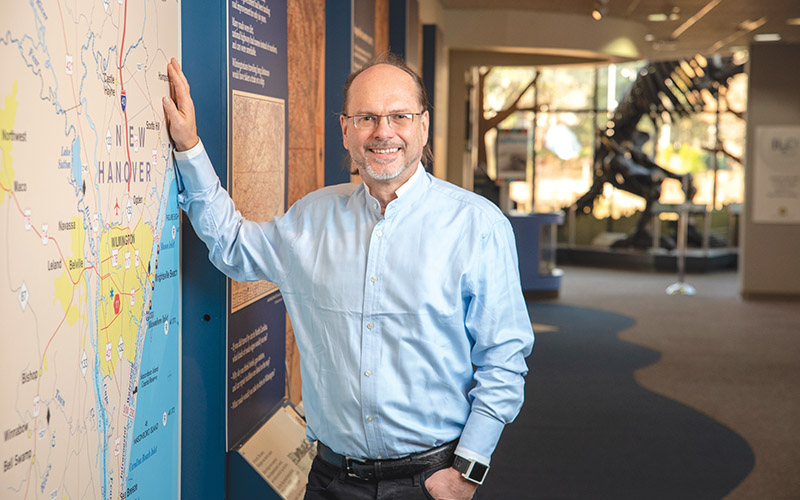
Seven months into his new position, Wayne LaBar is already enmeshed in the process that will transform the Cape Fear Museum of History and Science.
The new museum director came to the position last July and has spent his early days getting to know the museum and its staff as well as the community.
The Cape Fear Museum itself was part of what attracted LaBar to Wilmington from Sacramento, California, where he served as executive director of the Powerhouse Science Center, part of his 20 years in senior museum administration.
“I’m really excited about the blend of science, technology and history. It’s an interesting blend,” he said, referencing the Cape Fear Museum’s interdisciplinary approach to representing the region. “We don’t split our daily lives into [separate] art, history and science time. The idea of institutions that have multiple thematic content is apropos and exciting. Presenting things in ways that show their interconnectedness; that’s the way we experience things anyway.”
In his 36-year career, LaBar has worked in museums in Pennsylvania, New Jersey, Colorado and California (twice). Born in California, he grew up in New Jersey and earned a degree in aerospace engineering from Georgia Tech. After working briefly for NASA, he landed a job at the Carnegie Science Center in Pittsburgh, which was preparing to open on the banks of the Allegheny River. The nascent museum was looking for an engineer who could explain principles of engineering to the public.
“There’s a tendency to not talk at the level most museum-goers understand,” he said.
LaBar said returning to the East Coast – specifically to North Carolina, where he has family – was another attractive aspect of the Wilmington position. Another part of his family is staying in Sacramento for now.
“My partner has two kids in high school and has opted not to move them at this point,” he said. “So I’m living here with the three dogs. I’m fond of food and wine and have been trying some of the local restaurants and learning about them. I’m trying to learn about the community and taking advantage of what it has to offer.”
A third factor that lured LaBar to Wilmington was Project Grace and the prospect of reimagining the county’s museum for the benefit of existing and new audiences.
“I’ve had a lot of experience with master planning and designing museums,” he said. “I’ve spent a lot of time developing exhibitions and managing operations.”
Plans for a new facility downtown that will house both the museum and the county library’s main branch have received the go-ahead from New Hanover County officials. A team that includes museum and library staff, county representatives and the designer, LS3P, has completed the facility’s schematic design.
“We’re just wrapping up the design development phase, which gives a clearer picture of the layout and more architectural detail,” LaBar said. “It should be complete within the next few months; then it goes for review at the state level. Once it’s approved, a memorandum of understanding – a contract – will be signed by the county and the developers. A construction drawing will be complete in late spring or early summer.”
LaBar isn’t sure when construction will start and expects the new facility won’t be finished until 2025 or 2026. But he believes the process itself is important.
“As a part of our portion of the project, [the museum team] has convened community listening sessions over the past couple of months,” LaBar said, adding that his staff has heard from the county’s African American, Native American, Latino and LGBTQ communities about what they’d like to see in the museum.
The current museum space on Market Street will remain a vital part of the institution, LaBar said.
“The more than 57,000 objects we have that represent our collection are staying in this building,” he said. “Certain objects will be part of the exhibition program at Grace Street, but it’s impossible to display all these objects. The vast [majority] of the collection stays here in storage. The exhibit design and fabrication staff will remain here on Market Street; we’re planning to expand their offices. Our goal is to have some public space here on Market Street so researchers can come in, and so the public can see how we preserve [objects].
“We envision [this building] as the history research facility, and our dream is that there will be a small exhibit space,” LaBar added. “The park will stay here as well.”
Meanwhile, the museum’s share of the Project Grace facility will bring new exhibit space, an expanded lobby area and a theater – a feature missing from the current museum building. Having the main exhibition and events portion of the museum located in the heart of downtown will make it a draw for what LaBar calls “happenstance” visitors as well as people who plan a visit.
While Project Grace is occupying much of the museum staff’s attention these days, LaBar and his colleagues are also involved in several other initiatives.
“We have a new exhibit opening in May about the science of fire and the local history of fire prevention, including fire departments and fire safety,” he said. “On March 24 we’re having a giant community celebration, STEM-ILM 2.0.”
NOTE: This version of the story corrects the previous statement that LaBar was at Sacramento's Powerhouse Science Center for 20 years. He has 20 years of experience in senior museum administration, part of which included his tenure at the science center.