State and local health leaders highlighted the Wilmington region’s rapidly expanding healthcare infrastructure at the Greater Wilmington Chamber of Commerce’s Healthcare Summit on Tuesday.
While N.C. Department of Health and Human Services Secretary Devdutta Sangvai, the summit's keynote speaker, did not comment directly on the three-way battle between major healthcare providers seeking state permission to build hospitals in the region, he stressed that, on the brink of so much change, Wilmington’s health systems have a rare opportunity to reshape models of care.
"I think what I've already seen here in Wilmington is a willingness or a boldness to say, ‘How do we change that community model?'” he said. “I think that’s the development here throughout the state, but I think Wilmington is that context of economic activity as well as innovation that can help us, as well.”
Sangvai emphasized that the traditional fee-for-service model has become unsustainable, with primary care becoming relatively underfunded. Instead, value-based care, which rewards providers for patient health outcomes, has become an increasingly popular care model.
“As a state, we don't spend as much on primary care as we spend on our schools,” he said. “What if we were to change the model where we actually incentivize individuals to get primary care, incentivize primary care providers to provide primary care?”
He said that adding more facilities is an opportunity to rethink what it means to deliver complex high-level care.
“Several hospitals are fairly on a 1% to 2% margin in North Carolina,” he said. “Those types of differences can really matter.”
Healthcare leaders Lynda Stanley, president and CEO of Dosher Memorial Hospital; Laurie Whalin, president of Novant Health's Coastal Region; and Jeff James, CEO of Wilmington Health, also shared strategies for increasing care capacity in the region.
James identified Wilmington Health’s goal of becoming the most trusted partner in healthcare through reduced costs, demonstrable quality, and improved patient experience. He pointed to growth opportunities, including a planned joint cancer center with UNC Health, and identified Jacksonville as one of Wilmington Health’s biggest growth areas, with plans to add as many as 30 additional positions in the next few years.
Stanley emphasized that capacity building is more than constructing facilities, and that Dosher Memorial Hospital prioritizes community health needs assessments, claims data and smart technology applications to address community needs. She also spotlighted Dosher Memorial’s seven-year expansion plan across the Southport region, including its newly opened emergency department.
“Our greatest asset is not our buildings,” she said. “It's the people that we serve. It's the people that we support. It's the people that we build a trusted relationship with, and how we do our business.”
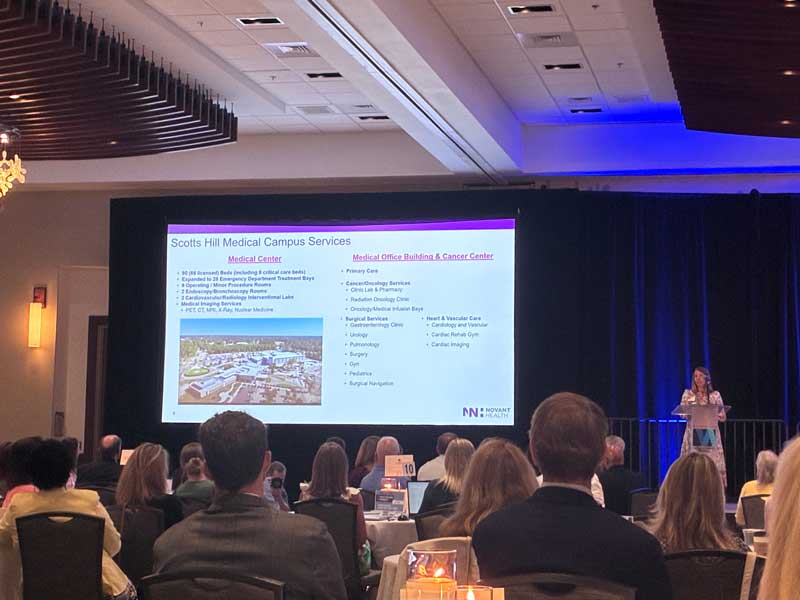
Whalin pointed to Novant Health’s past five-year investments, estimated at over $600 million, as part of its over $2.5 billion investment in regional healthcare infrastructure. She also shared details on the much-needed renovations to the Novant Health New Hanover Regional Medical Center as part of the master facility plan – one of Novant’s largest single projects in its history at $1.26 billion, according to Whalin.
The renovations would modernize and expand all major first-floor clinical areas and expand support space for residency programs, pharmacy, pathology and other services, Whalin said. She also shared plans for eight levels of the proposed $236 million heart and vascular tower, which awaits state approval.
Joe Pino, senior vice president of medical education and research at Novant Health and executive director of South East Area Health Education Center (SEAHEC), spoke with UNCW Chancellor Aswani Volety on a panel about medical education and the importance of strategic workforce pipelines amid a healthcare worker shortage.
UNCW announced plans to establish a standalone medical school in April, which, if completed after several years of planning and accreditation, could further transform the region's healthcare.
Sangvai pointed out the coordination in the region among employers for talent, adding that continued collaboration is essential to fuel a growing region.
"The level of coordination you have here is really important,” he said, “because you're not tripping over one another, all trying to create the same things."
“If Wilmington wants to look back in 20 years and see more than just higher healthcare spending and more buildings,” he added. “It will need coordinated talent strategies, bold pilots in care delivery, and relentless use of data to show that every dollar is buying more health.”

King Named Head Of Commercial Real Estate Alliance, COO Of Cape Fear Realtors
Staff Reports
-
Aug 18, 2026
|
|
Kiwanis Club Of Topsail Area Granted $9K
Staff Reports
-
Aug 18, 2026
|
|
NextBoat Revenue Surges 88% In Second Quarter Following Acquisitions
Cierra Noffke
-
Aug 17, 2026
|
|
CFCC Honors Staff, Faculty With Annual Excellence Awards
Staff Reports
-
Aug 18, 2026
|
|
Report Weighs Potential Impacts From Cape Fear Memorial Bridge Alternatives
Emma Dill
-
Aug 17, 2026
|
|

The mayor said town officials expect to go before the N.C. Local Government Commission in September for financing approval for the land purc...
"The bond is about refreshing our infrastructure, not for the next couple of years, but for the next several decades,” said Christopher Barn...
"Our goal is to preserve teeth that might otherwise need to be extracted and replaced with implants. Saving a patient’s natural tooth is alm...

The 2026 WilmingtonBiz: Book on Business is an annual publication showcasing the Wilmington region as a center of business.