Though the film industry is experiencing a downturn both locally and nationally, workforce training persists.
Factors responsible for a recent slump include film incentives offered by other countries and a decline in the growth of streaming.
Duke Fire, the program director of film and video production at Cape Fear Community College, said there’s uncertainty about when things will return to normal. But in show biz, fluctuations aren’t unique.
“Quite honestly, I call it a roller coaster,” he said. “I’ve been here 23 years now, and I’ve been up and down that roller coaster several times, and I think the yellow brick road leads to the fact that it’ll come back around. We just don’t know when.”
Fire, who’s been involved in the film industry for 38 years and led practical film classes for more than two decades, added that the slowdown affects the entire community, including the periphery of the city, the hotels, the restaurants, the caterers, the electricians and all of the union personnel.
“Most of my family and friends are film personnel, and they went through COVID, they went through a writer’s strike, (and) they’re going through this right now,” he said. “It’s very, very difficult to make a living.”
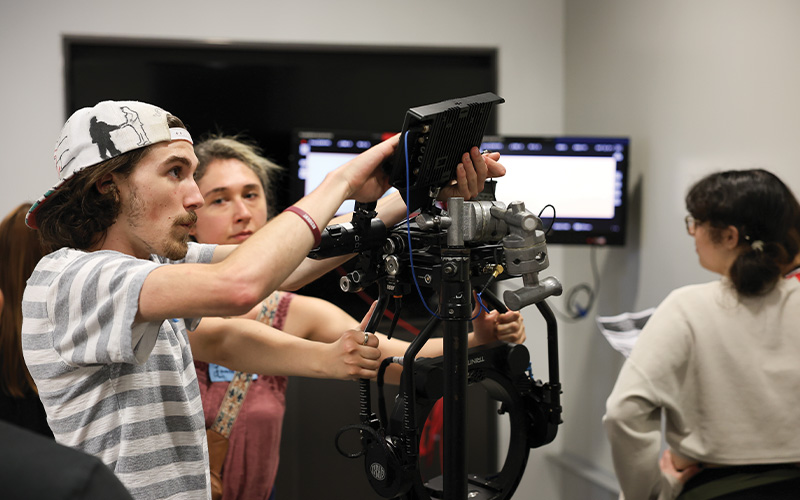
But Fire continues to develop students through the college’s film and video production technology program.
The program trains students for entry-level employment in production support and specific areas of video, film and associated media production, according to its website. It additionally equips students with training for entry-level crew roles, production assistant roles and post-production assistant roles.
In the first year, students learn about the complete production process and receive instruction from industry professionals. And in the second year, students receive professional training while performing on production projects.
But workforce training in Wilmington doesn’t stop there.
The Film Partnership of North Carolina offers a paid internship program for those looking to work in film, said Susi Hamilton, president of the organization. The partnership launched in 2021 with the help of American Rescue Plan funds from local governments.
The partnership’s program allows interns to work on a live production set, even if they don’t have experience or industry connections. Interns can earn $15 an hour, with up to 20 hours of pre-approved overtime each week at $22.50 an hour.
“Our mission is to grow the film and television production workforce in North Carolina as a whole,” Hamilton said. “We raise money so that we can pay interns to work on film and television production sets.”
She added that, in just over three years, the program had worked with more than 400 interns. The training program, she said, has additionally paid many trainers to do training sessions and smaller productions, and it’s worked with CFCC, CFCC’s Wilson Center and Winston-Salem State University.
But as for the film slowdown, she offered sentiments similar to Fire’s about the state of the industry, describing the current situation as “disturbing” and referencing the competition the town faces from abroad.
“(There’s) just a lot of competition internationally with film and television production,” she said. “There are a lot of other countries that are offering incentive programs that match and/or exceed our own.”
Hamilton, who is also a former Democratic member of the state House of Representatives, added that there is some work going on in Wilmington, but it’s not as robust as it was.
Alluding to the 2023 writers and actors strikes, she said the film partnership program came online at a time when both strikes were heating up. This inspired the partnership to pivot and begin to work directly with film professionals, she said.
Initially, “we would provide the intern to the projects, and we would then reimburse the production for the payment on training the interns,” Hamilton added. “But when there were no productions happening, we turned that inside out, and we created our own training events.”
She said the partnership did a 10-minute short film, Bellum, with students at CFCC and added that they paid the designated professional crew for training their interns and helping them make the film.
“We started basically creating our own opportunities for these small productions and using them as training opportunities so we could keep people going during that downtime,” she said. “So, we really came online when things weren’t great out in Hollywood, sort of like what we’re dealing with now. We find a way to persevere.”
As for its partnerships with CFCC and the Wilson Center, she said the organization plans to continue its professional relationship with both, and she mentioned that – as long as the funds are available to train – the Film Partnership of North Carolina would like to work with other community colleges and performing arts centers across the state.
“We are an excellent state in which to do series, you know, like Dawson’s Creek and things of that nature,” she said. “We’ve had a real niche there for the last few years. We just want to continue to bring work to North Carolina and the industry.”
See other stories on Film:
Unraveling a Film Industry Slump