Voters in New Hanover and Brunswick counties have some high-dollar decisions to make this November to fund school improvements.
If a $320 million general obligation bond passes in New Hanover County, it will be the single largest bond referendum okayed by county voters. Officials say it would reshape the county’s school system for decades.
The New Hanover County Board of Commissioners and the New Hanover County Board of Education agreed to pursue the bond last November to fund capital improvements in New Hanover County Schools. They include Phase I of New Hanover High School’s $230 million master facility plan and the construction of new schools.
Although districtwide enrollment has declined in recent years, officials say growth has been uneven, with some schools exceeding capacity while others have room available.
“The bond is about refreshing our infrastructure, not for the next couple of years, but for the next several decades,” said Christopher Barnes, superintendent of New Hanover County Schools. “What we’re wanting to do is to move from being reactive to emerging needs to being proactive for what’s happening in the future.”
When it was originally announced, county officials estimated that the burden for taxpayers would be 1.75 cents per $100 of property value or $17.50 per year for property valued at $100,000.
That forecasted tax increase dropped after the New Hanover Community Endowment announced it would grant $116 million to the county over 10 years for school capital projects approved by the school district's finance, capital and bond joint committee. The endowment grant, contingent on voters greenlighting the bond this fall, would be the endowment’s single largest commitment to date since the endowment’s creation after the sale of New Hanover Regional Medical Center in 2021.
With the tax increase now estimated to be one-half cent ($0.005) per $100 of assessed value, or $5 a year for property valued at $100,000, bond advocates are optimistic about the referendum gaining voter approval in the fall.
“The saving grace in this whole thing is the New Hanover County endowment,” said Pat Bradford, New Hanover County Board of Education member and chair of the finance, capital and bond joint committee, “because they came in and brilliantly offered to take down $116 million of that debt. That’s a big deal.”
According to Bradford, the bond is the result of renewed trust between the county and the school district – and represents a step forward for both entities, as well as a chance to fix over 20 years of deferred capital improvements to New Hanover County Schools.
A 2023 school facility study found most schools are projected to operate near or above capacity over the next decade, despite districtwide enrollment declines.
“Capital construction will be required at all levels to address current and future overcrowding,” the study said.

According to the district, the average age of a New Hanover County school building is 47, and there are nine schools over 70 years old. Aging buildings require increasingly expensive repairs, said Rob Morgan, assistant superintendent of operations. He added that some of the highest costs of those repairs, namely labor and parts, are unlikely to decrease.
The last time the district added new facilities was in 2019 with the construction of College Park and Blair elementary schools, said Morgan. Both schools were demolished and rebuilt using finances from a $160 million school bond passed by voters in 2014.
Bradford said reviving the district’s bond committee helped build consensus around a 2026 school bond after officials completed facilities assessments and two rounds of credible budgets.
The school district commissioned a facilities assessment from Atlanta-based Turner & Townsend Heery, which identified nearly $2.5 billion in needs across all district facilities and, according to county officials, helped identify the highest-need buildings.
“Our goal is to make sure that this bond touched every school, through safety and security upgrades, technology upgrades, HVAC upgrades and the new buildings,” Barnes said.
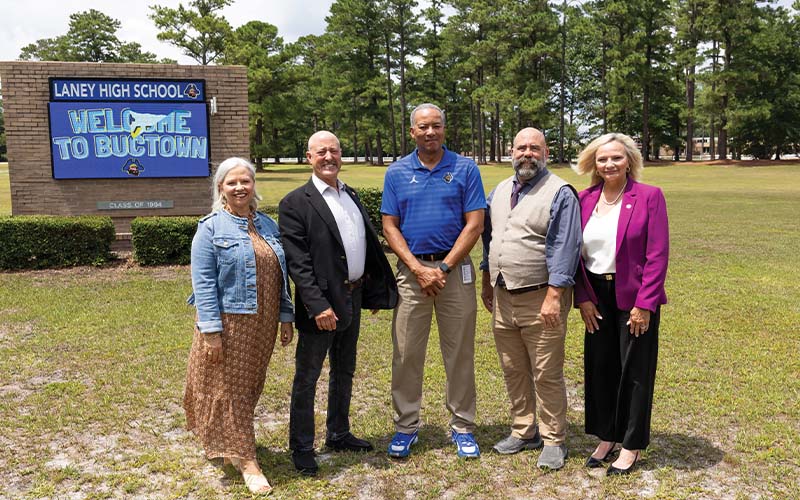
After deliberation, the committee whittled the project list down, addressing overcrowding at Laney High School by building a new Trask Middle School off Sidbury Road and allowing Laney’s campus to absorb the old building, replacing the Pine Valley and Mary C. Williams elementary schools and earmarking $40 million for district-wide improvements, including safety and HVAC infrastructure.
The project list drew some concern from parents and faculty about the exclusion of facilities like Isaac Bear Early College High School or Williston Middle School, a 72-year-old facility. In response, county officials pointed to results from the facilities study, emphasizing that the bond covered the most high-need facility issues, and that it would impact every school with systems updates and technology infrastructure.
If approved, the bond funds would be released in three tranches over seven years, starting in fiscal year 2026-27 with $150 million, then $100 million in fiscal year 2028-29, and the last tranche of $70 million in for fiscal year 2031-32. Each bond series will be paid off in 20 years, county officials said.
The county is still paying down what is left of 2014 and 2005 referendum bonds, or $89.2 million and $8.2 million, respectively, according to Eric Credle, New Hanover County’s chief financial officer.
The county’s current outstanding debt, across all bonds, is $364 million, and its debt per capita is $1,670. Compared to debt-per-capita peers, New Hanover ranks near the middle, notably much higher than neighboring counties of Brunswick ($690) and Pender ($1,059).
In addition to aging facilities, New Hanover County is also grappling with declining enrollment. Enrollment decreased by 301 students for the 2025-26 school year, to 24,599 students overall, a big drop compared to the anticipated total of 27,276 students for 2026. Barnes estimates that over the past five to six years, the district has lost about 2,000 students.
“Enrollment is down in New Hanover County,” New Hanover County Board of Commissioners Chair LeAnn Pierce said. “Birth rate is down, but the issue is that there are certain areas, certain schools that are overcapacity, and certain schools that are full.”
Only a handful of North Carolina’s 115 school districts saw enrollment growth last year, among them Brunswick and Pender, which are contending with facility capital needs of their own.
Brunswick County voters also will see a $349.6 million school bond referendum on the ballot this fall, which would fund the construction of a new elementary school and a new high school.
“We are out of seats in quite a few of our schools,” said Brunswick County Schools superintendent Dale Cole. “We have been putting Band-Aids on that, and we’re at the point where we have to build schools.”
By Cole’s estimation, the county educates close to 400 students in modular trailers.
Brunswick County’s school bond was trimmed down from $409 million, a decision made possible by the removal of an additional elementary school. County staff project an increase of about 2.15 cents per $100 of assessed value in 2027, rising in stages to a cumulative increase of about 5.47 cents by 2031, with the caveat that the actual tax impact could be lower depending on growth in the county’s tax base.
While this bond is more financially feasible without a second elementary school, Cole predicts that by the time the new Jackey’s Creek elementary school opens, it will already be at 90% capacity once the district relocates students from modulars to the new school.
Even with New Hanover County’s enrollment down about 9.5% over the past decade, Barnes points to overcrowding and the fact that the district is still the 12th largest in the state.
“Our elementary schools are about 85% capacity, our middle schools 89%, our high schools almost 95%,” he said, adding that the “sweet spot” is closer to 80% so schools have room to grow.
To prepare for budget strain amidst falling enrollment, two years ago the district eliminated around 300 positions to become fiscally balanced, Barnes said.
Pierce estimates the county gives the district about $143 million a year for operations, with leftover funds and lottery money covering facility repairs. About 70% of the budget goes to instruction, leaving only around 1% for capital outlay. New Hanover’s per-pupil spending is $4,120, Credle said, ranking 17th among North Carolina’s 100 counties, according to state data.
“Between county-appropriated money and state lottery funds, we’re able to maintain, and we’re able to tackle certain projects. But when we start talking about renovating an entire school,” said Morgan, “the numbers just get far more expensive than county appropriations or lottery are going to be able to afford.”
A timeline for which projects would be tackled first if the bond is approved hasn’t been finalized.
Progress on the projects outlined in the bond will be regularly reported to the public, Morgan said.
Neither the school district, county nor the endowment have an alternate financing plan if voters reject the bond. Without approval, the county would continue funding capital improvements incrementally, Pierce said, and would lose the endowment’s $116 million commitment.
Correction: This version is different from the print edition. It corrects the origin of the school district's finance, capital and bond joint committee.
View other stories on Education:
$chool Building
Reshaping Community College Funds
OPINION: CTE Ain’t Your Grandpa’s Shop Class
UNCW Master Plan Picks Up Steam
Gardner Guides Students On, Off Court